

98
5 Tailored Biointerfaces via Derivatization of Polystyrene-b-Poly …
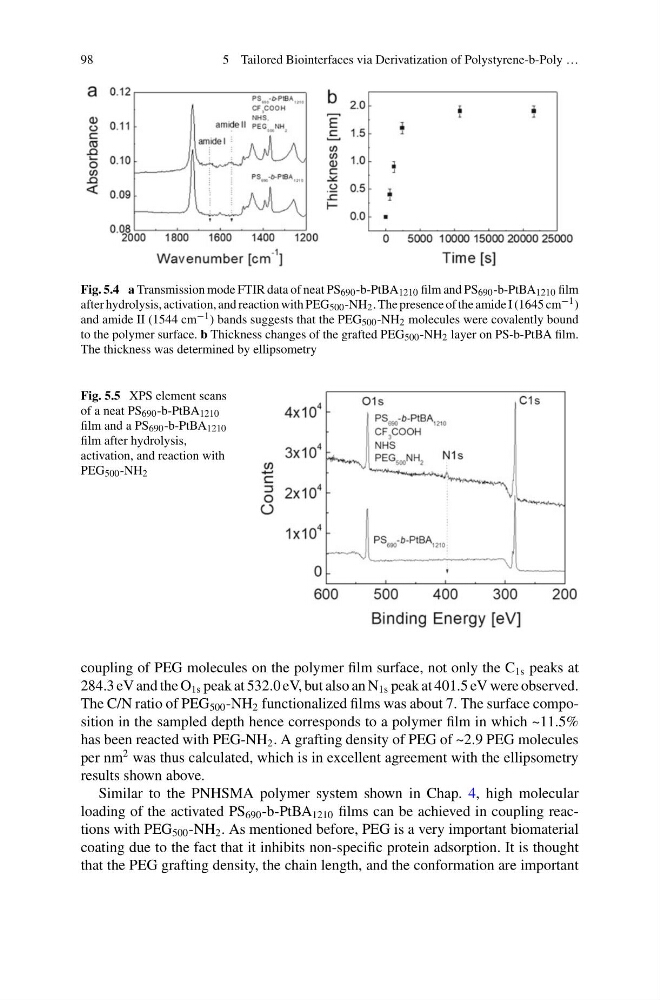
Fig. 5.4 a Transmission mode FTIR data of neat PS 690 -b-PtBA 1210 film and PS 690 -b-PtBA 1210 film
after hydrolysis, activation, and reaction with PEG 500 -NH 2 . The presence of the amide I (1645 cm −1 )
and amide II (1544 cm −1 ) bands suggests that the PEG 500 -NH 2 molecules were covalently bound
to the polymer surface. b Thickness changes of the grafted PEG 500 -NH 2 layer on PS-b-PtBA film.
The thickness was determined by ellipsometry
Fig. 5.5 XPS element scans
of a neat PS 690 -b-PtBA 1210
film and a PS 690 -b-PtBA 1210
film after hydrolysis,
activation, and reaction with
PEG 500 -NH 2
coupling of PEG molecules on the polymer film surface, not only the C 1s peaks at
284.3 eV and the O 1s peak at 532.0 eV, but also an N 1s peak at 401.5 eV were observed.
The C/N ratio of PEG 500 -NH 2 functionalized films was about 7. The surface composition in the sampled depth hence corresponds to a polymer film in which ~11.5%
has been reacted with PEG-NH 2 . A grafting density of PEG of ~2.9 PEG molecules
per nm
2 was thus calculated, which is in excellent agreement with the ellipsometry
results shown above.
Similar to the PNHSMA polymer system shown in Chap. 4, high molecular
loading of the activated PS 690 -b-PtBA 1210 films can be achieved in coupling reactions with PEG 500 -NH 2 . As mentioned before, PEG is a very important biomaterial
coating due to the fact that it inhibits non-specific protein adsorption. It is thought
that the PEG grafting density, the chain length, and the conformation are important
5 Tailored Biointerfaces via Derivatization of Polystyrene-b-Poly …
Fig. 5.4 a Transmission mode FTIR data of neat PS 690 -b-PtBA 1210 film and PS 690 -b-PtBA 1210 film
after hydrolysis, activation, and reaction with PEG 500 -NH 2 . The presence of the amide I (1645 cm −1 )
and amide II (1544 cm −1 ) bands suggests that the PEG 500 -NH 2 molecules were covalently bound
to the polymer surface. b Thickness changes of the grafted PEG 500 -NH 2 layer on PS-b-PtBA film.
The thickness was determined by ellipsometry
Fig. 5.5 XPS element scans
of a neat PS 690 -b-PtBA 1210
film and a PS 690 -b-PtBA 1210
film after hydrolysis,
activation, and reaction with
PEG 500 -NH 2
coupling of PEG molecules on the polymer film surface, not only the C 1s peaks at
284.3 eV and the O 1s peak at 532.0 eV, but also an N 1s peak at 401.5 eV were observed.
The C/N ratio of PEG 500 -NH 2 functionalized films was about 7. The surface composition in the sampled depth hence corresponds to a polymer film in which ~11.5%
has been reacted with PEG-NH 2 . A grafting density of PEG of ~2.9 PEG molecules
per nm
2 was thus calculated, which is in excellent agreement with the ellipsometry
results shown above.
Similar to the PNHSMA polymer system shown in Chap. 4, high molecular
loading of the activated PS 690 -b-PtBA 1210 films can be achieved in coupling reactions with PEG 500 -NH 2 . As mentioned before, PEG is a very important biomaterial
coating due to the fact that it inhibits non-specific protein adsorption. It is thought
that the PEG grafting density, the chain length, and the conformation are important