

5.2 Investigation of the Surface Chemistry of PS 690 -b-PtBA 1210 Films
95
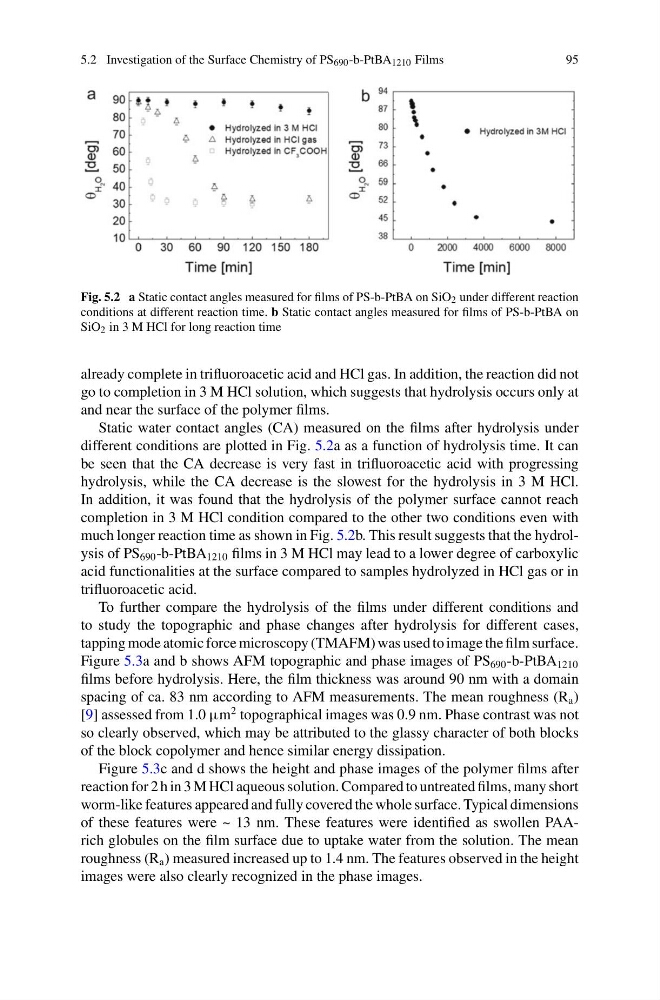
Fig. 5.2 a Static contact angles measured for films of PS-b-PtBA on SiO 2 under different reaction
conditions at different reaction time. b Static contact angles measured for films of PS-b-PtBA on
SiO 2 in 3 M HCl for long reaction time
already complete in trifluoroacetic acid and HCl gas. In addition, the reaction did not
go to completion in 3 M HCl solution, which suggests that hydrolysis occurs only at
and near the surface of the polymer films.
Static water contact angles (CA) measured on the films after hydrolysis under
different conditions are plotted in Fig. 5.2a as a function of hydrolysis time. It can
be seen that the CA decrease is very fast in trifluoroacetic acid with progressing
hydrolysis, while the CA decrease is the slowest for the hydrolysis in 3 M HCl.
In addition, it was found that the hydrolysis of the polymer surface cannot reach
completion in 3 M HCl condition compared to the other two conditions even with
much longer reaction time as shown in Fig. 5.2b. This result suggests that the hydrolysis of PS 690 -b-PtBA 1210 films in 3 M HCl may lead to a lower degree of carboxylic
acid functionalities at the surface compared to samples hydrolyzed in HCl gas or in
trifluoroacetic acid.
To further compare the hydrolysis of the films under different conditions and
to study the topographic and phase changes after hydrolysis for different cases,
tapping mode atomic force microscopy (TMAFM) was used to image the film surface.
Figure 5.3a and b shows AFM topographic and phase images of PS 690 -b-PtBA 1210
films before hydrolysis. Here, the film thickness was around 90 nm with a domain
spacing of ca. 83 nm according to AFM measurements. The mean roughness (R a )
[9] assessed from 1.0 μm
2 topographical images was 0.9 nm. Phase contrast was not
so clearly observed, which may be attributed to the glassy character of both blocks
of the block copolymer and hence similar energy dissipation.
Figure 5.3c and d shows the height and phase images of the polymer films after
reaction for 2 h in 3 M HCl aqueous solution. Compared to untreated films, many short
worm-like features appeared and fully covered the whole surface. Typical dimensions
of these features were ~ 13 nm. These features were identified as swollen PAArich globules on the film surface due to uptake water from the solution. The mean
roughness (R a ) measured increased up to 1.4 nm. The features observed in the height
images were also clearly recognized in the phase images.
95
Fig. 5.2 a Static contact angles measured for films of PS-b-PtBA on SiO 2 under different reaction
conditions at different reaction time. b Static contact angles measured for films of PS-b-PtBA on
SiO 2 in 3 M HCl for long reaction time
already complete in trifluoroacetic acid and HCl gas. In addition, the reaction did not
go to completion in 3 M HCl solution, which suggests that hydrolysis occurs only at
and near the surface of the polymer films.
Static water contact angles (CA) measured on the films after hydrolysis under
different conditions are plotted in Fig. 5.2a as a function of hydrolysis time. It can
be seen that the CA decrease is very fast in trifluoroacetic acid with progressing
hydrolysis, while the CA decrease is the slowest for the hydrolysis in 3 M HCl.
In addition, it was found that the hydrolysis of the polymer surface cannot reach
completion in 3 M HCl condition compared to the other two conditions even with
much longer reaction time as shown in Fig. 5.2b. This result suggests that the hydrolysis of PS 690 -b-PtBA 1210 films in 3 M HCl may lead to a lower degree of carboxylic
acid functionalities at the surface compared to samples hydrolyzed in HCl gas or in
trifluoroacetic acid.
To further compare the hydrolysis of the films under different conditions and
to study the topographic and phase changes after hydrolysis for different cases,
tapping mode atomic force microscopy (TMAFM) was used to image the film surface.
Figure 5.3a and b shows AFM topographic and phase images of PS 690 -b-PtBA 1210
films before hydrolysis. Here, the film thickness was around 90 nm with a domain
spacing of ca. 83 nm according to AFM measurements. The mean roughness (R a )
[9] assessed from 1.0 μm
2 topographical images was 0.9 nm. Phase contrast was not
so clearly observed, which may be attributed to the glassy character of both blocks
of the block copolymer and hence similar energy dissipation.
Figure 5.3c and d shows the height and phase images of the polymer films after
reaction for 2 h in 3 M HCl aqueous solution. Compared to untreated films, many short
worm-like features appeared and fully covered the whole surface. Typical dimensions
of these features were ~ 13 nm. These features were identified as swollen PAArich globules on the film surface due to uptake water from the solution. The mean
roughness (R a ) measured increased up to 1.4 nm. The features observed in the height
images were also clearly recognized in the phase images.