

94
5 Tailored Biointerfaces via Derivatization of Polystyrene-b-Poly …
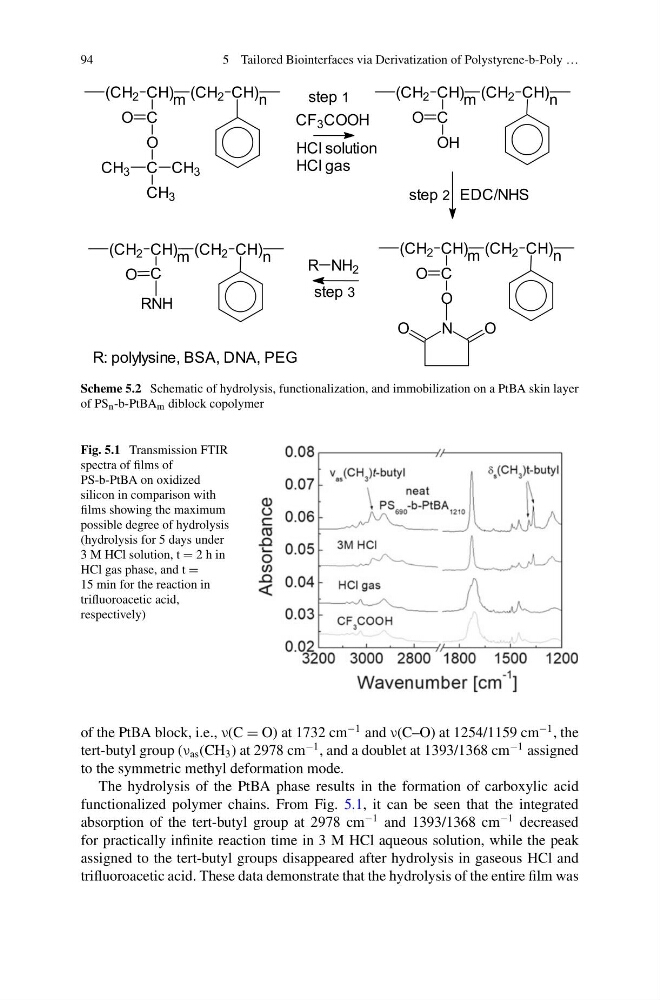
Scheme 5.2 Schematic of hydrolysis, functionalization, and immobilization on a PtBA skin layer
of PS n -b-PtBA m diblock copolymer
Fig. 5.1 Transmission FTIR
spectra of films of
PS-b-PtBA on oxidized
silicon in comparison with
films showing the maximum
possible degree of hydrolysis
(hydrolysis for 5 days under
3 M HCl solution, t = 2 h in
HCl gas phase, and t =
15 min for the reaction in
trifluoroacetic acid,
respectively)
of the PtBA block, i.e., ν(C = O) at 1732 cm
−1 and ν(C–O) at 1254/1159 cm
−1 , the
tert-butyl group (ν as (CH 3 ) at 2978 cm
−1 , and a doublet at 1393/1368 cm
−1 assigned
to the symmetric methyl deformation mode.
The hydrolysis of the PtBA phase results in the formation of carboxylic acid
functionalized polymer chains. From Fig. 5.1, it can be seen that the integrated
absorption of the tert-butyl group at 2978 cm
−1 and 1393/1368 cm
−1 decreased
for practically infinite reaction time in 3 M HCl aqueous solution, while the peak
assigned to the tert-butyl groups disappeared after hydrolysis in gaseous HCl and
trifluoroacetic acid. These data demonstrate that the hydrolysis of the entire film was
5 Tailored Biointerfaces via Derivatization of Polystyrene-b-Poly …
Scheme 5.2 Schematic of hydrolysis, functionalization, and immobilization on a PtBA skin layer
of PS n -b-PtBA m diblock copolymer
Fig. 5.1 Transmission FTIR
spectra of films of
PS-b-PtBA on oxidized
silicon in comparison with
films showing the maximum
possible degree of hydrolysis
(hydrolysis for 5 days under
3 M HCl solution, t = 2 h in
HCl gas phase, and t =
15 min for the reaction in
trifluoroacetic acid,
respectively)
of the PtBA block, i.e., ν(C = O) at 1732 cm
−1 and ν(C–O) at 1254/1159 cm
−1 , the
tert-butyl group (ν as (CH 3 ) at 2978 cm
−1 , and a doublet at 1393/1368 cm
−1 assigned
to the symmetric methyl deformation mode.
The hydrolysis of the PtBA phase results in the formation of carboxylic acid
functionalized polymer chains. From Fig. 5.1, it can be seen that the integrated
absorption of the tert-butyl group at 2978 cm
−1 and 1393/1368 cm
−1 decreased
for practically infinite reaction time in 3 M HCl aqueous solution, while the peak
assigned to the tert-butyl groups disappeared after hydrolysis in gaseous HCl and
trifluoroacetic acid. These data demonstrate that the hydrolysis of the entire film was