

OFDM for Terahertz Wireless Communication Systems
163
scattering points, r is the distance from transmitter and receiver, and N represent the
whole number of NLOS paths. In this chapter, scaled versions of different normalized
delay profiles are used to generate taps for the channel model.
8.4 Numerical Results
In simulation part, we study the performance of multi-carrier systems through a Thz
channel described above. We try to minimize the average BER of the system for a
given bit rate. In fact, to define the quality of a digital transmission chain, BER is
used as a metric, depending on the type of modulation used. There is a relationship
between BER and the SNR. To compare the performances of the different types of
M-PSK and M-QAM technics, we choose to plot the variations of the BER according
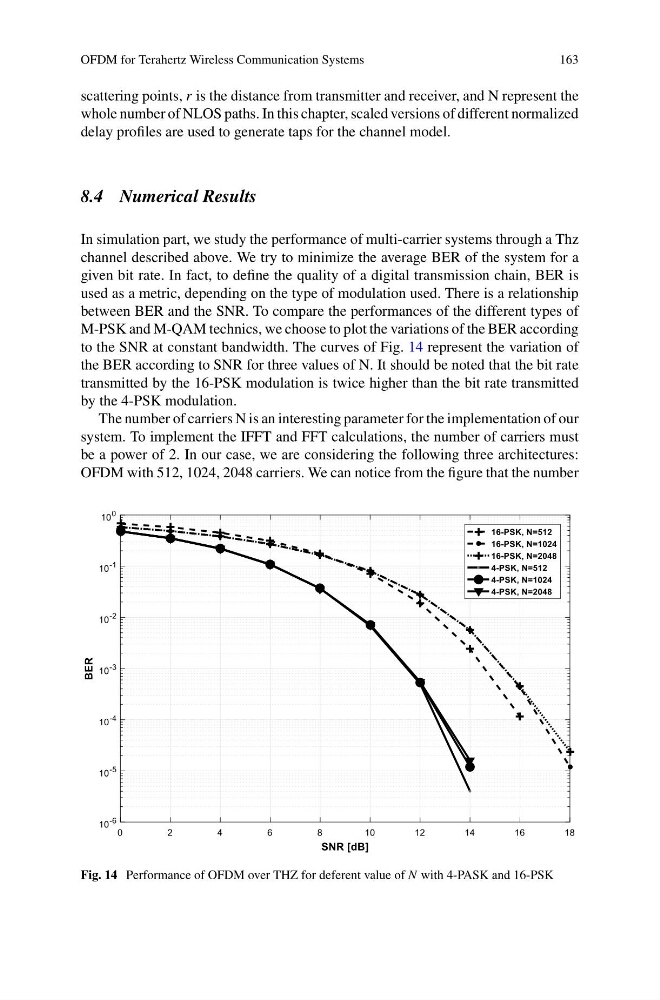
to the SNR at constant bandwidth. The curves of Fig. 14 represent the variation of
the BER according to SNR for three values of N. It should be noted that the bit rate
transmitted by the 16-PSK modulation is twice higher than the bit rate transmitted
by the 4-PSK modulation.
The number of carriers N is an interesting parameter for the implementation of our
system. To implement the IFFT and FFT calculations, the number of carriers must
be a power of 2. In our case, we are considering the following three architectures:
OFDM with 512, 1024, 2048 carriers. We can notice from the figure that the number
Fig. 14 Performance of OFDM over THZ for deferent value of N with 4-PASK and 16-PSK
163
scattering points, r is the distance from transmitter and receiver, and N represent the
whole number of NLOS paths. In this chapter, scaled versions of different normalized
delay profiles are used to generate taps for the channel model.
8.4 Numerical Results
In simulation part, we study the performance of multi-carrier systems through a Thz
channel described above. We try to minimize the average BER of the system for a
given bit rate. In fact, to define the quality of a digital transmission chain, BER is
used as a metric, depending on the type of modulation used. There is a relationship
between BER and the SNR. To compare the performances of the different types of
M-PSK and M-QAM technics, we choose to plot the variations of the BER according
to the SNR at constant bandwidth. The curves of Fig. 14 represent the variation of
the BER according to SNR for three values of N. It should be noted that the bit rate
transmitted by the 16-PSK modulation is twice higher than the bit rate transmitted
by the 4-PSK modulation.
The number of carriers N is an interesting parameter for the implementation of our
system. To implement the IFFT and FFT calculations, the number of carriers must
be a power of 2. In our case, we are considering the following three architectures:
OFDM with 512, 1024, 2048 carriers. We can notice from the figure that the number
Fig. 14 Performance of OFDM over THZ for deferent value of N with 4-PASK and 16-PSK