

164
M. El Ghzaoui and S. Das
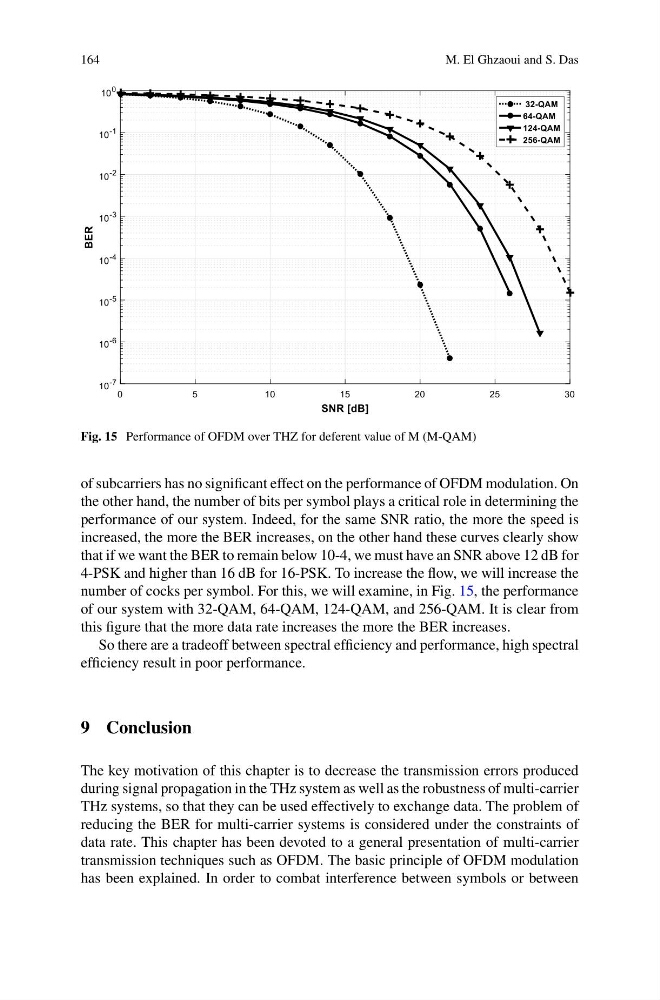
Fig. 15 Performance of OFDM over THZ for deferent value of M (M-QAM)
of subcarriers has no significant effect on the performance of OFDM modulation. On
the other hand, the number of bits per symbol plays a critical role in determining the
performance of our system. Indeed, for the same SNR ratio, the more the speed is
increased, the more the BER increases, on the other hand these curves clearly show
that if we want the BER to remain below 10-4, we must have an SNR above 12 dB for
4-PSK and higher than 16 dB for 16-PSK. To increase the flow, we will increase the
number of cocks per symbol. For this, we will examine, in Fig. 15, the performance
of our system with 32-QAM, 64-QAM, 124-QAM, and 256-QAM. It is clear from
this figure that the more data rate increases the more the BER increases.
So there are a tradeoff between spectral efficiency and performance, high spectral
efficiency result in poor performance.
9 Conclusion
The key motivation of this chapter is to decrease the transmission errors produced
during signal propagation in the THz system as well as the robustness of multi-carrier
THz systems, so that they can be used effectively to exchange data. The problem of
reducing the BER for multi-carrier systems is considered under the constraints of
data rate. This chapter has been devoted to a general presentation of multi-carrier
transmission techniques such as OFDM. The basic principle of OFDM modulation
has been explained. In order to combat interference between symbols or between
M. El Ghzaoui and S. Das
Fig. 15 Performance of OFDM over THZ for deferent value of M (M-QAM)
of subcarriers has no significant effect on the performance of OFDM modulation. On
the other hand, the number of bits per symbol plays a critical role in determining the
performance of our system. Indeed, for the same SNR ratio, the more the speed is
increased, the more the BER increases, on the other hand these curves clearly show
that if we want the BER to remain below 10-4, we must have an SNR above 12 dB for
4-PSK and higher than 16 dB for 16-PSK. To increase the flow, we will increase the
number of cocks per symbol. For this, we will examine, in Fig. 15, the performance
of our system with 32-QAM, 64-QAM, 124-QAM, and 256-QAM. It is clear from
this figure that the more data rate increases the more the BER increases.
So there are a tradeoff between spectral efficiency and performance, high spectral
efficiency result in poor performance.
9 Conclusion
The key motivation of this chapter is to decrease the transmission errors produced
during signal propagation in the THz system as well as the robustness of multi-carrier
THz systems, so that they can be used effectively to exchange data. The problem of
reducing the BER for multi-carrier systems is considered under the constraints of
data rate. This chapter has been devoted to a general presentation of multi-carrier
transmission techniques such as OFDM. The basic principle of OFDM modulation
has been explained. In order to combat interference between symbols or between