

162
M. El Ghzaoui and S. Das
Table 1 Main parameters of
the proposed OFDM system
used in THz communication
system
Nominal rate
10 Gbps
Number of bands
4 bands
Data rate
128 Gbps
Bandwidth
8 GHz
Baseband
4 GHz
Modulation type
OFDM
Signal-to-noise ration
0–30 dB
Carrier frequency
300 GHz
Sampling frequency
12 GHz
Sampling period
0.32552 ns
FFT size (NC)
2048
Cyclic prefix length
18 samples
Data subcarriers
512, 1024, 2048
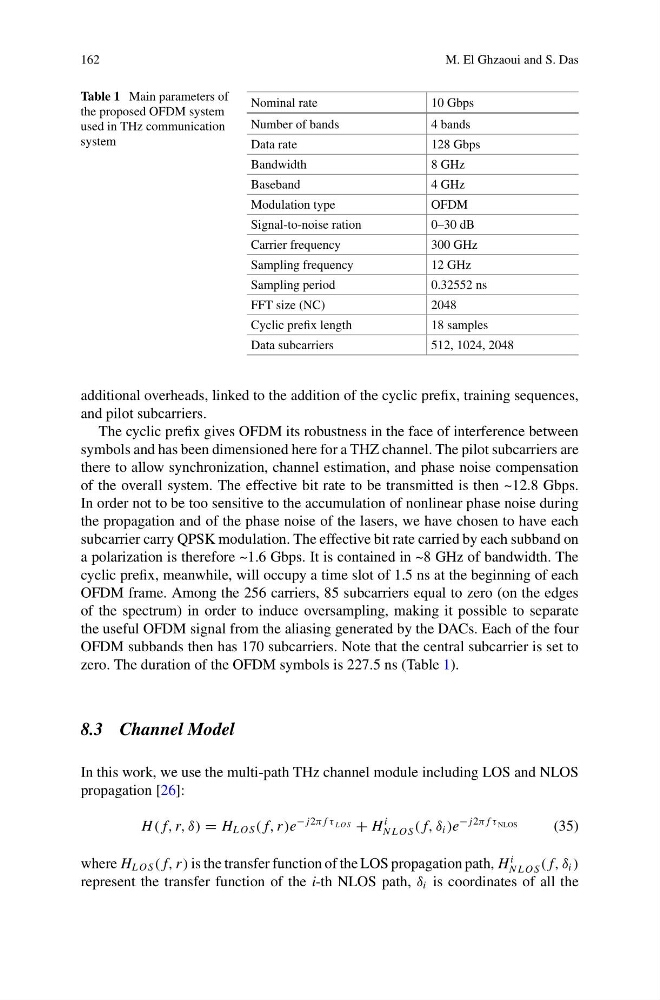
additional overheads, linked to the addition of the cyclic prefix, training sequences,
and pilot subcarriers.
The cyclic prefix gives OFDM its robustness in the face of interference between
symbols and has been dimensioned here for a THZ channel. The pilot subcarriers are
there to allow synchronization, channel estimation, and phase noise compensation
of the overall system. The effective bit rate to be transmitted is then ~12.8 Gbps.
In order not to be too sensitive to the accumulation of nonlinear phase noise during
the propagation and of the phase noise of the lasers, we have chosen to have each
subcarrier carry QPSK modulation. The effective bit rate carried by each subband on
a polarization is therefore ~1.6 Gbps. It is contained in ~8 GHz of bandwidth. The
cyclic prefix, meanwhile, will occupy a time slot of 1.5 ns at the beginning of each
OFDM frame. Among the 256 carriers, 85 subcarriers equal to zero (on the edges
of the spectrum) in order to induce oversampling, making it possible to separate
the useful OFDM signal from the aliasing generated by the DACs. Each of the four
OFDM subbands then has 170 subcarriers. Note that the central subcarrier is set to
zero. The duration of the OFDM symbols is 227.5 ns (Table 1).
8.3 Channel Model
In this work, we use the multi-path THz channel module including LOS and NLOS
propagation [26]:
H ( f, r, δ) = H L O S ( f, r )e
− j2π f τ L O S + H
i
N L O S ( f, δ i )e
− j2π f τ NLOS
(35)
where H L O S ( f, r ) is the transfer function of the LOS propagation path, H
i
N L O S ( f, δ i )
represent the transfer function of the i-th NLOS path, δ i is coordinates of all the
M. El Ghzaoui and S. Das
Table 1 Main parameters of
the proposed OFDM system
used in THz communication
system
Nominal rate
10 Gbps
Number of bands
4 bands
Data rate
128 Gbps
Bandwidth
8 GHz
Baseband
4 GHz
Modulation type
OFDM
Signal-to-noise ration
0–30 dB
Carrier frequency
300 GHz
Sampling frequency
12 GHz
Sampling period
0.32552 ns
FFT size (NC)
2048
Cyclic prefix length
18 samples
Data subcarriers
512, 1024, 2048
additional overheads, linked to the addition of the cyclic prefix, training sequences,
and pilot subcarriers.
The cyclic prefix gives OFDM its robustness in the face of interference between
symbols and has been dimensioned here for a THZ channel. The pilot subcarriers are
there to allow synchronization, channel estimation, and phase noise compensation
of the overall system. The effective bit rate to be transmitted is then ~12.8 Gbps.
In order not to be too sensitive to the accumulation of nonlinear phase noise during
the propagation and of the phase noise of the lasers, we have chosen to have each
subcarrier carry QPSK modulation. The effective bit rate carried by each subband on
a polarization is therefore ~1.6 Gbps. It is contained in ~8 GHz of bandwidth. The
cyclic prefix, meanwhile, will occupy a time slot of 1.5 ns at the beginning of each
OFDM frame. Among the 256 carriers, 85 subcarriers equal to zero (on the edges
of the spectrum) in order to induce oversampling, making it possible to separate
the useful OFDM signal from the aliasing generated by the DACs. Each of the four
OFDM subbands then has 170 subcarriers. Note that the central subcarrier is set to
zero. The duration of the OFDM symbols is 227.5 ns (Table 1).
8.3 Channel Model
In this work, we use the multi-path THz channel module including LOS and NLOS
propagation [26]:
H ( f, r, δ) = H L O S ( f, r )e
− j2π f τ L O S + H
i
N L O S ( f, δ i )e
− j2π f τ NLOS
(35)
where H L O S ( f, r ) is the transfer function of the LOS propagation path, H
i
N L O S ( f, δ i )
represent the transfer function of the i-th NLOS path, δ i is coordinates of all the