

146
M. El Ghzaoui and S. Das
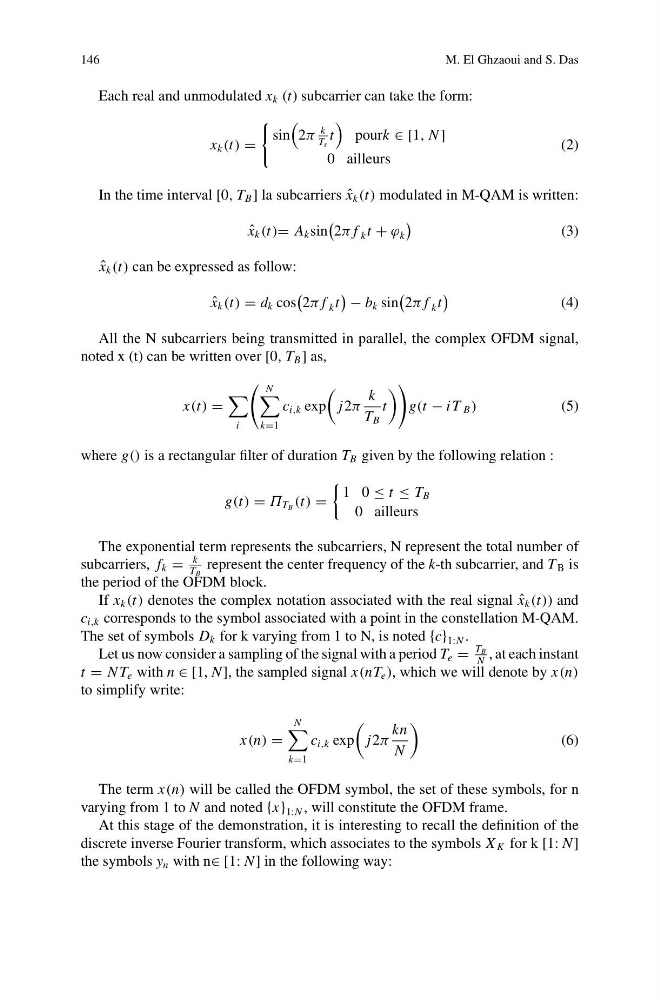
Each real and unmodulated x k (t) subcarrier can take the form:
x k (t) =
sin
2π
k
T s
t
pourk ∈ [1, N ]
0 ailleurs
(2)
In the time interval [0, T B ] la subcarriers ˆ
x k (t) modulated in M-QAM is written:
ˆ
x k (t)= A k sin
2π f k t + ϕ k
(3)
ˆ
x k (t) can be expressed as follow:
ˆ
x k (t) = d k cos
2π f k t
− b k sin
2π f k t
(4)
All the N subcarriers being transmitted in parallel, the complex OFDM signal,
noted x (t) can be written over [0, T B ] as,
x(t) =
i
N
k=1
c i,k exp
j2π
k
T B
t
g(t − i T B )
(5)
where g() is a rectangular filter of duration T B given by the following relation :
g(t) = Π T B (t) =
1 0 ≤ t ≤ T B
0 ailleurs
The exponential term represents the subcarriers, N represent the total number of
subcarriers, f k =
k
T B
represent the center frequency of the k-th subcarrier, and T B is
the period of the OFDM block.
If x k (t) denotes the complex notation associated with the real signal ˆ
x k (t)) and
c i,k corresponds to the symbol associated with a point in the constellation M-QAM.
The set of symbols D k for k varying from 1 to N, is noted {c} 1:N .
Let us now consider a sampling of the signal with a period T e =
T B
N
, at each instant
t = N T e with n ∈ [1, N], the sampled signal x(nT e ), which we will denote by x(n)
to simplify write:
x(n) =
N
k=1
c i,k exp
j2π
kn
N
(6)
The term x(n) will be called the OFDM symbol, the set of these symbols, for n
varying from 1 to N and noted {x} 1:N , will constitute the OFDM frame.
At this stage of the demonstration, it is interesting to recall the definition of the
discrete inverse Fourier transform, which associates to the symbols X K for k [1: N]
the symbols y n with n∈ [1: N] in the following way:
M. El Ghzaoui and S. Das
Each real and unmodulated x k (t) subcarrier can take the form:
x k (t) =
sin
2π
k
T s
t
pourk ∈ [1, N ]
0 ailleurs
(2)
In the time interval [0, T B ] la subcarriers ˆ
x k (t) modulated in M-QAM is written:
ˆ
x k (t)= A k sin
2π f k t + ϕ k
(3)
ˆ
x k (t) can be expressed as follow:
ˆ
x k (t) = d k cos
2π f k t
− b k sin
2π f k t
(4)
All the N subcarriers being transmitted in parallel, the complex OFDM signal,
noted x (t) can be written over [0, T B ] as,
x(t) =
i
N
k=1
c i,k exp
j2π
k
T B
t
g(t − i T B )
(5)
where g() is a rectangular filter of duration T B given by the following relation :
g(t) = Π T B (t) =
1 0 ≤ t ≤ T B
0 ailleurs
The exponential term represents the subcarriers, N represent the total number of
subcarriers, f k =
k
T B
represent the center frequency of the k-th subcarrier, and T B is
the period of the OFDM block.
If x k (t) denotes the complex notation associated with the real signal ˆ
x k (t)) and
c i,k corresponds to the symbol associated with a point in the constellation M-QAM.
The set of symbols D k for k varying from 1 to N, is noted {c} 1:N .
Let us now consider a sampling of the signal with a period T e =
T B
N
, at each instant
t = N T e with n ∈ [1, N], the sampled signal x(nT e ), which we will denote by x(n)
to simplify write:
x(n) =
N
k=1
c i,k exp
j2π
kn
N
(6)
The term x(n) will be called the OFDM symbol, the set of these symbols, for n
varying from 1 to N and noted {x} 1:N , will constitute the OFDM frame.
At this stage of the demonstration, it is interesting to recall the definition of the
discrete inverse Fourier transform, which associates to the symbols X K for k [1: N]
the symbols y n with n∈ [1: N] in the following way: