

OFDM for Terahertz Wireless Communication Systems
145
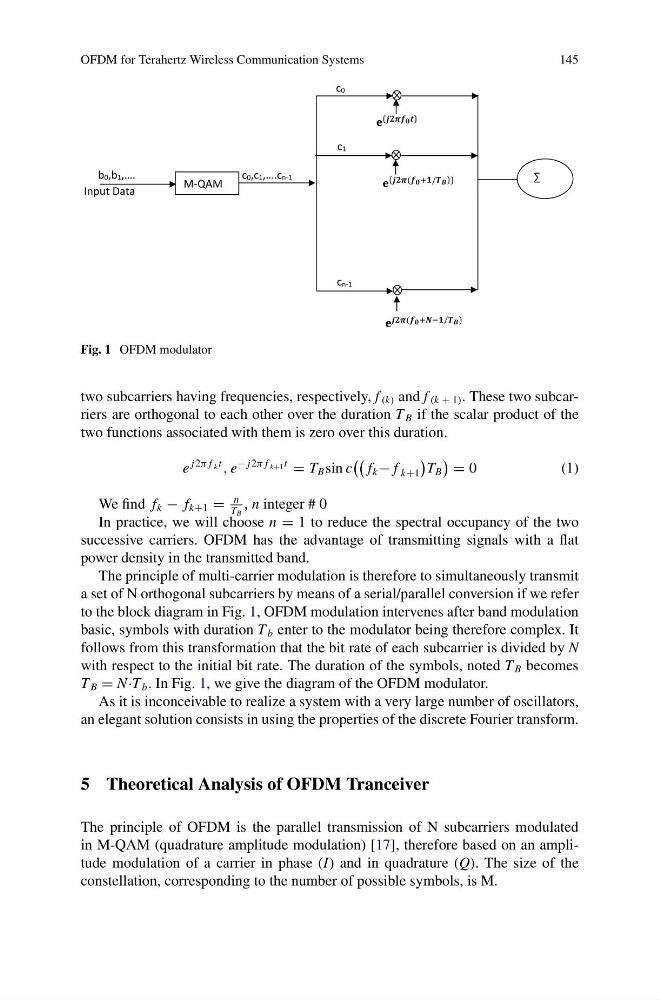
Fig. 1 OFDM modulator
two subcarriers having frequencies, respectively, f (k) and f (k + 1) . These two subcarriers are orthogonal to each other over the duration T B if the scalar product of the
two functions associated with them is zero over this duration.
e
j2π f k t
, e
− j2π f k+1 t
= T B sin c
f k − f k+1
T B
= 0
( 1 )
We find f k − f k+1 =
n
T B
, n integer # 0
In practice, we will choose n = 1 to reduce the spectral occupancy of the two
successive carriers. OFDM has the advantage of transmitting signals with a flat
power density in the transmitted band.
The principle of multi-carrier modulation is therefore to simultaneously transmit
a set of N orthogonal subcarriers by means of a serial/parallel conversion if we refer
to the block diagram in Fig. 1, OFDM modulation intervenes after band modulation
basic, symbols with duration T b enter to the modulator being therefore complex. It
follows from this transformation that the bit rate of each subcarrier is divided by N
with respect to the initial bit rate. The duration of the symbols, noted T B becomes
T B = N·T b . In Fig. 1, we give the diagram of the OFDM modulator.
As it is inconceivable to realize a system with a very large number of oscillators,
an elegant solution consists in using the properties of the discrete Fourier transform.
5 Theoretical Analysis of OFDM Tranceiver
The principle of OFDM is the parallel transmission of N subcarriers modulated
in M-QAM (quadrature amplitude modulation) [17], therefore based on an amplitude modulation of a carrier in phase (I) and in quadrature (Q). The size of the
constellation, corresponding to the number of possible symbols, is M.
145
Fig. 1 OFDM modulator
two subcarriers having frequencies, respectively, f (k) and f (k + 1) . These two subcarriers are orthogonal to each other over the duration T B if the scalar product of the
two functions associated with them is zero over this duration.
e
j2π f k t
, e
− j2π f k+1 t
= T B sin c
f k − f k+1
T B
= 0
( 1 )
We find f k − f k+1 =
n
T B
, n integer # 0
In practice, we will choose n = 1 to reduce the spectral occupancy of the two
successive carriers. OFDM has the advantage of transmitting signals with a flat
power density in the transmitted band.
The principle of multi-carrier modulation is therefore to simultaneously transmit
a set of N orthogonal subcarriers by means of a serial/parallel conversion if we refer
to the block diagram in Fig. 1, OFDM modulation intervenes after band modulation
basic, symbols with duration T b enter to the modulator being therefore complex. It
follows from this transformation that the bit rate of each subcarrier is divided by N
with respect to the initial bit rate. The duration of the symbols, noted T B becomes
T B = N·T b . In Fig. 1, we give the diagram of the OFDM modulator.
As it is inconceivable to realize a system with a very large number of oscillators,
an elegant solution consists in using the properties of the discrete Fourier transform.
5 Theoretical Analysis of OFDM Tranceiver
The principle of OFDM is the parallel transmission of N subcarriers modulated
in M-QAM (quadrature amplitude modulation) [17], therefore based on an amplitude modulation of a carrier in phase (I) and in quadrature (Q). The size of the
constellation, corresponding to the number of possible symbols, is M.