

OFDM for Terahertz Wireless Communication Systems
147
y n =
1
N
N
k=1
X k exp
j2π
kn
N
(7)
The signal x(n) of expression (6) appears as the inverse discrete Fourier transform
(IDFT) of the symbols c k , the index k referring to the k-th subcarrier. If we introduce
these symbols c k associated with the M-QAM modulation, in a IDFT module, we
will obtain at output, the set of complex symbols x n of the baseband signal, i.e., the
OFDM frame. at the receiver, it will suffice to carry out the direct discrete Fourier
transform (TFD) on the symbols received to restore the desired message. In practice, the algorithms of IFFT and FFT implemented in a DSP will be used for these
calculations.
5.1 Guard Interval
Interferences [13] is an inevitable phenomenon in transmissions in multi-path channels. It is reflected in the time domain, by the overlapping of the echoes of an OFDM
symbol on the start of a new symbol. It is due to the interlacing of the direct signals
and part of the previous indirect signal which was delayed by the multiple paths.
ISI results in loss of information. Although inevitable, it is nevertheless possible to
interpose between two successive OFDM symbols, a guard interval linked to the
spreading of the channel. This is the role of the cyclic prefix that we describe below.
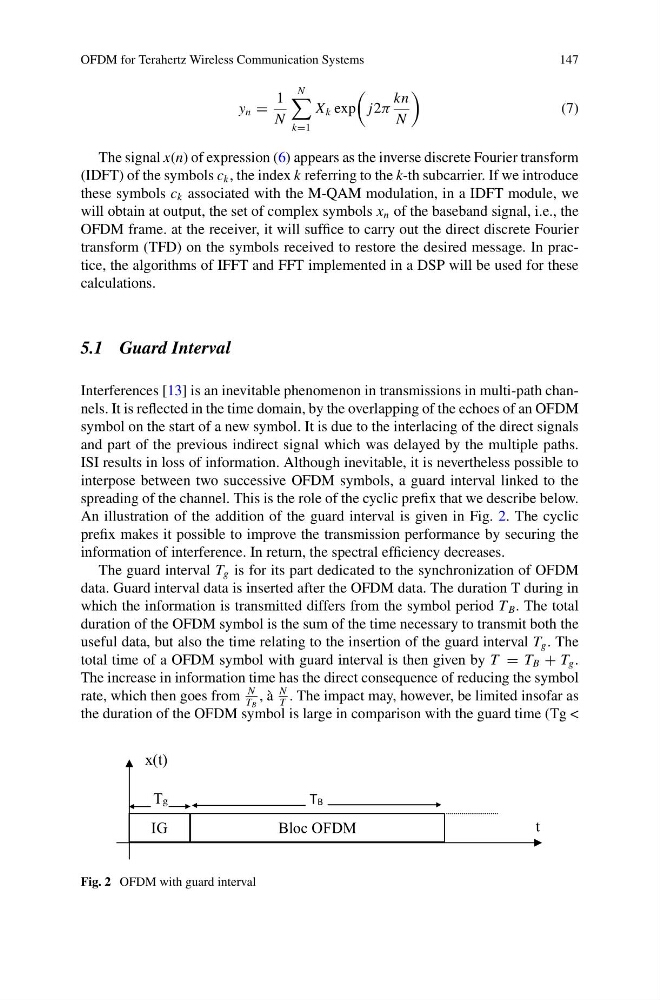
An illustration of the addition of the guard interval is given in Fig. 2. The cyclic
prefix makes it possible to improve the transmission performance by securing the
information of interference. In return, the spectral efficiency decreases.
The guard interval T g is for its part dedicated to the synchronization of OFDM
data. Guard interval data is inserted after the OFDM data. The duration T during in
which the information is transmitted differs from the symbol period T B . The total
duration of the OFDM symbol is the sum of the time necessary to transmit both the
useful data, but also the time relating to the insertion of the guard interval T g . The
total time of a OFDM symbol with guard interval is then given by T = T B + T g .
The increase in information time has the direct consequence of reducing the symbol
rate, which then goes from
N
T B
, à
N
T
. The impact may, however, be limited insofar as
the duration of the OFDM symbol is large in comparison with the guard time (Tg <
IG
Bloc OFDM
x(t)
t
Tg
TB
Fig. 2 OFDM with guard interval
147
y n =
1
N
N
k=1
X k exp
j2π
kn
N
(7)
The signal x(n) of expression (6) appears as the inverse discrete Fourier transform
(IDFT) of the symbols c k , the index k referring to the k-th subcarrier. If we introduce
these symbols c k associated with the M-QAM modulation, in a IDFT module, we
will obtain at output, the set of complex symbols x n of the baseband signal, i.e., the
OFDM frame. at the receiver, it will suffice to carry out the direct discrete Fourier
transform (TFD) on the symbols received to restore the desired message. In practice, the algorithms of IFFT and FFT implemented in a DSP will be used for these
calculations.
5.1 Guard Interval
Interferences [13] is an inevitable phenomenon in transmissions in multi-path channels. It is reflected in the time domain, by the overlapping of the echoes of an OFDM
symbol on the start of a new symbol. It is due to the interlacing of the direct signals
and part of the previous indirect signal which was delayed by the multiple paths.
ISI results in loss of information. Although inevitable, it is nevertheless possible to
interpose between two successive OFDM symbols, a guard interval linked to the
spreading of the channel. This is the role of the cyclic prefix that we describe below.
An illustration of the addition of the guard interval is given in Fig. 2. The cyclic
prefix makes it possible to improve the transmission performance by securing the
information of interference. In return, the spectral efficiency decreases.
The guard interval T g is for its part dedicated to the synchronization of OFDM
data. Guard interval data is inserted after the OFDM data. The duration T during in
which the information is transmitted differs from the symbol period T B . The total
duration of the OFDM symbol is the sum of the time necessary to transmit both the
useful data, but also the time relating to the insertion of the guard interval T g . The
total time of a OFDM symbol with guard interval is then given by T = T B + T g .
The increase in information time has the direct consequence of reducing the symbol
rate, which then goes from
N
T B
, à
N
T
. The impact may, however, be limited insofar as
the duration of the OFDM symbol is large in comparison with the guard time (Tg <
IG
Bloc OFDM
x(t)
t
Tg
TB
Fig. 2 OFDM with guard interval