

712
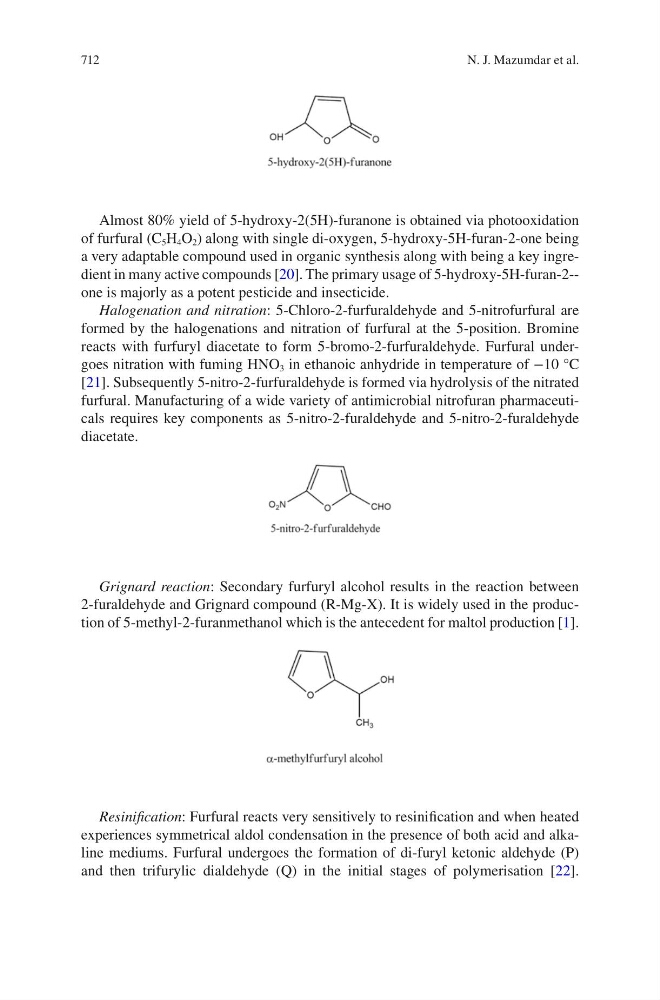
Almost 80% yield of 5-hydroxy-2(5H)-furanone is obtained via photooxidation
of furfural (C 5 H 4 O 2 ) along with single di-oxygen, 5-hydroxy-5H-furan-2-one being
a very adaptable compound used in organic synthesis along with being a key ingredient in many active compounds [20]. The primary usage of 5-hydroxy-5H-furan-2- -
one is majorly as a potent pesticide and insecticide.
Halogenation and nitration: 5-Chloro-2-furfuraldehyde and 5-nitrofurfural are
formed by the halogenations and nitration of furfural at the 5-position. Bromine
reacts with furfuryl diacetate to form 5-bromo-2-furfuraldehyde. Furfural undergoes nitration with fuming HNO 3 in ethanoic anhydride in temperature of −10 °C
[21]. Subsequently 5-nitro-2-furfuraldehyde is formed via hydrolysis of the nitrated
furfural. Manufacturing of a wide variety of antimicrobial nitrofuran pharmaceuticals requires key components as 5-nitro-2-furaldehyde and 5-nitro-2-furaldehyde
diacetate.
Grignard reaction: Secondary furfuryl alcohol results in the reaction between
2-furaldehyde and Grignard compound (R-Mg-X). It is widely used in the production of 5-methyl-2-furanmethanol which is the antecedent for maltol production [1].
Resinification: Furfural reacts very sensitively to resinification and when heated
experiences symmetrical aldol condensation in the presence of both acid and alkaline mediums. Furfural undergoes the formation of di-furyl ketonic aldehyde (P)
and then trifurylic dialdehyde (Q) in the initial stages of polymerisation [22].
N. J. Mazumdar et al.