

711
Condensation reactions: Aldol reaction of furfural is done with sodium hydroxide or potassium hydroxide along with aldehydes which reacts as alkaline catalysts
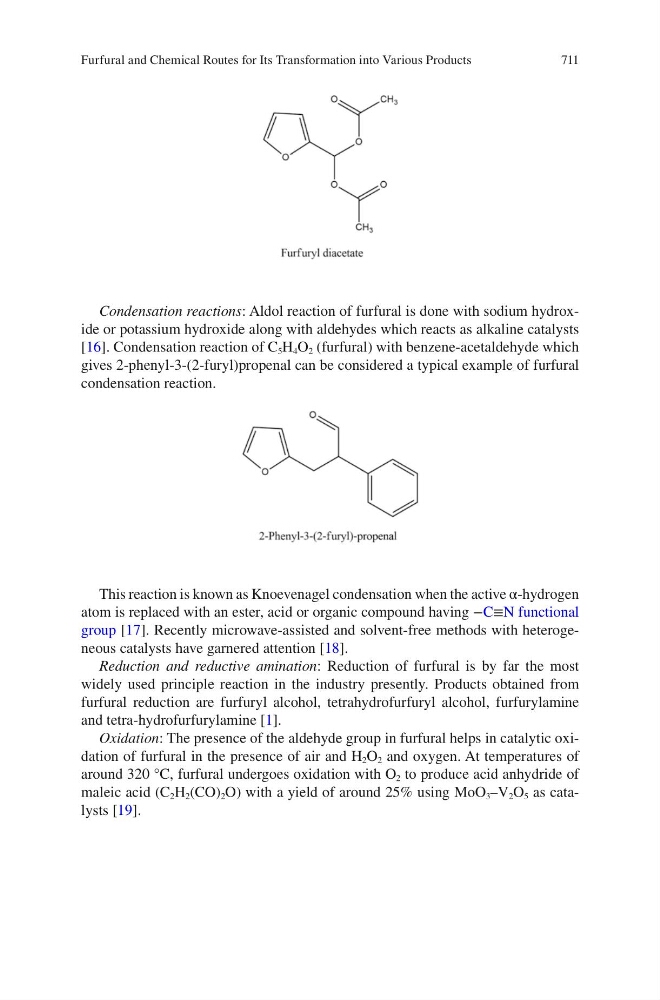
[16]. Condensation reaction of C 5 H 4 O 2 (furfural) with benzene-acetaldehyde which
gives 2-phenyl-3-(2-furyl)propenal can be considered a typical example of furfural
condensation reaction.
This reaction is known as Knoevenagel condensation when the active α-hydrogen
atom is replaced with an ester, acid or organic compound having −C≡N functional
group [17]. Recently microwave-assisted and solvent-free methods with heterogeneous catalysts have garnered attention [18].
Reduction and reductive amination: Reduction of furfural is by far the most
widely used principle reaction in the industry presently. Products obtained from
furfural reduction are furfuryl alcohol, tetrahydrofurfuryl alcohol, furfurylamine
and tetra-hydrofurfurylamine [1].
Oxidation: The presence of the aldehyde group in furfural helps in catalytic oxidation of furfural in the presence of air and H 2 O 2 and oxygen. At temperatures of
around 320 °C, furfural undergoes oxidation with O 2 to produce acid anhydride of
maleic acid (C 2 H 2 (CO) 2 O) with a yield of around 25% using MoO 3 –V 2 O 5 as catalysts [19].
Furfural and Chemical Routes for Its Transformation into Various Products