

55
and forestry residuals a zero cost potential feedstock for hydrogen production,
although careful calculation of energy input required along with the pretreatment
method should be made [44]. Crude glycerol, which is a co-product in the production process of biodiesel, could also be used to obtain hydrogen with a potential
growth of biodiesel production economics.
Other complex waste and wastewaters, including solid residuals from food
industry and agro-based industries; domestic organic wastes; wastewaters from the
juice, dairy and meat industries; oil-based industry residuals, etc., have also been
studied in fermentative hydrogen production processes. These types of feedstock
have lower conversion efficiencies compared to carbohydrate-based waste since
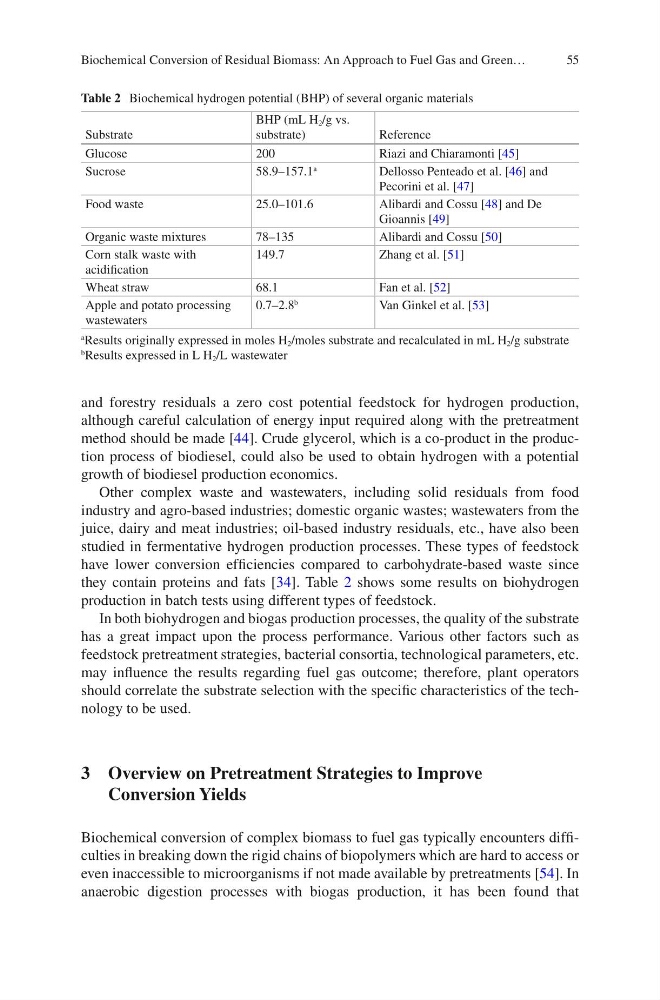
they contain proteins and fats [34]. Table 2 shows some results on biohydrogen
production in batch tests using different types of feedstock.
In both biohydrogen and biogas production processes, the quality of the substrate
has a great impact upon the process performance. Various other factors such as
feedstock pretreatment strategies, bacterial consortia, technological parameters, etc.
may influence the results regarding fuel gas outcome; therefore, plant operators
should correlate the substrate selection with the specific characteristics of the technology to be used.
3 Overview on Pretreatment Strategies to Improve
Conversion Yields
Biochemical conversion of complex biomass to fuel gas typically encounters difficulties in breaking down the rigid chains of biopolymers which are hard to access or
even inaccessible to microorganisms if not made available by pretreatments [54]. In
anaerobic digestion processes with biogas production, it has been found that
Table 2 Biochemical hydrogen potential (BHP) of several organic materials
Substrate
BHP (mL H 2 /g vs.
substrate)
Reference
Glucose
200
Riazi and Chiaramonti [45]
Sucrose
58.9–157.1
a
Dellosso Penteado et al. [46] and
Pecorini et al. [47]
Food waste
25.0–101.6
Alibardi and Cossu [48] and De
Gioannis [49]
Organic waste mixtures
78–135
Alibardi and Cossu [50]
Corn stalk waste with
acidification
149.7
Zhang et al. [51]
Wheat straw
68.1
Fan et al. [52]
Apple and potato processing
wastewaters
0.7–2.8
b
Van Ginkel et al. [53]
a
Results originally expressed in moles H 2 /moles substrate and recalculated in mL H 2 /g substrate
b
Results expressed in L H 2 /L wastewater
Biochemical Conversion of Residual Biomass: An Approach to Fuel Gas and Green…
and forestry residuals a zero cost potential feedstock for hydrogen production,
although careful calculation of energy input required along with the pretreatment
method should be made [44]. Crude glycerol, which is a co-product in the production process of biodiesel, could also be used to obtain hydrogen with a potential
growth of biodiesel production economics.
Other complex waste and wastewaters, including solid residuals from food
industry and agro-based industries; domestic organic wastes; wastewaters from the
juice, dairy and meat industries; oil-based industry residuals, etc., have also been
studied in fermentative hydrogen production processes. These types of feedstock
have lower conversion efficiencies compared to carbohydrate-based waste since
they contain proteins and fats [34]. Table 2 shows some results on biohydrogen
production in batch tests using different types of feedstock.
In both biohydrogen and biogas production processes, the quality of the substrate
has a great impact upon the process performance. Various other factors such as
feedstock pretreatment strategies, bacterial consortia, technological parameters, etc.
may influence the results regarding fuel gas outcome; therefore, plant operators
should correlate the substrate selection with the specific characteristics of the technology to be used.
3 Overview on Pretreatment Strategies to Improve
Conversion Yields
Biochemical conversion of complex biomass to fuel gas typically encounters difficulties in breaking down the rigid chains of biopolymers which are hard to access or
even inaccessible to microorganisms if not made available by pretreatments [54]. In
anaerobic digestion processes with biogas production, it has been found that
Table 2 Biochemical hydrogen potential (BHP) of several organic materials
Substrate
BHP (mL H 2 /g vs.
substrate)
Reference
Glucose
200
Riazi and Chiaramonti [45]
Sucrose
58.9–157.1
a
Dellosso Penteado et al. [46] and
Pecorini et al. [47]
Food waste
25.0–101.6
Alibardi and Cossu [48] and De
Gioannis [49]
Organic waste mixtures
78–135
Alibardi and Cossu [50]
Corn stalk waste with
acidification
149.7
Zhang et al. [51]
Wheat straw
68.1
Fan et al. [52]
Apple and potato processing
wastewaters
0.7–2.8
b
Van Ginkel et al. [53]
a
Results originally expressed in moles H 2 /moles substrate and recalculated in mL H 2 /g substrate
b
Results expressed in L H 2 /L wastewater
Biochemical Conversion of Residual Biomass: An Approach to Fuel Gas and Green…