

56
hydrolysis of biopolymers is a rate-determining step. Some studies have shown that
methanogenesis can also be considered a process stage that may control the decomposition rate at certain ratios between the microorganisms responsible for hydrolysis and methanogenesis, respectively [55].
Lignocellulosic biomass that represents a huge amount of renewable bioresources available worldwide contains much lignin which is the biopolymer responsible for impairing cellulose and hemicellulose hydrolysis [56, 57]. Lignin is
embedding cellulose and hemicellulose in the cell to sustain its structure, but in
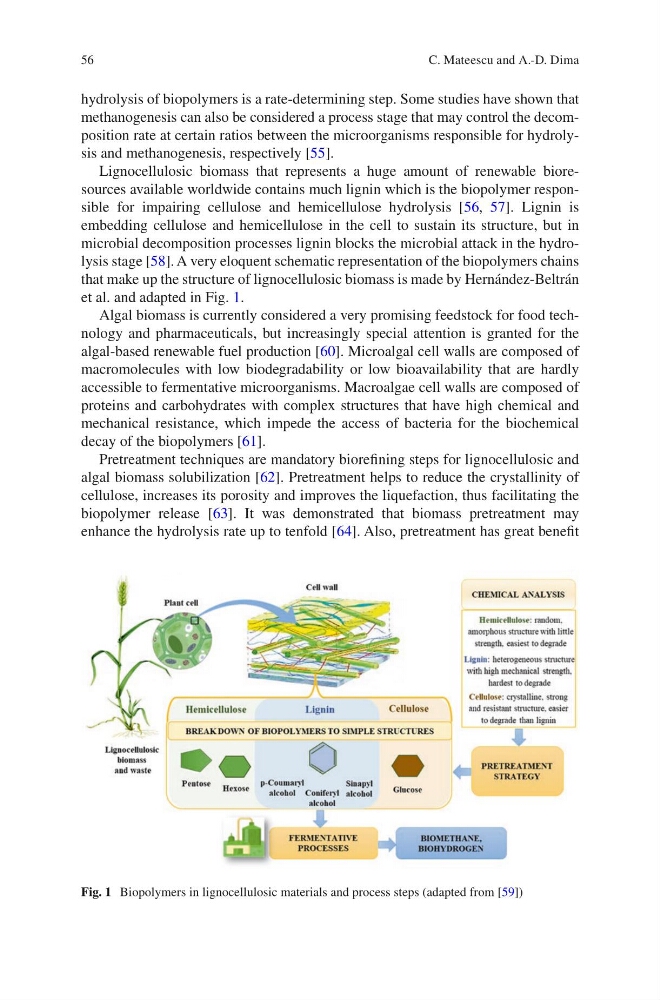
microbial decomposition processes lignin blocks the microbial attack in the hydrolysis stage [58]. A very eloquent schematic representation of the biopolymers chains
that make up the structure of lignocellulosic biomass is made by Hernández-Beltrán
et al. and adapted in Fig. 1.
Algal biomass is currently considered a very promising feedstock for food technology and pharmaceuticals, but increasingly special attention is granted for the
algal-based renewable fuel production [60]. Microalgal cell walls are composed of
macromolecules with low biodegradability or low bioavailability that are hardly
accessible to fermentative microorganisms. Macroalgae cell walls are composed of
proteins and carbohydrates with complex structures that have high chemical and
mechanical resistance, which impede the access of bacteria for the biochemical
decay of the biopolymers [61].
Pretreatment techniques are mandatory biorefining steps for lignocellulosic and
algal biomass solubilization [62]. Pretreatment helps to reduce the crystallinity of
cellulose, increases its porosity and improves the liquefaction, thus facilitating the
biopolymer release [63]. It was demonstrated that biomass pretreatment may
enhance the hydrolysis rate up to tenfold [64]. Also, pretreatment has great benefit
Fig. 1 Biopolymers in lignocellulosic materials and process steps (adapted from [59])
C. Mateescu and A.-D. Dima
hydrolysis of biopolymers is a rate-determining step. Some studies have shown that
methanogenesis can also be considered a process stage that may control the decomposition rate at certain ratios between the microorganisms responsible for hydrolysis and methanogenesis, respectively [55].
Lignocellulosic biomass that represents a huge amount of renewable bioresources available worldwide contains much lignin which is the biopolymer responsible for impairing cellulose and hemicellulose hydrolysis [56, 57]. Lignin is
embedding cellulose and hemicellulose in the cell to sustain its structure, but in
microbial decomposition processes lignin blocks the microbial attack in the hydrolysis stage [58]. A very eloquent schematic representation of the biopolymers chains
that make up the structure of lignocellulosic biomass is made by Hernández-Beltrán
et al. and adapted in Fig. 1.
Algal biomass is currently considered a very promising feedstock for food technology and pharmaceuticals, but increasingly special attention is granted for the
algal-based renewable fuel production [60]. Microalgal cell walls are composed of
macromolecules with low biodegradability or low bioavailability that are hardly
accessible to fermentative microorganisms. Macroalgae cell walls are composed of
proteins and carbohydrates with complex structures that have high chemical and
mechanical resistance, which impede the access of bacteria for the biochemical
decay of the biopolymers [61].
Pretreatment techniques are mandatory biorefining steps for lignocellulosic and
algal biomass solubilization [62]. Pretreatment helps to reduce the crystallinity of
cellulose, increases its porosity and improves the liquefaction, thus facilitating the
biopolymer release [63]. It was demonstrated that biomass pretreatment may
enhance the hydrolysis rate up to tenfold [64]. Also, pretreatment has great benefit
Fig. 1 Biopolymers in lignocellulosic materials and process steps (adapted from [59])
C. Mateescu and A.-D. Dima