

54
of sewage sludge may be done through biochemical conversion in anaerobic digesters, by which the organic component diminishes its biological activity, pathogens
and weed seeds, as well as its unpleasant odour. About 300 TWh energy could be
obtained if wastewater treatment plants would collect the sewage sludge of each
household and couple the purification stages to fermentative processes. Additionally,
algae seem to gain increasing interest for valorization in biofuel production; taking
into account their high productivities and implementing economically viable technologies using algal biomass are a burning issue [32]. Macroalgae and microalgae
are considered renewable and inexpensive feedstock for third-generation biofuels
[7, 33].
Biogas-obtaining substrates have various advantages with minimum preliminary
processing requirements if recovered by anaerobic digestion (high moisture, high
buffering capacity, rich microbial flora) [34]. The biochemical methane potential
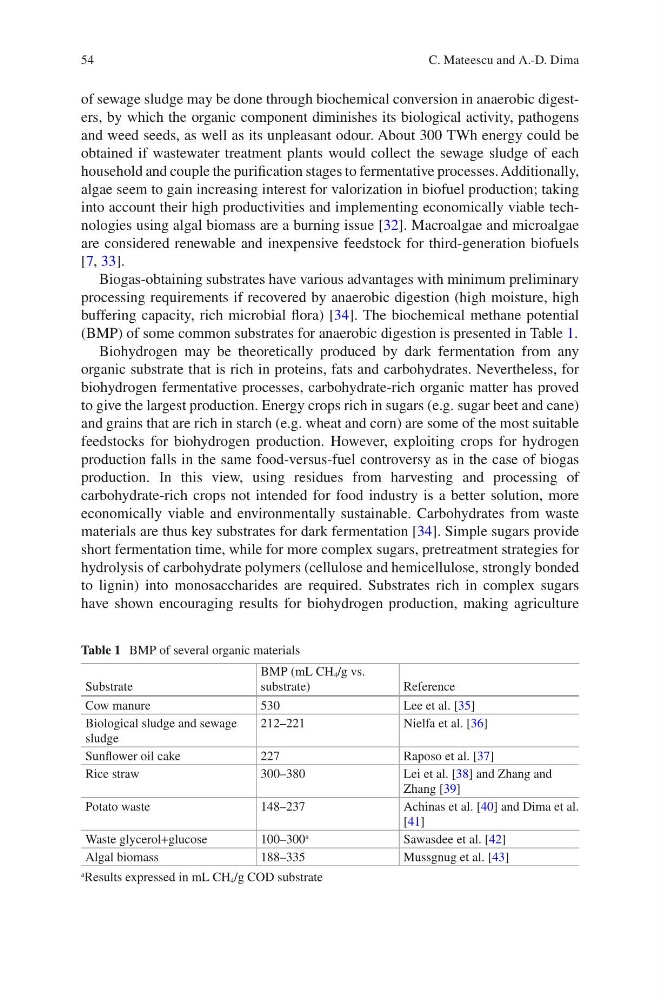
(BMP) of some common substrates for anaerobic digestion is presented in Table 1.
Biohydrogen may be theoretically produced by dark fermentation from any
organic substrate that is rich in proteins, fats and carbohydrates. Nevertheless, for
biohydrogen fermentative processes, carbohydrate-rich organic matter has proved
to give the largest production. Energy crops rich in sugars (e.g. sugar beet and cane)
and grains that are rich in starch (e.g. wheat and corn) are some of the most suitable
feedstocks for biohydrogen production. However, exploiting crops for hydrogen
production falls in the same food-versus-fuel controversy as in the case of biogas
production. In this view, using residues from harvesting and processing of
carbohydrate- rich crops not intended for food industry is a better solution, more
economically viable and environmentally sustainable. Carbohydrates from waste
materials are thus key substrates for dark fermentation [34]. Simple sugars provide
short fermentation time, while for more complex sugars, pretreatment strategies for
hydrolysis of carbohydrate polymers (cellulose and hemicellulose, strongly bonded
to lignin) into monosaccharides are required. Substrates rich in complex sugars
have shown encouraging results for biohydrogen production, making agriculture
Table 1 BMP of several organic materials
Substrate
BMP (mL CH 4 /g vs.
substrate)
Reference
Cow manure
530
Lee et al. [35]
Biological sludge and sewage
sludge
212–221
Nielfa et al. [36]
Sunflower oil cake
227
Raposo et al. [37]
Rice straw
300–380
Lei et al. [38] and Zhang and
Zhang [39]
Potato waste
148–237
Achinas et al. [40] and Dima et al.
[41]
Waste glycerol+glucose
100–300
a
Sawasdee et al. [42]
Algal biomass
188–335
Mussgnug et al. [43]
a Results expressed in mL CH 4 /g COD substrate
C. Mateescu and A.-D. Dima
of sewage sludge may be done through biochemical conversion in anaerobic digesters, by which the organic component diminishes its biological activity, pathogens
and weed seeds, as well as its unpleasant odour. About 300 TWh energy could be
obtained if wastewater treatment plants would collect the sewage sludge of each
household and couple the purification stages to fermentative processes. Additionally,
algae seem to gain increasing interest for valorization in biofuel production; taking
into account their high productivities and implementing economically viable technologies using algal biomass are a burning issue [32]. Macroalgae and microalgae
are considered renewable and inexpensive feedstock for third-generation biofuels
[7, 33].
Biogas-obtaining substrates have various advantages with minimum preliminary
processing requirements if recovered by anaerobic digestion (high moisture, high
buffering capacity, rich microbial flora) [34]. The biochemical methane potential
(BMP) of some common substrates for anaerobic digestion is presented in Table 1.
Biohydrogen may be theoretically produced by dark fermentation from any
organic substrate that is rich in proteins, fats and carbohydrates. Nevertheless, for
biohydrogen fermentative processes, carbohydrate-rich organic matter has proved
to give the largest production. Energy crops rich in sugars (e.g. sugar beet and cane)
and grains that are rich in starch (e.g. wheat and corn) are some of the most suitable
feedstocks for biohydrogen production. However, exploiting crops for hydrogen
production falls in the same food-versus-fuel controversy as in the case of biogas
production. In this view, using residues from harvesting and processing of
carbohydrate- rich crops not intended for food industry is a better solution, more
economically viable and environmentally sustainable. Carbohydrates from waste
materials are thus key substrates for dark fermentation [34]. Simple sugars provide
short fermentation time, while for more complex sugars, pretreatment strategies for
hydrolysis of carbohydrate polymers (cellulose and hemicellulose, strongly bonded
to lignin) into monosaccharides are required. Substrates rich in complex sugars
have shown encouraging results for biohydrogen production, making agriculture
Table 1 BMP of several organic materials
Substrate
BMP (mL CH 4 /g vs.
substrate)
Reference
Cow manure
530
Lee et al. [35]
Biological sludge and sewage
sludge
212–221
Nielfa et al. [36]
Sunflower oil cake
227
Raposo et al. [37]
Rice straw
300–380
Lei et al. [38] and Zhang and
Zhang [39]
Potato waste
148–237
Achinas et al. [40] and Dima et al.
[41]
Waste glycerol+glucose
100–300
a
Sawasdee et al. [42]
Algal biomass
188–335
Mussgnug et al. [43]
a Results expressed in mL CH 4 /g COD substrate
C. Mateescu and A.-D. Dima