

566
account for nearly two thirds of GHG emissions from the chemical industry, would
be significantly higher, if alternative renewable feedstocks were to be used as of
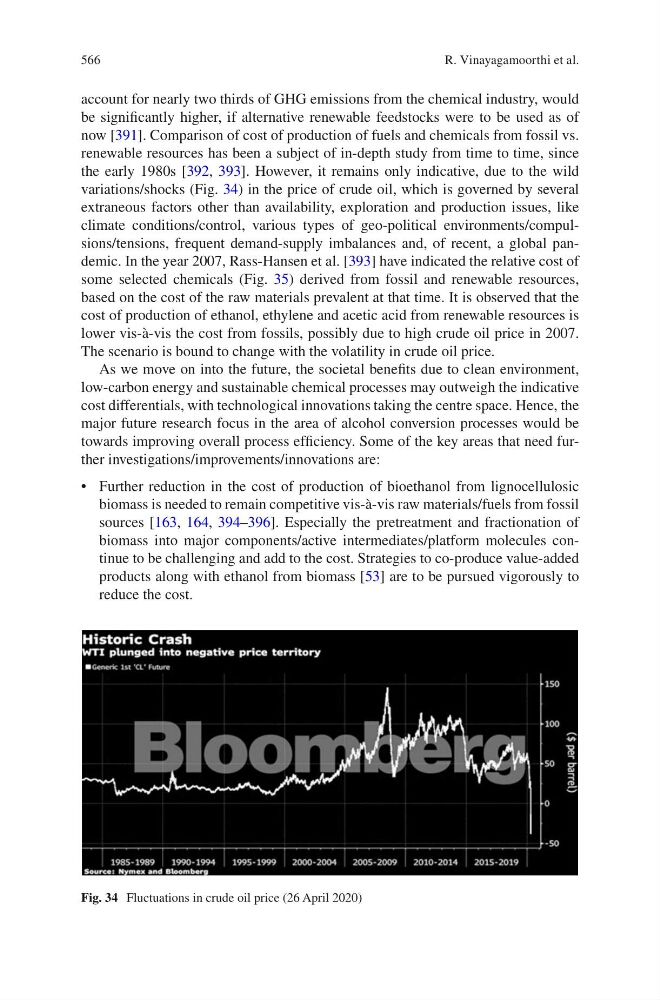
now [391]. Comparison of cost of production of fuels and chemicals from fossil vs.
renewable resources has been a subject of in-depth study from time to time, since
the early 1980s [392, 393]. However, it remains only indicative, due to the wild
variations/shocks (Fig. 34) in the price of crude oil, which is governed by several
extraneous factors other than availability, exploration and production issues, like
climate conditions/control, various types of geo-political environments/compulsions/tensions, frequent demand-supply imbalances and, of recent, a global pandemic. In the year 2007, Rass-Hansen et al. [393] have indicated the relative cost of
some selected chemicals (Fig. 35) derived from fossil and renewable resources,
based on the cost of the raw materials prevalent at that time. It is observed that the
cost of production of ethanol, ethylene and acetic acid from renewable resources is
lower vis-à-vis the cost from fossils, possibly due to high crude oil price in 2007.
The scenario is bound to change with the volatility in crude oil price.
As we move on into the future, the societal benefits due to clean environment,
low-carbon energy and sustainable chemical processes may outweigh the indicative
cost differentials, with technological innovations taking the centre space. Hence, the
major future research focus in the area of alcohol conversion processes would be
towards improving overall process efficiency. Some of the key areas that need further investigations/improvements/innovations are:
• Further reduction in the cost of production of bioethanol from lignocellulosic
biomass is needed to remain competitive vis-à-vis raw materials/fuels from fossil
sources [163, 164, 394–396]. Especially the pretreatment and fractionation of
biomass into major components/active intermediates/platform molecules continue to be challenging and add to the cost. Strategies to co-produce value-added
products along with ethanol from biomass [53] are to be pursued vigorously to
reduce the cost.
Fig. 34 Fluctuations in crude oil price (26 April 2020)
R. Vinayagamoorthi et al.