

565
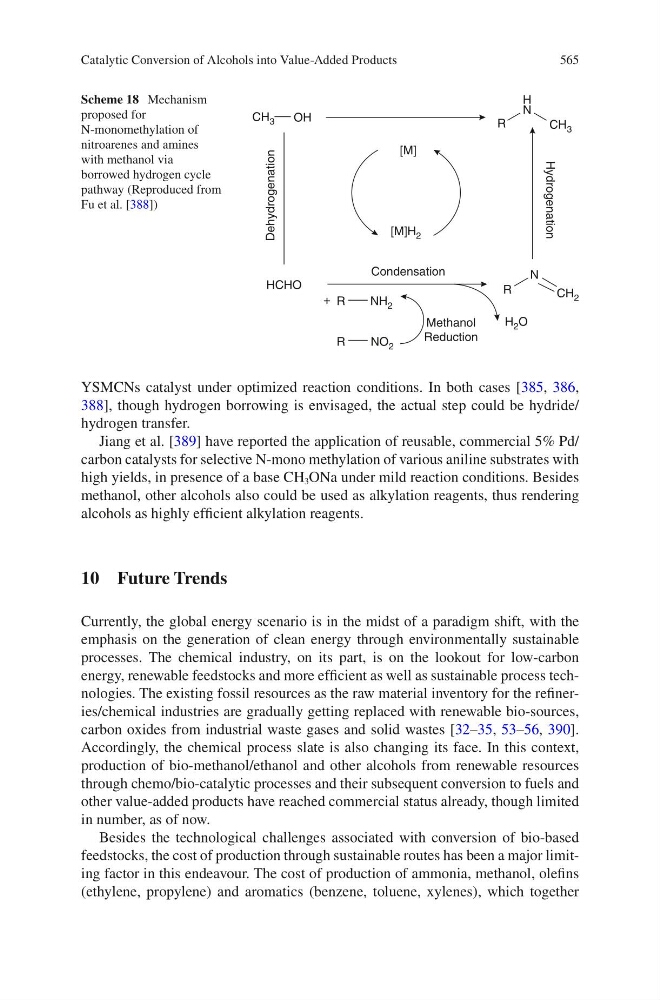
YSMCNs catalyst under optimized reaction conditions. In both cases [385, 386,
388], though hydrogen borrowing is envisaged, the actual step could be hydride/
hydrogen transfer.
Jiang et al. [389] have reported the application of reusable, commercial 5% Pd/
carbon catalysts for selective N-mono methylation of various aniline substrates with
high yields, in presence of a base CH 3 ONa under mild reaction conditions. Besides
methanol, other alcohols also could be used as alkylation reagents, thus rendering
alcohols as highly efficient alkylation reagents.
10 Future Trends
Currently, the global energy scenario is in the midst of a paradigm shift, with the
emphasis on the generation of clean energy through environmentally sustainable
processes. The chemical industry, on its part, is on the lookout for low-carbon
energy, renewable feedstocks and more efficient as well as sustainable process technologies. The existing fossil resources as the raw material inventory for the refineries/chemical industries are gradually getting replaced with renewable bio-sources,
carbon oxides from industrial waste gases and solid wastes [32–35, 53–56, 390].
Accordingly, the chemical process slate is also changing its face. In this context,
production of bio-methanol/ethanol and other alcohols from renewable resources
through chemo/bio-catalytic processes and their subsequent conversion to fuels and
other value-added products have reached commercial status already, though limited
in number, as of now.
Besides the technological challenges associated with conversion of bio-based
feedstocks, the cost of production through sustainable routes has been a major limiting factor in this endeavour. The cost of production of ammonia, methanol, olefins
(ethylene, propylene) and aromatics (benzene, toluene, xylenes), which together
CH 3
OH
H
N
R
Condensation
R
HCHO
NH 2
Methanol
Reduction
NO 2
H 2 O
R
N
CH 2
R
+
CH 3
[M]
Hydrogenation
Dehydrogenation
[M]H 2
Scheme 18 Mechanism
proposed for
N-monomethylation of
nitroarenes and amines
with methanol via
borrowed hydrogen cycle
pathway (Reproduced from
Fu et al. [388])
Catalytic Conversion of Alcohols into Value-Added Products