

564
nanoparticles immobilized on inorganic supports, have been explored for alphaalkylation [382]. Typical examples of such conversions are presented for illustration.
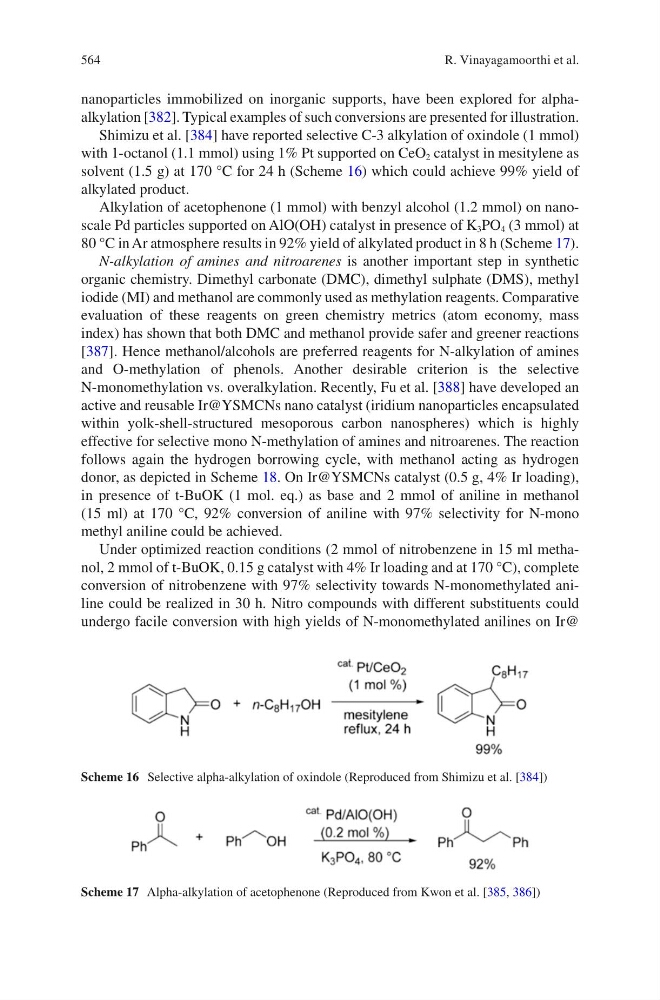
Shimizu et al. [384] have reported selective C-3 alkylation of oxindole (1 mmol)
with 1-octanol (1.1 mmol) using 1% Pt supported on CeO 2 catalyst in mesitylene as
solvent (1.5 g) at 170 °C for 24 h (Scheme 16) which could achieve 99% yield of
alkylated product.
Alkylation of acetophenone (1 mmol) with benzyl alcohol (1.2 mmol) on nanoscale Pd particles supported on AlO(OH) catalyst in presence of K 3 PO 4 (3 mmol) at
80 °C in Ar atmosphere results in 92% yield of alkylated product in 8 h (Scheme 17).
N-alkylation of amines and nitroarenes is another important step in synthetic
organic chemistry. Dimethyl carbonate (DMC), dimethyl sulphate (DMS), methyl
iodide (MI) and methanol are commonly used as methylation reagents. Comparative
evaluation of these reagents on green chemistry metrics (atom economy, mass
index) has shown that both DMC and methanol provide safer and greener reactions
[387]. Hence methanol/alcohols are preferred reagents for N-alkylation of amines
and O-methylation of phenols. Another desirable criterion is the selective
N-monomethylation vs. overalkylation. Recently, Fu et al. [388] have developed an
active and reusable Ir@YSMCNs nano catalyst (iridium nanoparticles encapsulated
within yolk-shell-structured mesoporous carbon nanospheres) which is highly
effective for selective mono N-methylation of amines and nitroarenes. The reaction
follows again the hydrogen borrowing cycle, with methanol acting as hydrogen
donor, as depicted in Scheme 18. On Ir@YSMCNs catalyst (0.5 g, 4% Ir loading),
in presence of t-BuOK (1 mol. eq.) as base and 2 mmol of aniline in methanol
(15 ml) at 170 °C, 92% conversion of aniline with 97% selectivity for N-mono
methyl aniline could be achieved.
Under optimized reaction conditions (2 mmol of nitrobenzene in 15 ml methanol, 2 mmol of t-BuOK, 0.15 g catalyst with 4% Ir loading and at 170 °C), complete
conversion of nitrobenzene with 97% selectivity towards N-monomethylated aniline could be realized in 30 h. Nitro compounds with different substituents could
undergo facile conversion with high yields of N-monomethylated anilines on Ir@
Scheme 17 Alpha-alkylation of acetophenone (Reproduced from Kwon et al. [385, 386])
Scheme 16 Selective alpha-alkylation of oxindole (Reproduced from Shimizu et al. [384])
R. Vinayagamoorthi et al.