

563
to acetic acid with >90% selectivity [377]. However, the process is not viable on
industrial scale, wherein carbonylation of methanol with CO in homogeneous
phase, with Rh/Ir complexes (Monsanto/CATIVA processes), is the preferred route.
Alkylation with alcohols is a well-known reaction, and catalytic alkylation of
aromatics with alcohols is a well-established process in petrochemical industry.
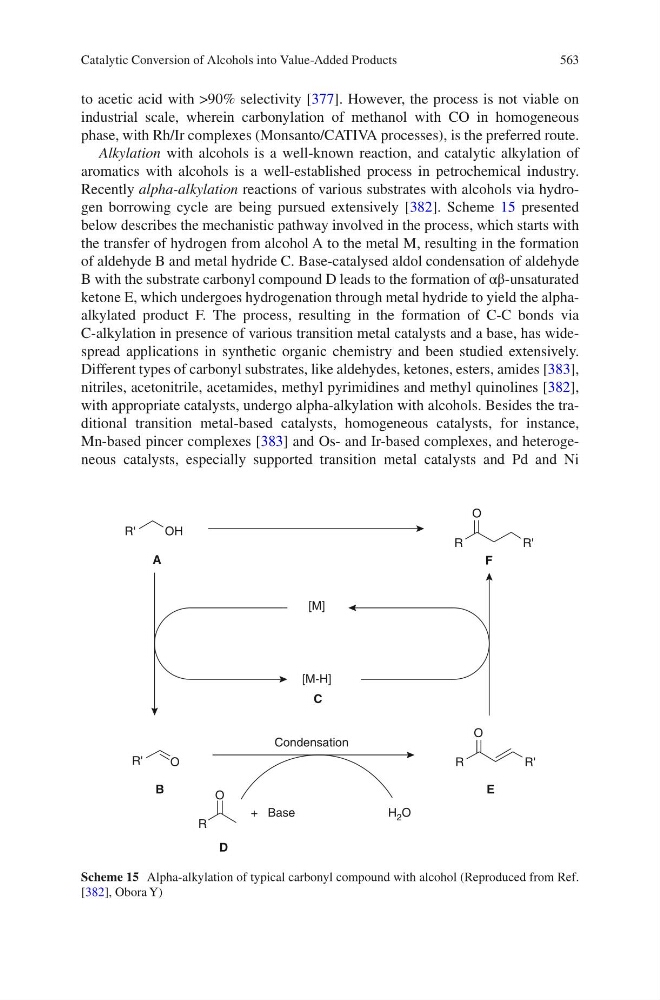
Recently alpha-alkylation reactions of various substrates with alcohols via hydrogen borrowing cycle are being pursued extensively [382]. Scheme 15 presented
below describes the mechanistic pathway involved in the process, which starts with
the transfer of hydrogen from alcohol A to the metal M, resulting in the formation
of aldehyde B and metal hydride C. Base-catalysed aldol condensation of aldehyde
B with the substrate carbonyl compound D leads to the formation of αβ-unsaturated
ketone E, which undergoes hydrogenation through metal hydride to yield the alphaalkylated product F. The process, resulting in the formation of C-C bonds via
C-alkylation in presence of various transition metal catalysts and a base, has widespread applications in synthetic organic chemistry and been studied extensively.
Different types of carbonyl substrates, like aldehydes, ketones, esters, amides [383],
nitriles, acetonitrile, acetamides, methyl pyrimidines and methyl quinolines [382],
with appropriate catalysts, undergo alpha-alkylation with alcohols. Besides the traditional transition metal-based catalysts, homogeneous catalysts, for instance,
Mn-based pincer complexes [383] and Os- and Ir-based complexes, and heterogeneous catalysts, especially supported transition metal catalysts and Pd and Ni
R'
R'
F
R
O
R'
R'
O
B
O
O
C
[M-H]
[M]
R
R
D
E
+ Base
Condensation
H 2 O
OH
A
Scheme 15 Alpha-alkylation of typical carbonyl compound with alcohol (Reproduced from Ref.
[382], Obora Y)
Catalytic Conversion of Alcohols into Value-Added Products