

562
9 Miscellaneous Conversions of Alcohols
Oxygenates of alcohols, namely, aldehydes, ketones, acids, ethers and esters, are
important class of derivatives, useful mainly as solvents, raw materials and intermediates for the synthesis of value-added products. Depending on the type of catalysts
(usually supported metal/metal oxide) and the process conditions, different oxygenated products are formed. Dehydration, dehydrogenation, oxidative dehydrogenation, etherification, oxidation and esterification are the typical reactions involved.
Synthesis and applications of oxygenates from ethanol have been studied extensively and reviewed [166, 377, 378]. Simplest of all is the conversion of ethanol to
diethyl ether (DEE) by vapour phase acid-catalysed dehydration of ethanol. On
gamma alumina [379], DEE with 80% selectivity is obtained, while on heteropoly
acid catalyst [380], nearly 100% selectivity could be achieved. While monofunctional supported copper catalysts are active for acetaldehyde formation via dehydrogenation, supported gold catalysts, on the other hand, catalyse oxidative
dehydrogenation of ethanol to yield acetaldehyde [377]. A bi-functional redoxacidic catalyst [Cu/ZrO 2 ] further transforms acetaldehyde into ethyl acetate by reaction with ethanol. It is proposed that a pair of Cu
0
/Cu
+1
sites present at metal/support
interface facilitate further reaction of acetaldehyde and ethanol to ethyl acetate
[381]. Both liquid phase (supported Au catalysts) and vapour phase (supported
Mo-V-Nb catalysts) oxidation of ethanol to acetic acid have been reported. Cu-doped
Au/NiO is found to be highly active at 120 °C in aqueous phase oxidation of ethanol
O
OH H'
H
Furfuryl alcohol (FOL)
O
O
R
O
O
n=1-3, R=H, CH 2 OH
R
H 2
H
n
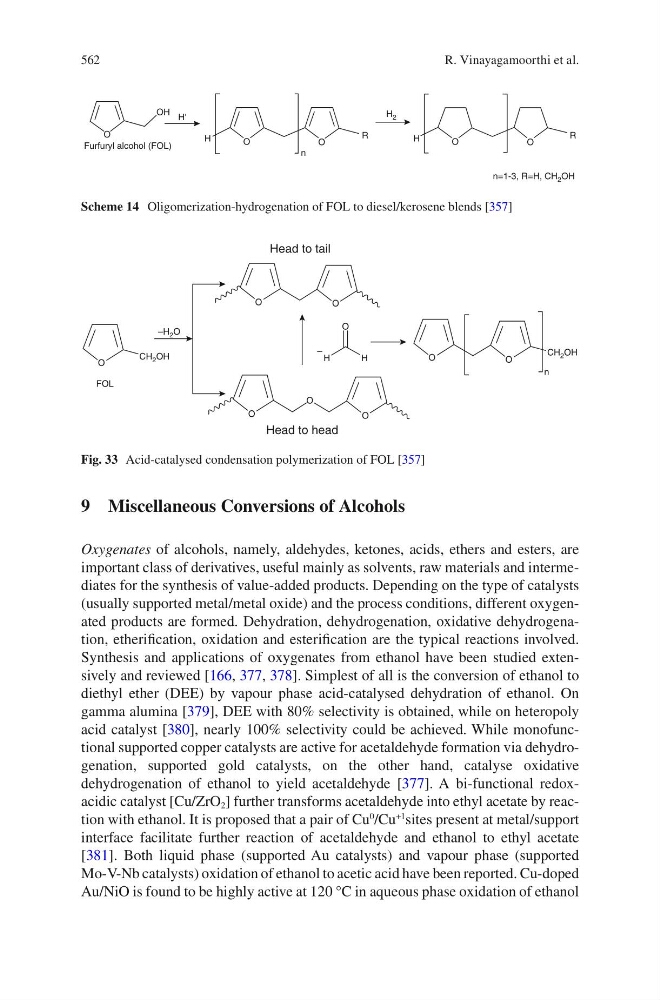
Scheme 14 Oligomerization-hydrogenation of FOL to diesel/kerosene blends [357]
Head to tail
Head to head
O
O
O
O
O
O
O
O
O
n
CH 2 OH
CH 2 OH
FOL
–H 2 O
H
H
–
Fig. 33 Acid-catalysed condensation polymerization of FOL [357]
R. Vinayagamoorthi et al.