

561
alternative more selective catalysts and optimization of process conditions and
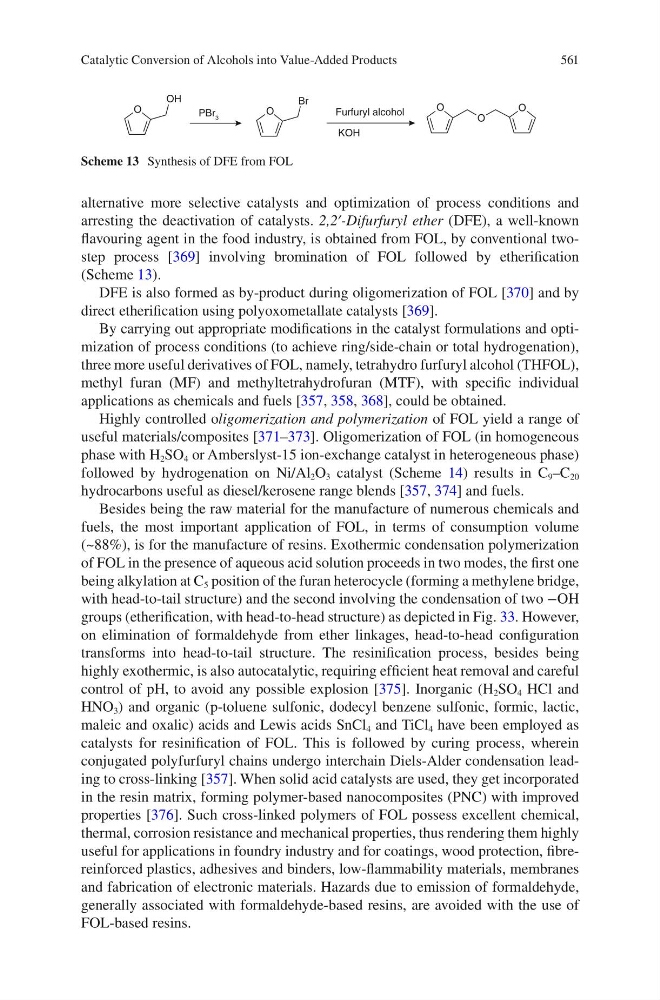
arresting the deactivation of catalysts. 2,2′-Difurfuryl ether (DFE), a well-known
flavouring agent in the food industry, is obtained from FOL, by conventional twostep process [369] involving bromination of FOL followed by etherification
(Scheme 13).
DFE is also formed as by-product during oligomerization of FOL [370] and by
direct etherification using polyoxometallate catalysts [369].
By carrying out appropriate modifications in the catalyst formulations and optimization of process conditions (to achieve ring/side-chain or total hydrogenation),
three more useful derivatives of FOL, namely, tetrahydro furfuryl alcohol (THFOL),
methyl furan (MF) and methyltetrahydrofuran (MTF), with specific individual
applications as chemicals and fuels [357, 358, 368], could be obtained.
Highly controlled oligomerization and polymerization of FOL yield a range of
useful materials/composites [371–373]. Oligomerization of FOL (in homogeneous
phase with H 2 SO 4 or Amberslyst-15 ion-exchange catalyst in heterogeneous phase)
followed by hydrogenation on Ni/Al 2 O 3 catalyst (Scheme 14) results in C 9 –C 20
hydrocarbons useful as diesel/kerosene range blends [357, 374] and fuels.
Besides being the raw material for the manufacture of numerous chemicals and
fuels, the most important application of FOL, in terms of consumption volume
(~88%), is for the manufacture of resins. Exothermic condensation polymerization
of FOL in the presence of aqueous acid solution proceeds in two modes, the first one
being alkylation at C 5 position of the furan heterocycle (forming a methylene bridge,
with head-to-tail structure) and the second involving the condensation of two −OH
groups (etherification, with head-to-head structure) as depicted in Fig. 33. However,
on elimination of formaldehyde from ether linkages, head-to-head configuration
transforms into head-to-tail structure. The resinification process, besides being
highly exothermic, is also autocatalytic, requiring efficient heat removal and careful
control of pH, to avoid any possible explosion [375]. Inorganic (H 2 SO 4 HCl and
HNO 3 ) and organic (p-toluene sulfonic, dodecyl benzene sulfonic, formic, lactic,
maleic and oxalic) acids and Lewis acids SnCl 4 and TiCl 4 have been employed as
catalysts for resinification of FOL. This is followed by curing process, wherein
conjugated polyfurfuryl chains undergo interchain Diels-Alder condensation leading to cross-linking [357]. When solid acid catalysts are used, they get incorporated
in the resin matrix, forming polymer-based nanocomposites (PNC) with improved
properties [376]. Such cross-linked polymers of FOL possess excellent chemical,
thermal, corrosion resistance and mechanical properties, thus rendering them highly
useful for applications in foundry industry and for coatings, wood protection, fibrereinforced plastics, adhesives and binders, low-flammability materials, membranes
and fabrication of electronic materials. Hazards due to emission of formaldehyde,
generally associated with formaldehyde-based resins, are avoided with the use of
FOL-based resins.
O
O
KOH
Furfuryl alcohol
OH
PBr 3
Br
O
O
O
Scheme 13 Synthesis of DFE from FOL
Catalytic Conversion of Alcohols into Value-Added Products