

545
temperature (at <500 K compared to 773–1073 K required for vapour phase steam
reforming process) and pressure of 20–25 bar, to maintain water in liquid state, thus
eliminating energy required for evaporation. Besides, APR includes water-gas shift
reaction (WGS) that involves the formation of additional hydrogen to lower CO
content, along with the conversion of CO to CO 2 [284].
Aqueous solutions containing 5–20 wt% of any type of biomass intermediates/
platform chemicals, like cellulose, C 5 –C 6 sugars, polyols and C 1 –C 4 aliphatic alcohols, could be used as feed, rendering APR as a highly versatile process for the
production of fuels and chemicals from biomass [285, 286]. APR is a carbon- neutral
process, which can be integrated with other biological, thermal, chemical or fermentation processes [287] without the need for external hydrogen source. A recent
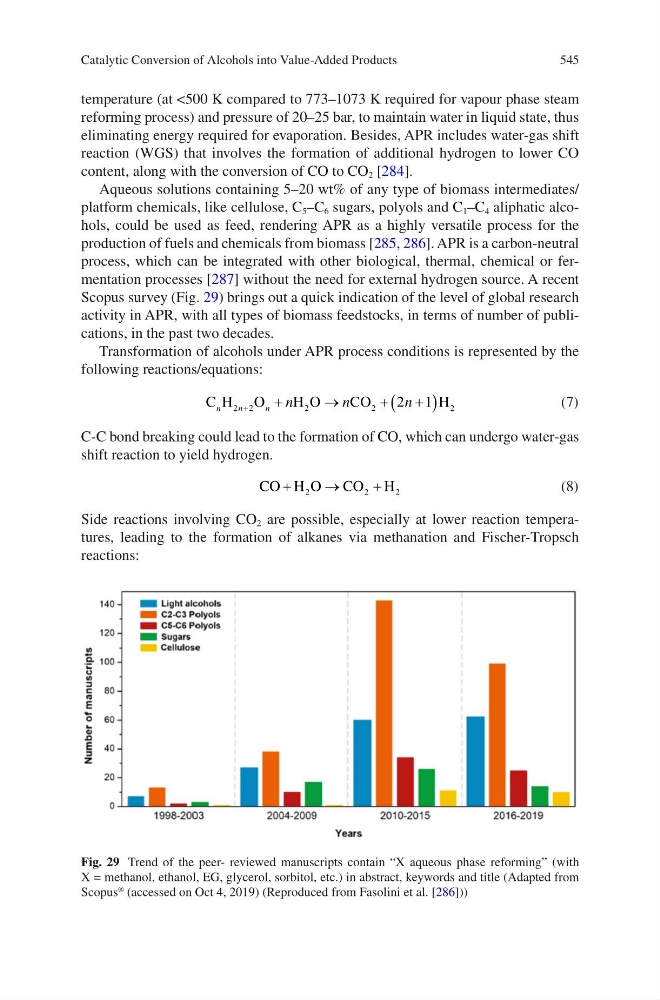
Scopus survey (Fig. 29) brings out a quick indication of the level of global research
activity in APR, with all types of biomass feedstocks, in terms of number of publications, in the past two decades.
Transformation of alcohols under APR process conditions is represented by the
following reactions/equations:
C H O
H O
CO
H
n
n
n
n
n
n
2 2
2
2
2
2 1
+
+
→
+
+
(
)
(7)
C-C bond breaking could lead to the formation of CO, which can undergo water-gas
shift reaction to yield hydrogen.
CO H O CO H
+
→
+
2
2
2
(8)
Side reactions involving CO 2 are possible, especially at lower reaction temperatures, leading to the formation of alkanes via methanation and Fischer-Tropsch
reactions:
Fig. 29 Trend of the peer- reviewed manuscripts contain “X aqueous phase reforming” (with
X = methanol, ethanol, EG, glycerol, sorbitol, etc.) in abstract, keywords and title (Adapted from
Scopus
® (accessed on Oct 4, 2019) (Reproduced from Fasolini et al. [286]))
Catalytic Conversion of Alcohols into Value-Added Products