

546
3 2
4
2
H CO CH H O
+
→
+
(9)
4
2
2
2
4
2
H CO
CH
H O
+
→
+
(10)
n
n
n n
CO
H
C H
HO
+
→[
] +
2 2
2
2
—
—
(11)
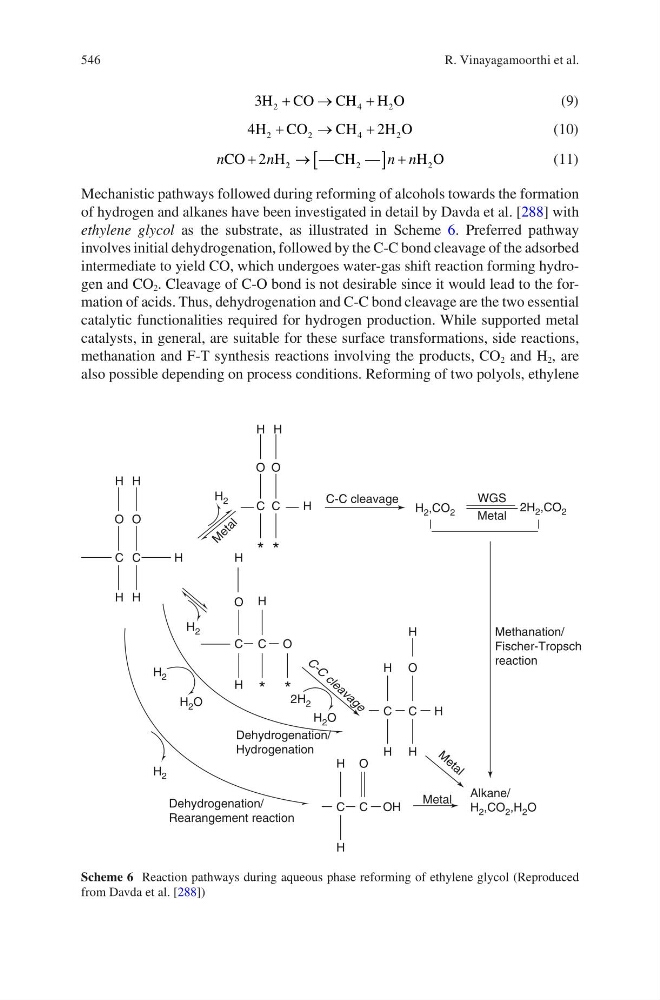
Mechanistic pathways followed during reforming of alcohols towards the formation
of hydrogen and alkanes have been investigated in detail by Davda et al. [288] with
ethylene glycol as the substrate, as illustrated in Scheme 6. Preferred pathway
involves initial dehydrogenation, followed by the C-C bond cleavage of the adsorbed
intermediate to yield CO, which undergoes water-gas shift reaction forming hydrogen and CO 2 . Cleavage of C-O bond is not desirable since it would lead to the formation of acids. Thus, dehydrogenation and C-C bond cleavage are the two essential
catalytic functionalities required for hydrogen production. While supported metal
catalysts, in general, are suitable for these surface transformations, side reactions,
methanation and F-T synthesis reactions involving the products, CO 2 and H 2 , are
also possible depending on process conditions. Reforming of two polyols, ethylene
H H
H H
H 2
H 2
H 2
Dehydrogenation/
Rearangement reaction
Dehydrogenation/
Hydrogenation
Alkane/
H 2 ,CO 2 ,H 2 O
H 2
H 2 O
H 2 O
2H 2
O O
C
H
H * *
O
C
H
H
O
C H
H
H
C
H
H
C
O
C OH
Metal
M
e t a l
M e t a l
C - C c l e a v a g e
C O
H
C
H
H H
*
O
*
O
C C
H
C-C cleavage
Methanation/
Fischer-Tropsch
reaction
WGS
Metal
H 2 ,CO 2
2H 2 ,CO 2
Scheme 6 Reaction pathways during aqueous phase reforming of ethylene glycol (Reproduced
from Davda et al. [288])
R. Vinayagamoorthi et al.