

544
(via C 2 –C 4 olefins oligomerization and hydrogenation) and the second through
DME (via MTG/MOGD), has been envisaged by Bradin [280] for methanol to jet
fuel (MTJ) process.
An integrated process involving biomass-derived syngas conversion to a mixture
of oxygenates, containing C 1 –C 5 alcohols, acetic acid and acetaldehyde, followed
by oligomerization and hydrogenation to jet fuel/distillates has been explored by
Dagle et al. [281] from PNNL. A systematic review of bio-jet fuel conversion technologies, covering the developments in each case, published by Wang et al. [282],
shows that this area has tremendous potential.
5 Aqueous Phase Reforming of Alcohols
Hydrogen is recognized as the clean and efficient source and carrier of energy.
Currently, hydrogen is produced by steam reforming, which utilizes non-renewable
fossil resources (natural gas, oil, coal) and is highly energy intensive with a large
carbon footprint as well. Renewable biomass-based hydrogen production processes
like gasification and pyrolysis, though carbon-neutral, are again energy-intensive.
In this context, aqueous phase reforming (APR) of biomass feedstocks, developed
by Dumesic et al. [283], has emerged as a viable and sustainable route for the production of hydrogen. Unlike steam reforming, APR is carried out at lower
Isobutene
Dehydration
(200-500°C, 1-20 bar)
Condensation +
Decomposition
(450°C-550°C, 1 bar)
Aldol condensation +
C=C hydrogenation
(50-150°C, 1 bar)
Aldol condensation +
total hydrogenation
(225-350°C, 1-30bar)
C 4-6 alcohols
C 4-10 paraffins and
aromatics
(gasoline and jet)
C 6-8 alcohols
C 12-16 aldehyde
(jet and diesel)
EtOH
Oligomerization
(metal or acid + metal:
50-150°C, 30-40 bar)
Propene
Butenes
Dehydration +
oligomerization
(300-400°C, 1-30bar)
Ethylene
Dehydration
(200-500°C, 1-20 bar)
C 12-16 alcohols
(diesel and jet)
C 8-22
olefins
Guerbet coupling
(225-350°C, 1-30 bar)
C 8 -
olefins
C 4-6 olefins
C 10-20 olefins
(jet and diesel)
Isobutene
n-Olefins
Oligomerization (acid)
(100-250°C, 30-50 bar)
Oligomerization (acid)
(50-150°C, 30-50 bar)
C 3-6 olefins
Guerbet coupling
Dehydrogenation
(200-350°C, 1-30bar)
Dehydration
(200-500°C, 1-20 bar)
Hydrogenation
(50-350°C, 5-50 bar)
C 4+ olefins
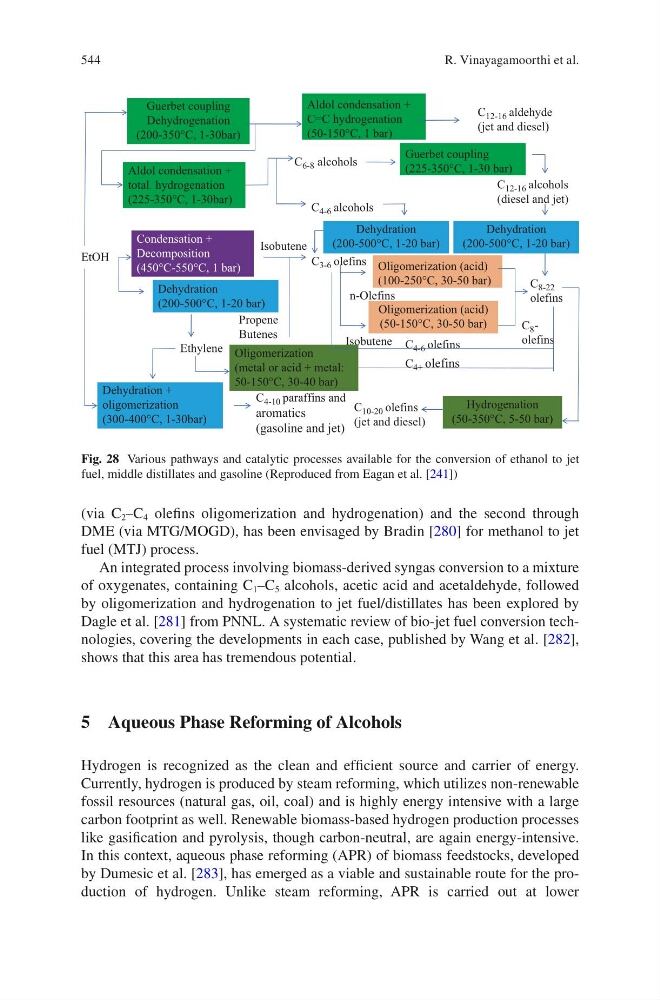
Fig. 28 Various pathways and catalytic processes available for the conversion of ethanol to jet
fuel, middle distillates and gasoline (Reproduced from Eagan et al. [241])
R. Vinayagamoorthi et al.