

534
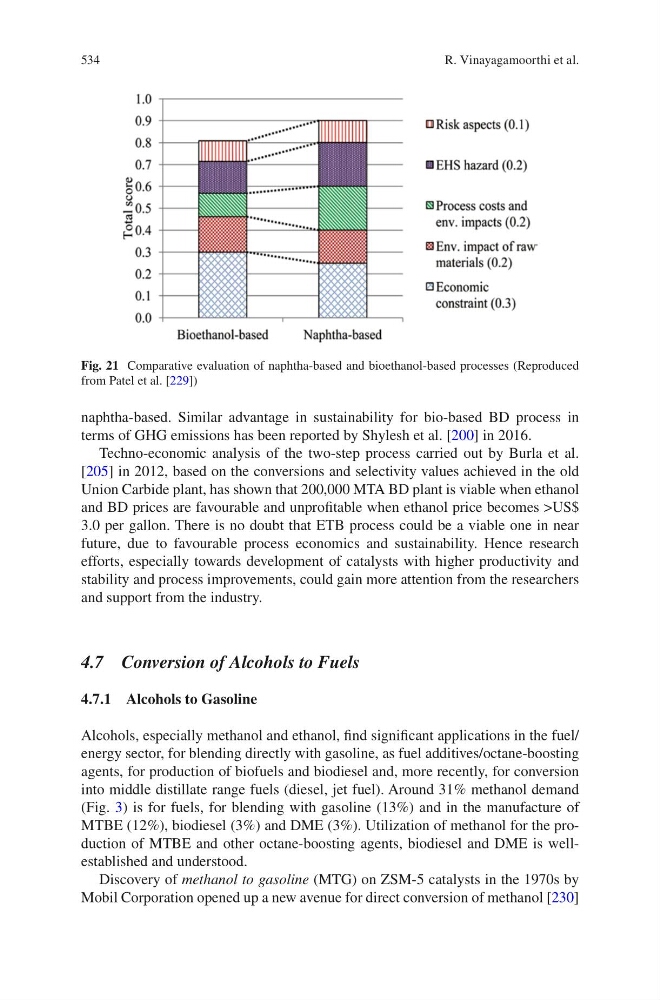
naphtha-based. Similar advantage in sustainability for bio-based BD process in
terms of GHG emissions has been reported by Shylesh et al. [200] in 2016.
Techno-economic analysis of the two-step process carried out by Burla et al.
[205] in 2012, based on the conversions and selectivity values achieved in the old
Union Carbide plant, has shown that 200,000 MTA BD plant is viable when ethanol
and BD prices are favourable and unprofitable when ethanol price becomes >US$
3.0 per gallon. There is no doubt that ETB process could be a viable one in near
future, due to favourable process economics and sustainability. Hence research
efforts, especially towards development of catalysts with higher productivity and
stability and process improvements, could gain more attention from the researchers
and support from the industry.
4.7 Conversion of Alcohols to Fuels
4.7.1 Alcohols to Gasoline
Alcohols, especially methanol and ethanol, find significant applications in the fuel/
energy sector, for blending directly with gasoline, as fuel additives/octane-boosting
agents, for production of biofuels and biodiesel and, more recently, for conversion
into middle distillate range fuels (diesel, jet fuel). Around 31% methanol demand
(Fig. 3) is for fuels, for blending with gasoline (13%) and in the manufacture of
MTBE (12%), biodiesel (3%) and DME (3%). Utilization of methanol for the production of MTBE and other octane-boosting agents, biodiesel and DME is wellestablished and understood.
Discovery of methanol to gasoline (MTG) on ZSM-5 catalysts in the 1970s by
Mobil Corporation opened up a new avenue for direct conversion of methanol [230]
Fig. 21 Comparative evaluation of naphtha-based and bioethanol-based processes (Reproduced
from Patel et al. [229])
R. Vinayagamoorthi et al.