

535
to gasoline, to start with. Elucidation of the mechanistic pathways in the MTG process, with methanol and ethanol as feed, by Derouane et al. [231] and Chang et al.
[232] and the development of fixed bed reactor process [233, 234] paved way for
further improvements in the process. With a better understanding of the catalytic
action by ZSM-5 zeolites and the process steps involved, Tabak and Yurchak [235]
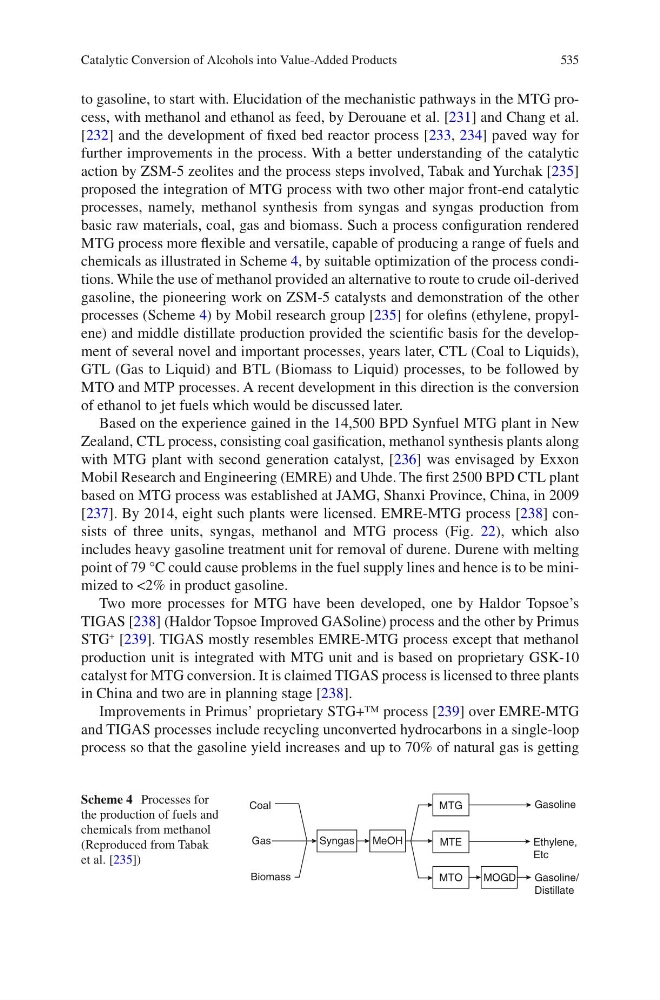
proposed the integration of MTG process with two other major front-end catalytic
processes, namely, methanol synthesis from syngas and syngas production from
basic raw materials, coal, gas and biomass. Such a process configuration rendered
MTG process more flexible and versatile, capable of producing a range of fuels and
chemicals as illustrated in Scheme 4, by suitable optimization of the process conditions. While the use of methanol provided an alternative to route to crude oil-derived
gasoline, the pioneering work on ZSM-5 catalysts and demonstration of the other
processes (Scheme 4) by Mobil research group [235] for olefins (ethylene, propylene) and middle distillate production provided the scientific basis for the development of several novel and important processes, years later, CTL (Coal to Liquids),
GTL (Gas to Liquid) and BTL (Biomass to Liquid) processes, to be followed by
MTO and MTP processes. A recent development in this direction is the conversion
of ethanol to jet fuels which would be discussed later.
Based on the experience gained in the 14,500 BPD Synfuel MTG plant in New
Zealand, CTL process, consisting coal gasification, methanol synthesis plants along
with MTG plant with second generation catalyst, [236] was envisaged by Exxon
Mobil Research and Engineering (EMRE) and Uhde. The first 2500 BPD CTL plant
based on MTG process was established at JAMG, Shanxi Province, China, in 2009
[237]. By 2014, eight such plants were licensed. EMRE-MTG process [238] consists of three units, syngas, methanol and MTG process (Fig. 22), which also
includes heavy gasoline treatment unit for removal of durene. Durene with melting
point of 79 °C could cause problems in the fuel supply lines and hence is to be minimized to <2% in product gasoline.
Two more processes for MTG have been developed, one by Haldor Topsoe’s
TIGAS [238] (Haldor Topsoe Improved GASoline) process and the other by Primus
STG
+
[239]. TIGAS mostly resembles EMRE-MTG process except that methanol
production unit is integrated with MTG unit and is based on proprietary GSK-10
catalyst for MTG conversion. It is claimed TIGAS process is licensed to three plants
in China and two are in planning stage [238].
Improvements in Primus’ proprietary STG+™ process [239] over EMRE-MTG
and TIGAS processes include recycling unconverted hydrocarbons in a single-loop
process so that the gasoline yield increases and up to 70% of natural gas is getting
Coal
Gas
Biomass
Syngas
MeOH
MTG
Gasoline
Gasoline/
Distillate
Ethylene,
Etc
MOGD
MTE
MTO
Scheme 4 Processes for
the production of fuels and
chemicals from methanol
(Reproduced from Tabak
et al. [235])
Catalytic Conversion of Alcohols into Value-Added Products