

533
• Silica-based bimetallic Zr-Zn and trimetallic Zr-Zn-CuO.
• Sepiolite and zeolite (BEA, Al-MCM-41) based.
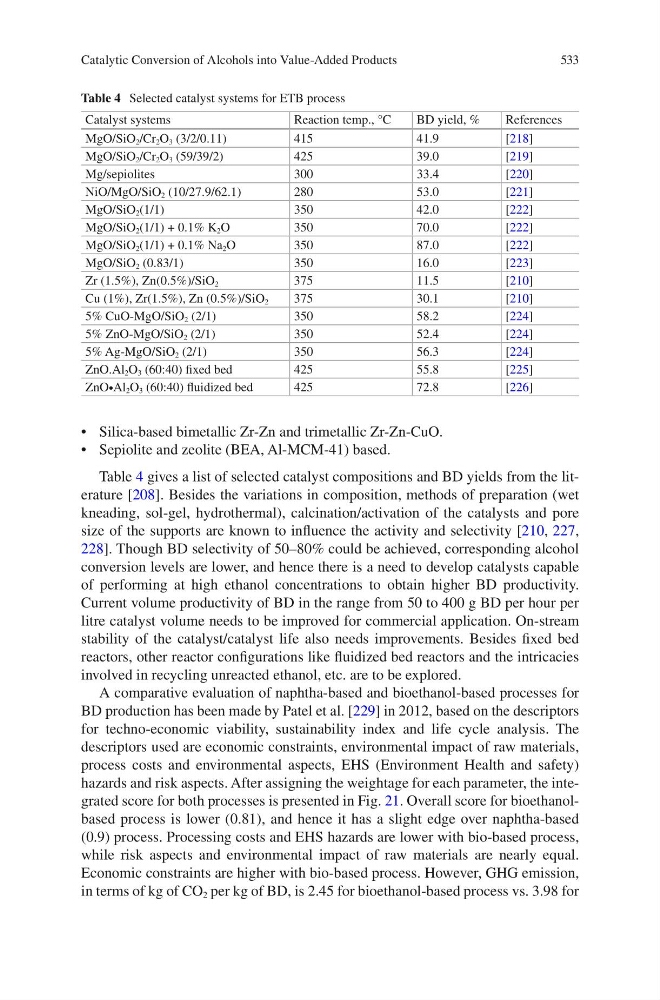
Table 4 gives a list of selected catalyst compositions and BD yields from the literature [208]. Besides the variations in composition, methods of preparation (wet
kneading, sol-gel, hydrothermal), calcination/activation of the catalysts and pore
size of the supports are known to influence the activity and selectivity [210, 227,
228]. Though BD selectivity of 50–80% could be achieved, corresponding alcohol
conversion levels are lower, and hence there is a need to develop catalysts capable
of performing at high ethanol concentrations to obtain higher BD productivity.
Current volume productivity of BD in the range from 50 to 400 g BD per hour per
litre catalyst volume needs to be improved for commercial application. On-stream
stability of the catalyst/catalyst life also needs improvements. Besides fixed bed
reactors, other reactor configurations like fluidized bed reactors and the intricacies
involved in recycling unreacted ethanol, etc. are to be explored.
A comparative evaluation of naphtha-based and bioethanol-based processes for
BD production has been made by Patel et al. [229] in 2012, based on the descriptors
for techno-economic viability, sustainability index and life cycle analysis. The
descriptors used are economic constraints, environmental impact of raw materials,
process costs and environmental aspects, EHS (Environment Health and safety)
hazards and risk aspects. After assigning the weightage for each parameter, the integrated score for both processes is presented in Fig. 21. Overall score for bioethanolbased process is lower (0.81), and hence it has a slight edge over naphtha-based
(0.9) process. Processing costs and EHS hazards are lower with bio-based process,
while risk aspects and environmental impact of raw materials are nearly equal.
Economic constraints are higher with bio-based process. However, GHG emission,
in terms of kg of CO 2 per kg of BD, is 2.45 for bioethanol-based process vs. 3.98 for
Table 4 Selected catalyst systems for ETB process
Catalyst systems
Reaction temp., °C
BD yield, %
References
MgO/SiO 2 /Cr 2 O 3 (3/2/0.11)
415
41.9
[218]
MgO/SiO 2 /Cr 2 O 3 (59/39/2)
425
39.0
[219]
Mg/sepiolites
300
33.4
[220]
NiO/MgO/SiO 2 (10/27.9/62.1)
280
53.0
[221]
MgO/SiO 2 (1/1)
350
42.0
[222]
MgO/SiO 2 (1/1) + 0.1% K 2 O
350
70.0
[222]
MgO/SiO 2 (1/1) + 0.1% Na 2 O
350
87.0
[222]
MgO/SiO 2 (0.83/1)
350
16.0
[223]
Zr (1.5%), Zn(0.5%)/SiO 2
375
11.5
[210]
Cu (1%), Zr(1.5%), Zn (0.5%)/SiO 2
375
30.1
[210]
5% CuO-MgO/SiO 2 (2/1)
350
58.2
[224]
5% ZnO-MgO/SiO 2 (2/1)
350
52.4
[224]
5% Ag-MgO/SiO 2 (2/1)
350
56.3
[224]
ZnO.Al 2 O 3 (60:40) fixed bed
425
55.8
[225]
ZnO∙Al 2 O 3 (60:40) fluidized bed
425
72.8
[226]
Catalytic Conversion of Alcohols into Value-Added Products