

526
provides the acid sites. Such high-temperature treatment ensures thermal stability of
the catalyst at temperatures up to 160 °C and pressures up to 40 bar. Besides the
reaction could be carried out in liquid phase in slurry mode—gas-solid-liquid – or
continuous-flow mode. Mesoporous character of the support leads to facile diffusion of the reactant and products resulting in lower deactivation and higher activity.
Besides the chemical nature and acidity, the texture and topology of the mesoporous
supports influence the oligomerization activity [174].
For example, Agirrezabal-Telleria and Iglesia [175] observed that Ni-MCM-41
is a very active and selective dimerization catalyst at sub-ambient temperature
(243–258 K) with 93% selectivity for 1-butene and TOF > 10 s
−1
with very little
deactivation. The high catalyst activity and stability as well as the C 4 selectivity
were attributed to the presence of the ethylene in liquid phase within MCM-41
channels.
Conversion of ethylene to propylene is an important process in petrochemical
industry considering the supply-demand gap for propylene. Several proven onpurpose processes like dehydrogenation of propane, methanol to olefins (MTO) and
methanol to propylene (MTP) are available for on-purpose propylene production.
Conversion of ethylene to propylene could be achieved through different processes:
1. Metathesis of ethylene and butenes.
2. Direct conversion of ethylene by dimerization and metathesis.
3. Direct conversion of ethylene by oligomerization and cracking.
Metathesis is based on supported Re, W and Mo catalysts, and the process technology is offered by ABB Lummus, BASF and Atofina, Mitsui Chemicals, BP Chemical
and Sinopec [176, 177].
Direct conversion of ethylene to propylene actually involves three steps, the first
being partial conversion of ethylene to1-butene by dimerization and then isomerization of 1-butene to 2-butene followed by metathesis of remaining ethylene with
2-butenes to yield propylene. Though two-stage processes and single-pot processes
have been attempted [165] a cascade process involving two different catalysts is
found to be promising (Fig. 17). Andrei and co-workers [178, 179] devised a
Si
Si
Si
Si
Si
1) exchange / NH 4
+
2) exchange / Ni 2+
3) 550 °C / air
AI
AI
AI
aluminosilicate support
Ni-exchanged catalyst
O
Na +
Na +
Na +
O
O
O
O
O
Si
Si
Si
Si
Si
AI
AI
AI
O
Ni G+
H +
Ni G+
O
O
O
O
O
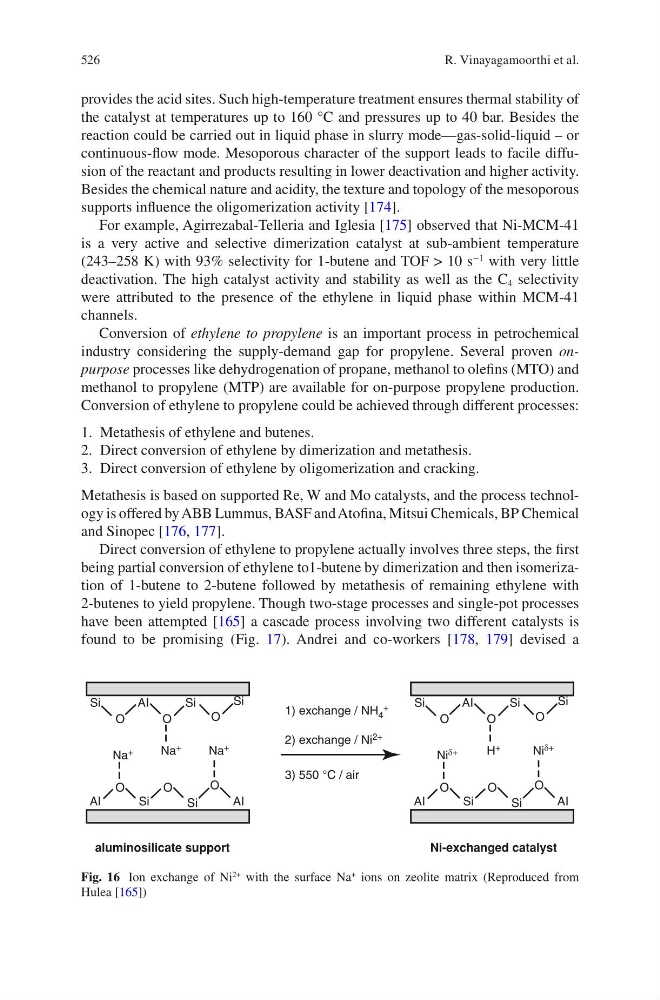
Fig. 16 Ion exchange of Ni
2+ with the surface Na
+ ions on zeolite matrix (Reproduced from
Hulea [165])
R. Vinayagamoorthi et al.