

527
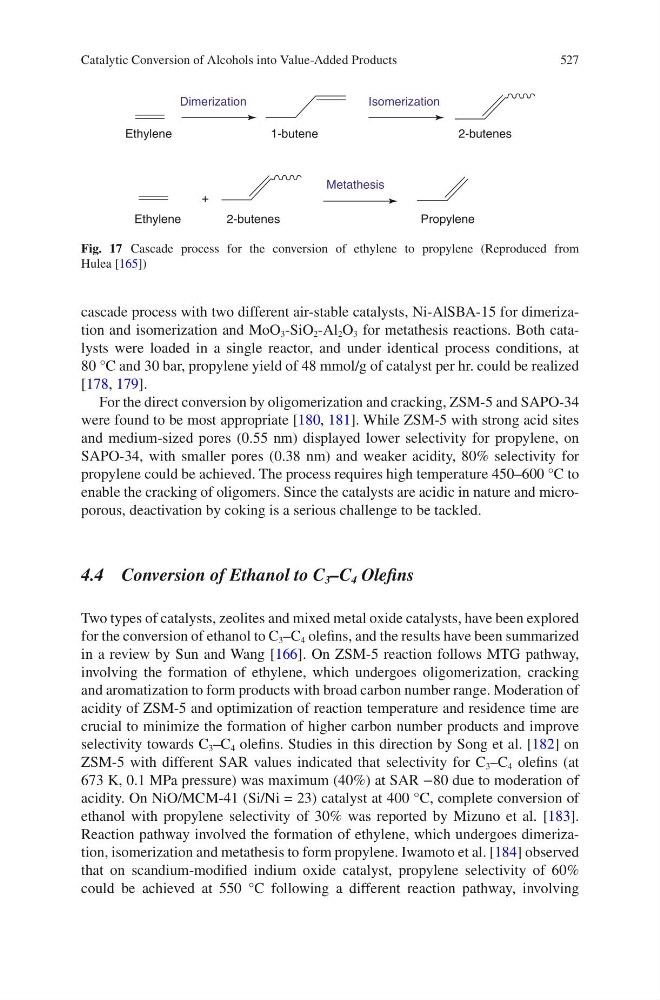
cascade process with two different air-stable catalysts, Ni-AlSBA-15 for dimerization and isomerization and MoO 3 -SiO 2 -Al 2 O 3 for metathesis reactions. Both catalysts were loaded in a single reactor, and under identical process conditions, at
80 °C and 30 bar, propylene yield of 48 mmol/g of catalyst per hr. could be realized
[178, 179].
For the direct conversion by oligomerization and cracking, ZSM-5 and SAPO-34
were found to be most appropriate [180, 181]. While ZSM-5 with strong acid sites
and medium-sized pores (0.55 nm) displayed lower selectivity for propylene, on
SAPO-34, with smaller pores (0.38 nm) and weaker acidity, 80% selectivity for
propylene could be achieved. The process requires high temperature 450–600 °C to
enable the cracking of oligomers. Since the catalysts are acidic in nature and microporous, deactivation by coking is a serious challenge to be tackled.
4.4 Conversion of Ethanol to C 3 –C 4 Olefins
Two types of catalysts, zeolites and mixed metal oxide catalysts, have been explored
for the conversion of ethanol to C 3 –C 4 olefins, and the results have been summarized
in a review by Sun and Wang [166]. On ZSM-5 reaction follows MTG pathway,
involving the formation of ethylene, which undergoes oligomerization, cracking
and aromatization to form products with broad carbon number range. Moderation of
acidity of ZSM-5 and optimization of reaction temperature and residence time are
crucial to minimize the formation of higher carbon number products and improve
selectivity towards C 3 –C 4 olefins. Studies in this direction by Song et al. [182] on
ZSM-5 with different SAR values indicated that selectivity for C 3 –C 4 olefins (at
673 K, 0.1 MPa pressure) was maximum (40%) at SAR −80 due to moderation of
acidity. On NiO/MCM-41 (Si/Ni = 23) catalyst at 400 °C, complete conversion of
ethanol with propylene selectivity of 30% was reported by Mizuno et al. [183].
Reaction pathway involved the formation of ethylene, which undergoes dimerization, isomerization and metathesis to form propylene. Iwamoto et al. [184] observed
that on scandium-modified indium oxide catalyst, propylene selectivity of 60%
could be achieved at 550 °C following a different reaction pathway, involving
Ethylene
Ethylene
1-butene
2-butenes
Propylene
Metathesis
Isomerization
Dimerization
2-butenes
+
Fig. 17 Cascade process for the conversion of ethylene to propylene (Reproduced from
Hulea [165])
Catalytic Conversion of Alcohols into Value-Added Products