

510
reported [36–40]. However, the maximum methanol concentration of 1.1 g/L makes
it unviable economically. Tyurin and Kiriukhin [41] could achieve more than 70 g/L
methanol from a 20% CO 2 /80% H 2 gas mixture in continuous fermentation using an
acetogenic Clostridium. The process could be a totally sustainable one, when CO 2
from any waste gas stream and renewable hydrogen from water via photovoltaicpowered electrolysis are used.
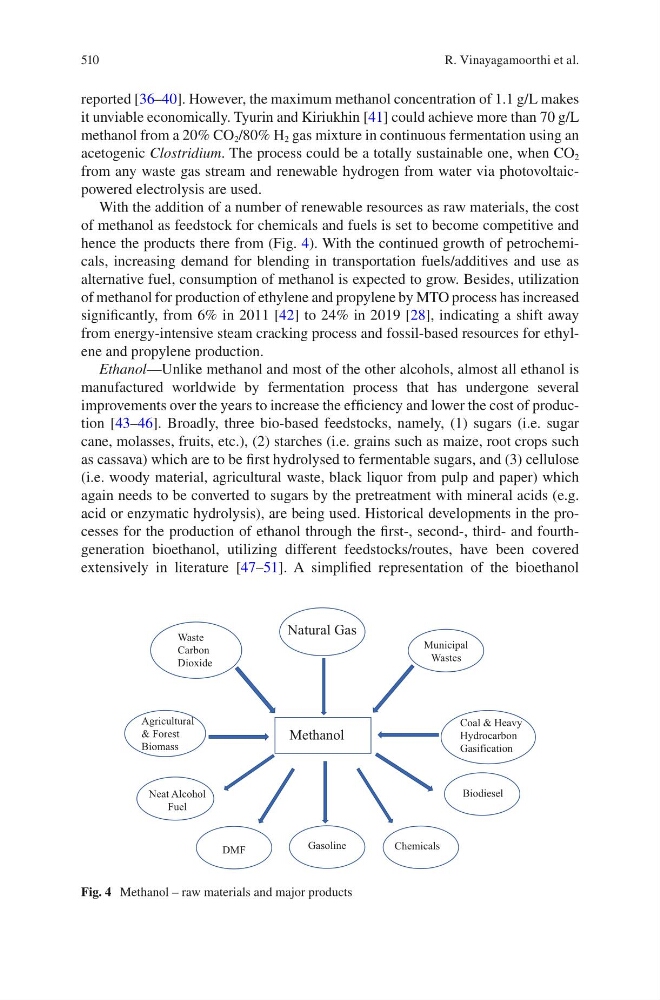
With the addition of a number of renewable resources as raw materials, the cost
of methanol as feedstock for chemicals and fuels is set to become competitive and
hence the products there from (Fig. 4). With the continued growth of petrochemicals, increasing demand for blending in transportation fuels/additives and use as
alternative fuel, consumption of methanol is expected to grow. Besides, utilization
of methanol for production of ethylene and propylene by MTO process has increased
significantly, from 6% in 2011 [42] to 24% in 2019 [28], indicating a shift away
from energy-intensive steam cracking process and fossil-based resources for ethylene and propylene production.
Ethanol—Unlike methanol and most of the other alcohols, almost all ethanol is
manufactured worldwide by fermentation process that has undergone several
improvements over the years to increase the efficiency and lower the cost of production [43–46]. Broadly, three bio-based feedstocks, namely, (1) sugars (i.e. sugar
cane, molasses, fruits, etc.), (2) starches (i.e. grains such as maize, root crops such
as cassava) which are to be first hydrolysed to fermentable sugars, and (3) cellulose
(i.e. woody material, agricultural waste, black liquor from pulp and paper) which
again needs to be converted to sugars by the pretreatment with mineral acids (e.g.
acid or enzymatic hydrolysis), are being used. Historical developments in the processes for the production of ethanol through the first-, second-, third- and fourthgeneration bioethanol, utilizing different feedstocks/routes, have been covered
extensively in literature [47–51]. A simplified representation of the bioethanol
Methanol
Natural Gas
Municipal
Wastes
Coal & Heavy
Hydrocarbon
Gasification
Waste
Carbon
Dioxide
Agricultural
& Forest
Biomass
Neat Alcohol
Fuel
DMF
Biodiesel
Chemicals
Gasoline
Fig. 4 Methanol – raw materials and major products
R. Vinayagamoorthi et al.