

511
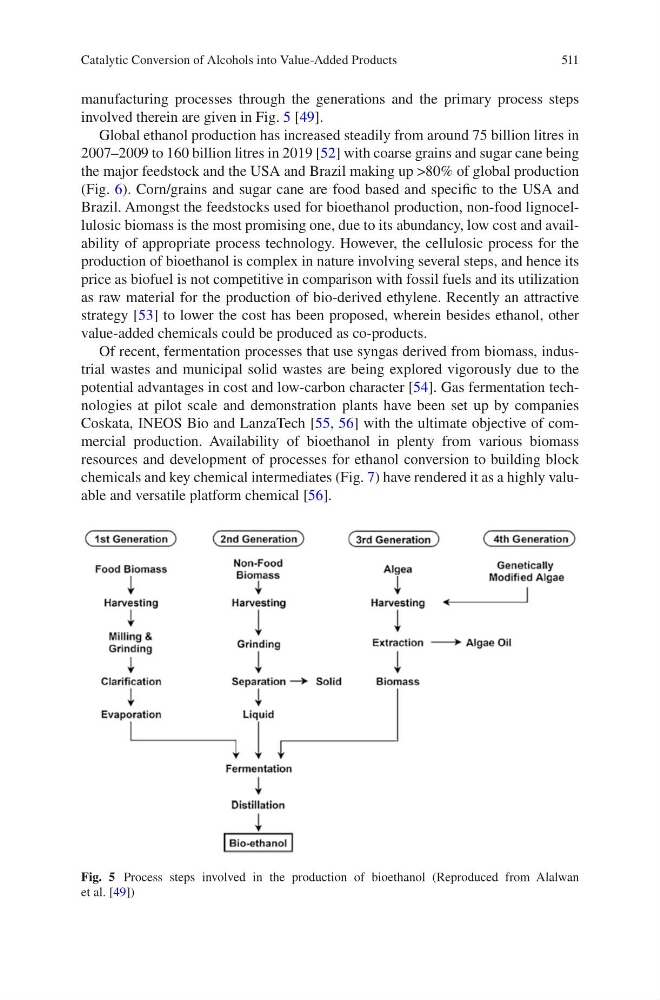
manufacturing processes through the generations and the primary process steps
involved therein are given in Fig. 5 [49].
Global ethanol production has increased steadily from around 75 billion litres in
2007–2009 to 160 billion litres in 2019 [52] with coarse grains and sugar cane being
the major feedstock and the USA and Brazil making up >80% of global production
(Fig. 6). Corn/grains and sugar cane are food based and specific to the USA and
Brazil. Amongst the feedstocks used for bioethanol production, non-food lignocellulosic biomass is the most promising one, due to its abundancy, low cost and availability of appropriate process technology. However, the cellulosic process for the
production of bioethanol is complex in nature involving several steps, and hence its
price as biofuel is not competitive in comparison with fossil fuels and its utilization
as raw material for the production of bio-derived ethylene. Recently an attractive
strategy [53] to lower the cost has been proposed, wherein besides ethanol, other
value-added chemicals could be produced as co-products.
Of recent, fermentation processes that use syngas derived from biomass, industrial wastes and municipal solid wastes are being explored vigorously due to the
potential advantages in cost and low-carbon character [54]. Gas fermentation technologies at pilot scale and demonstration plants have been set up by companies
Coskata, INEOS Bio and LanzaTech [55, 56] with the ultimate objective of commercial production. Availability of bioethanol in plenty from various biomass
resources and development of processes for ethanol conversion to building block
chemicals and key chemical intermediates (Fig. 7) have rendered it as a highly valuable and versatile platform chemical [56].
Fig. 5 Process steps involved in the production of bioethanol (Reproduced from Alalwan
et al. [49])
Catalytic Conversion of Alcohols into Value-Added Products