

489
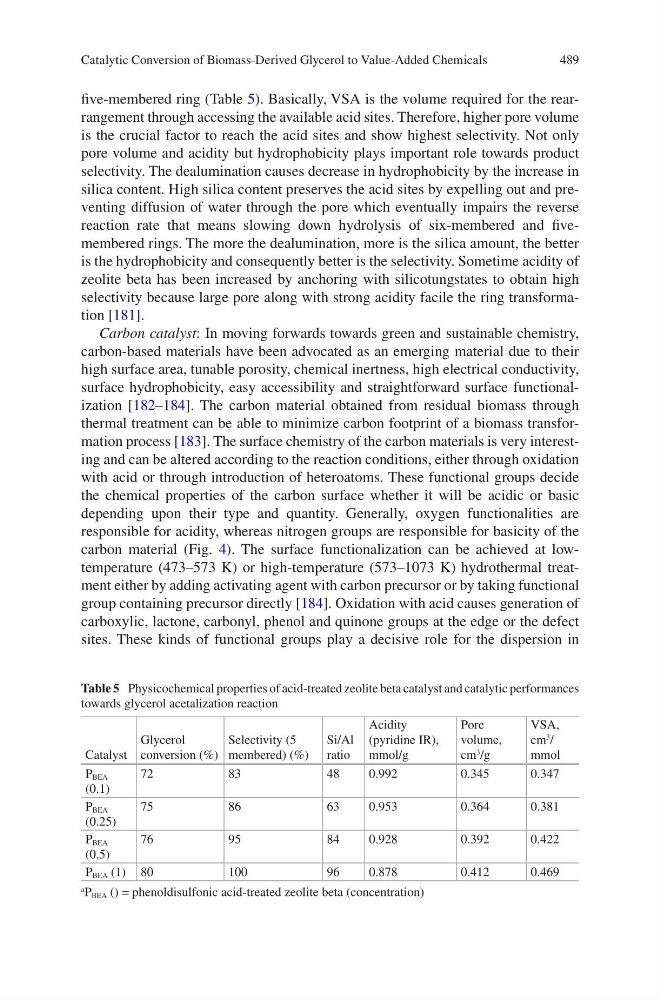
five-membered ring (Table 5). Basically, VSA is the volume required for the rearrangement through accessing the available acid sites. Therefore, higher pore volume
is the crucial factor to reach the acid sites and show highest selectivity. Not only
pore volume and acidity but hydrophobicity plays important role towards product
selectivity. The dealumination causes decrease in hydrophobicity by the increase in
silica content. High silica content preserves the acid sites by expelling out and preventing diffusion of water through the pore which eventually impairs the reverse
reaction rate that means slowing down hydrolysis of six-membered and fivemembered rings. The more the dealumination, more is the silica amount, the better
is the hydrophobicity and consequently better is the selectivity. Sometime acidity of
zeolite beta has been increased by anchoring with silicotungstates to obtain high
selectivity because large pore along with strong acidity facile the ring transformation [181].
Carbon catalyst: In moving forwards towards green and sustainable chemistry,
carbon-based materials have been advocated as an emerging material due to their
high surface area, tunable porosity, chemical inertness, high electrical conductivity,
surface hydrophobicity, easy accessibility and straightforward surface functionalization [182–184]. The carbon material obtained from residual biomass through
thermal treatment can be able to minimize carbon footprint of a biomass transformation process [183]. The surface chemistry of the carbon materials is very interesting and can be altered according to the reaction conditions, either through oxidation
with acid or through introduction of heteroatoms. These functional groups decide
the chemical properties of the carbon surface whether it will be acidic or basic
depending upon their type and quantity. Generally, oxygen functionalities are
responsible for acidity, whereas nitrogen groups are responsible for basicity of the
carbon material (Fig. 4). The surface functionalization can be achieved at lowtemperature (473–573 K) or high-temperature (573–1073 K) hydrothermal treatment either by adding activating agent with carbon precursor or by taking functional
group containing precursor directly [184]. Oxidation with acid causes generation of
carboxylic, lactone, carbonyl, phenol and quinone groups at the edge or the defect
sites. These kinds of functional groups play a decisive role for the dispersion in
Table 5 Physicochemical properties of acid-treated zeolite beta catalyst and catalytic performances
towards glycerol acetalization reaction
Catalyst
Glycerol
conversion (%)
Selectivity (5
membered) (%)
Si/Al
ratio
Acidity
(pyridine IR),
mmol/g
Pore
volume,
cm
3 /g
VSA,
cm
3
/
mmol
P BEA
(0.1)
72
83
48
0.992
0.345
0.347
P BEA
(0.25)
75
86
63
0.953
0.364
0.381
P BEA
(0.5)
76
95
84
0.928
0.392
0.422
P BEA (1) 80
100
96
0.878
0.412
0.469
a P BEA () = phenoldisulfonic acid-treated zeolite beta (concentration)
Catalytic Conversion of Biomass-Derived Glycerol to Value-Added Chemicals
five-membered ring (Table 5). Basically, VSA is the volume required for the rearrangement through accessing the available acid sites. Therefore, higher pore volume
is the crucial factor to reach the acid sites and show highest selectivity. Not only
pore volume and acidity but hydrophobicity plays important role towards product
selectivity. The dealumination causes decrease in hydrophobicity by the increase in
silica content. High silica content preserves the acid sites by expelling out and preventing diffusion of water through the pore which eventually impairs the reverse
reaction rate that means slowing down hydrolysis of six-membered and fivemembered rings. The more the dealumination, more is the silica amount, the better
is the hydrophobicity and consequently better is the selectivity. Sometime acidity of
zeolite beta has been increased by anchoring with silicotungstates to obtain high
selectivity because large pore along with strong acidity facile the ring transformation [181].
Carbon catalyst: In moving forwards towards green and sustainable chemistry,
carbon-based materials have been advocated as an emerging material due to their
high surface area, tunable porosity, chemical inertness, high electrical conductivity,
surface hydrophobicity, easy accessibility and straightforward surface functionalization [182–184]. The carbon material obtained from residual biomass through
thermal treatment can be able to minimize carbon footprint of a biomass transformation process [183]. The surface chemistry of the carbon materials is very interesting and can be altered according to the reaction conditions, either through oxidation
with acid or through introduction of heteroatoms. These functional groups decide
the chemical properties of the carbon surface whether it will be acidic or basic
depending upon their type and quantity. Generally, oxygen functionalities are
responsible for acidity, whereas nitrogen groups are responsible for basicity of the
carbon material (Fig. 4). The surface functionalization can be achieved at lowtemperature (473–573 K) or high-temperature (573–1073 K) hydrothermal treatment either by adding activating agent with carbon precursor or by taking functional
group containing precursor directly [184]. Oxidation with acid causes generation of
carboxylic, lactone, carbonyl, phenol and quinone groups at the edge or the defect
sites. These kinds of functional groups play a decisive role for the dispersion in
Table 5 Physicochemical properties of acid-treated zeolite beta catalyst and catalytic performances
towards glycerol acetalization reaction
Catalyst
Glycerol
conversion (%)
Selectivity (5
membered) (%)
Si/Al
ratio
Acidity
(pyridine IR),
mmol/g
Pore
volume,
cm
3 /g
VSA,
cm
3
/
mmol
P BEA
(0.1)
72
83
48
0.992
0.345
0.347
P BEA
(0.25)
75
86
63
0.953
0.364
0.381
P BEA
(0.5)
76
95
84
0.928
0.392
0.422
P BEA (1) 80
100
96
0.878
0.412
0.469
a P BEA () = phenoldisulfonic acid-treated zeolite beta (concentration)
Catalytic Conversion of Biomass-Derived Glycerol to Value-Added Chemicals