

490
polar solvent but show a negative impact for catalytic biomass transformation process where water is formed as a co-product.
Generally, oxidation can be done by fuming H 2 SO 4 or HNO 3 to prepare highly
acid carbon material [184, 186]. Using of H 2 SO 4 causes incorporation of −SO 3 H
groups along with generation of oxygen functionalities on the surface. These types
of materials are ideal for glycerol acetalization reaction as they possess predominantly Brønsted acid sites with excellent Hammett acid strength (H 0 ) in the range of
−8 < H0 ≤ −11 [186]. However, HNO 3 treatment generates a large number of oxygen functionalities as it is a stronger oxidizing agent than H 2 SO 4 , but sometimes
pyrrole-pyridine nitrogen groups are also generated inside the carbon matrix which
are not expected as catalytic sites for glycerol acetalization reaction. There are
mainly two factors responsible for glycerol acetalization reaction over carbon-based
solid acid catalyst. First factor is acidity of the carbon catalyst where acetalization
is done over untreated carbon, H 2 SO 4 -treated carbon and HNO 3 -treated carbon catalyst. It has been observed that the untreated carbon catalyst displayed poor glycerol
conversion than H 2 SO 4 - and HNO 3 -treated carbon catalyst as it exhibits lower
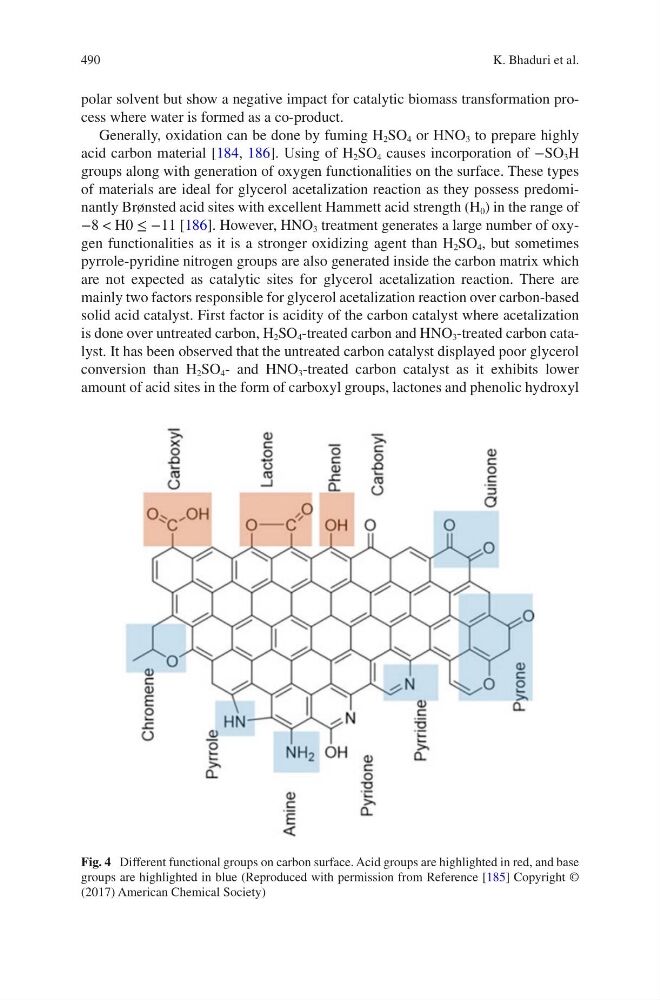
amount of acid sites in the form of carboxyl groups, lactones and phenolic hydroxyl
Fig. 4 Different functional groups on carbon surface. Acid groups are highlighted in red, and base
groups are highlighted in blue (Reproduced with permission from Reference [185] Copyright ©
(2017) American Chemical Society)
K. Bhaduri et al.
polar solvent but show a negative impact for catalytic biomass transformation process where water is formed as a co-product.
Generally, oxidation can be done by fuming H 2 SO 4 or HNO 3 to prepare highly
acid carbon material [184, 186]. Using of H 2 SO 4 causes incorporation of −SO 3 H
groups along with generation of oxygen functionalities on the surface. These types
of materials are ideal for glycerol acetalization reaction as they possess predominantly Brønsted acid sites with excellent Hammett acid strength (H 0 ) in the range of
−8 < H0 ≤ −11 [186]. However, HNO 3 treatment generates a large number of oxygen functionalities as it is a stronger oxidizing agent than H 2 SO 4 , but sometimes
pyrrole-pyridine nitrogen groups are also generated inside the carbon matrix which
are not expected as catalytic sites for glycerol acetalization reaction. There are
mainly two factors responsible for glycerol acetalization reaction over carbon-based
solid acid catalyst. First factor is acidity of the carbon catalyst where acetalization
is done over untreated carbon, H 2 SO 4 -treated carbon and HNO 3 -treated carbon catalyst. It has been observed that the untreated carbon catalyst displayed poor glycerol
conversion than H 2 SO 4 - and HNO 3 -treated carbon catalyst as it exhibits lower
amount of acid sites in the form of carboxyl groups, lactones and phenolic hydroxyl
Fig. 4 Different functional groups on carbon surface. Acid groups are highlighted in red, and base
groups are highlighted in blue (Reproduced with permission from Reference [185] Copyright ©
(2017) American Chemical Society)
K. Bhaduri et al.