

466
investigated the three efficient catalysts, Mo-V catalyst, Mo-Co oxide catalyst and
V-W system for conversion of acrolein to form acrylic acid [33]. It is revealed that
the efficient catalyst must have the presence of ions with amphoteric features such
as Mo
4+
and V
4+
and the existence of Mo
6+
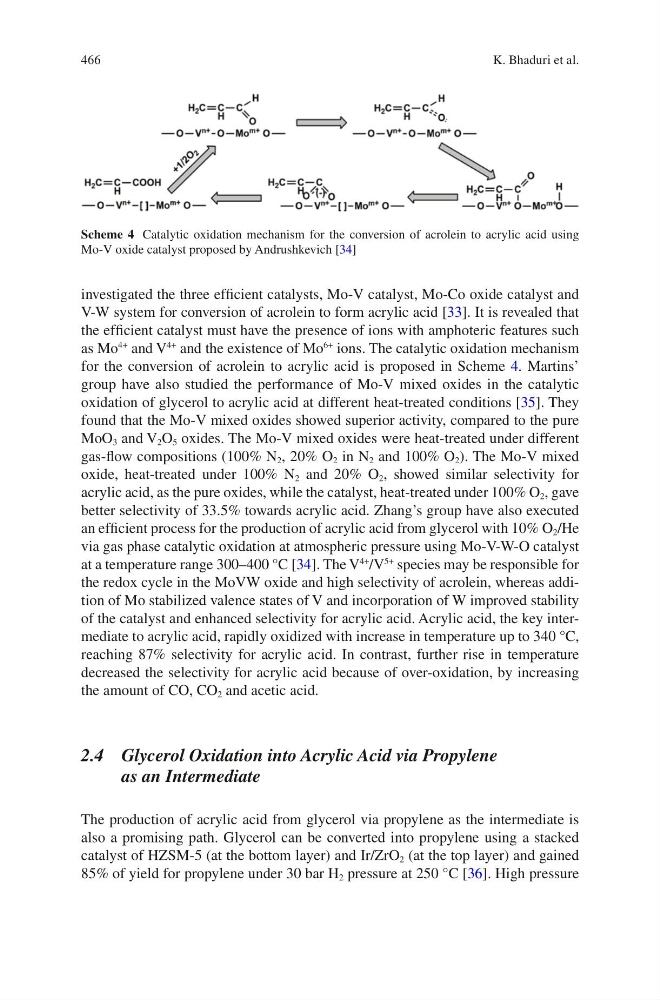
ions. The catalytic oxidation mechanism
for the conversion of acrolein to acrylic acid is proposed in Scheme 4. Martins’
group have also studied the performance of Mo-V mixed oxides in the catalytic
oxidation of glycerol to acrylic acid at different heat-treated conditions [35]. They
found that the Mo-V mixed oxides showed superior activity, compared to the pure
MoO 3 and V 2 O 5 oxides. The Mo-V mixed oxides were heat-treated under different
gas-flow compositions (100% N 2 , 20% O 2 in N 2 and 100% O 2 ). The Mo-V mixed
oxide, heat-treated under 100% N 2 and 20% O 2 , showed similar selectivity for
acrylic acid, as the pure oxides, while the catalyst, heat-treated under 100% O 2 , gave
better selectivity of 33.5% towards acrylic acid. Zhang’s group have also executed
an efficient process for the production of acrylic acid from glycerol with 10% O 2 /He
via gas phase catalytic oxidation at atmospheric pressure using Mo-V-W-O catalyst
at a temperature range 300–400 °C [34]. The V
4+
/V
5+
species may be responsible for
the redox cycle in the MoVW oxide and high selectivity of acrolein, whereas addition of Mo stabilized valence states of V and incorporation of W improved stability
of the catalyst and enhanced selectivity for acrylic acid. Acrylic acid, the key intermediate to acrylic acid, rapidly oxidized with increase in temperature up to 340 °C,
reaching 87% selectivity for acrylic acid. In contrast, further rise in temperature
decreased the selectivity for acrylic acid because of over-oxidation, by increasing
the amount of CO, CO 2 and acetic acid.
2.4 Glycerol Oxidation into Acrylic Acid via Propylene
as an Intermediate
The production of acrylic acid from glycerol via propylene as the intermediate is
also a promising path. Glycerol can be converted into propylene using a stacked
catalyst of HZSM-5 (at the bottom layer) and Ir/ZrO 2 (at the top layer) and gained
85% of yield for propylene under 30 bar H 2 pressure at 250 °C [36]. High pressure
Scheme 4 Catalytic oxidation mechanism for the conversion of acrolein to acrylic acid using
Mo-V oxide catalyst proposed by Andrushkevich [34]
K. Bhaduri et al.
investigated the three efficient catalysts, Mo-V catalyst, Mo-Co oxide catalyst and
V-W system for conversion of acrolein to form acrylic acid [33]. It is revealed that
the efficient catalyst must have the presence of ions with amphoteric features such
as Mo
4+
and V
4+
and the existence of Mo
6+
ions. The catalytic oxidation mechanism
for the conversion of acrolein to acrylic acid is proposed in Scheme 4. Martins’
group have also studied the performance of Mo-V mixed oxides in the catalytic
oxidation of glycerol to acrylic acid at different heat-treated conditions [35]. They
found that the Mo-V mixed oxides showed superior activity, compared to the pure
MoO 3 and V 2 O 5 oxides. The Mo-V mixed oxides were heat-treated under different
gas-flow compositions (100% N 2 , 20% O 2 in N 2 and 100% O 2 ). The Mo-V mixed
oxide, heat-treated under 100% N 2 and 20% O 2 , showed similar selectivity for
acrylic acid, as the pure oxides, while the catalyst, heat-treated under 100% O 2 , gave
better selectivity of 33.5% towards acrylic acid. Zhang’s group have also executed
an efficient process for the production of acrylic acid from glycerol with 10% O 2 /He
via gas phase catalytic oxidation at atmospheric pressure using Mo-V-W-O catalyst
at a temperature range 300–400 °C [34]. The V
4+
/V
5+
species may be responsible for
the redox cycle in the MoVW oxide and high selectivity of acrolein, whereas addition of Mo stabilized valence states of V and incorporation of W improved stability
of the catalyst and enhanced selectivity for acrylic acid. Acrylic acid, the key intermediate to acrylic acid, rapidly oxidized with increase in temperature up to 340 °C,
reaching 87% selectivity for acrylic acid. In contrast, further rise in temperature
decreased the selectivity for acrylic acid because of over-oxidation, by increasing
the amount of CO, CO 2 and acetic acid.
2.4 Glycerol Oxidation into Acrylic Acid via Propylene
as an Intermediate
The production of acrylic acid from glycerol via propylene as the intermediate is
also a promising path. Glycerol can be converted into propylene using a stacked
catalyst of HZSM-5 (at the bottom layer) and Ir/ZrO 2 (at the top layer) and gained
85% of yield for propylene under 30 bar H 2 pressure at 250 °C [36]. High pressure
Scheme 4 Catalytic oxidation mechanism for the conversion of acrolein to acrylic acid using
Mo-V oxide catalyst proposed by Andrushkevich [34]
K. Bhaduri et al.