

465
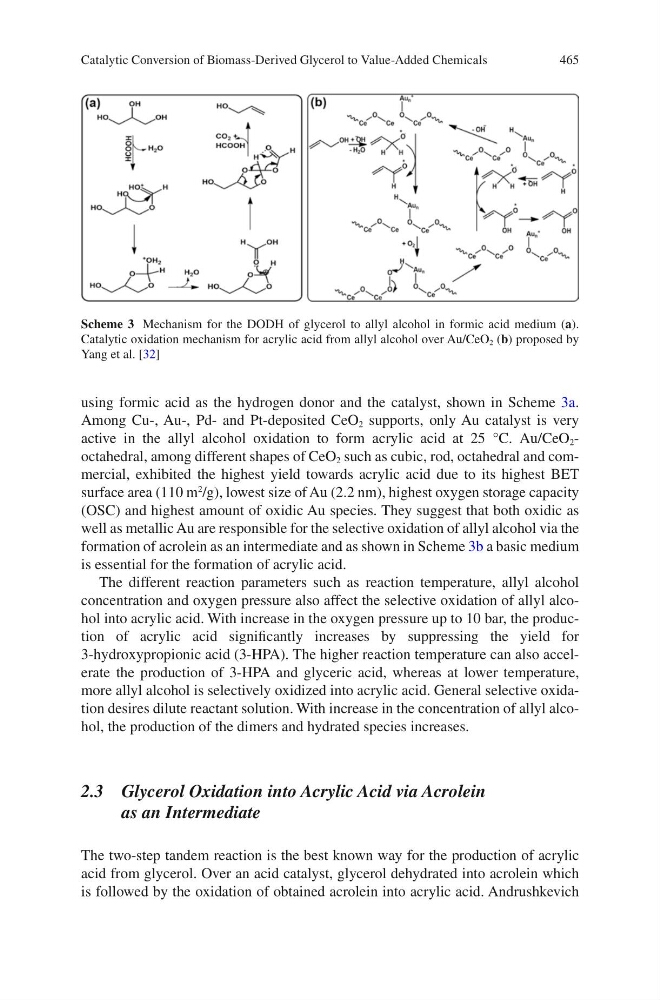
using formic acid as the hydrogen donor and the catalyst, shown in Scheme 3a.
Among Cu-, Au-, Pd- and Pt-deposited CeO 2 supports, only Au catalyst is very
active in the allyl alcohol oxidation to form acrylic acid at 25 °C. Au/CeO 2 -
octahedral, among different shapes of CeO 2 such as cubic, rod, octahedral and commercial, exhibited the highest yield towards acrylic acid due to its highest BET
surface area (110 m
2
/g), lowest size of Au (2.2 nm), highest oxygen storage capacity
(OSC) and highest amount of oxidic Au species. They suggest that both oxidic as
well as metallic Au are responsible for the selective oxidation of allyl alcohol via the
formation of acrolein as an intermediate and as shown in Scheme 3b a basic medium
is essential for the formation of acrylic acid.
The different reaction parameters such as reaction temperature, allyl alcohol
concentration and oxygen pressure also affect the selective oxidation of allyl alcohol into acrylic acid. With increase in the oxygen pressure up to 10 bar, the production of acrylic acid significantly increases by suppressing the yield for
3-hydroxypropionic acid (3-HPA). The higher reaction temperature can also accelerate the production of 3-HPA and glyceric acid, whereas at lower temperature,
more allyl alcohol is selectively oxidized into acrylic acid. General selective oxidation desires dilute reactant solution. With increase in the concentration of allyl alcohol, the production of the dimers and hydrated species increases.
2.3 Glycerol Oxidation into Acrylic Acid via Acrolein
as an Intermediate
The two-step tandem reaction is the best known way for the production of acrylic
acid from glycerol. Over an acid catalyst, glycerol dehydrated into acrolein which
is followed by the oxidation of obtained acrolein into acrylic acid. Andrushkevich
Scheme 3 Mechanism for the DODH of glycerol to allyl alcohol in formic acid medium (a).
Catalytic oxidation mechanism for acrylic acid from allyl alcohol over Au/CeO 2 (b) proposed by
Yang et al. [32]
Catalytic Conversion of Biomass-Derived Glycerol to Value-Added Chemicals
using formic acid as the hydrogen donor and the catalyst, shown in Scheme 3a.
Among Cu-, Au-, Pd- and Pt-deposited CeO 2 supports, only Au catalyst is very
active in the allyl alcohol oxidation to form acrylic acid at 25 °C. Au/CeO 2 -
octahedral, among different shapes of CeO 2 such as cubic, rod, octahedral and commercial, exhibited the highest yield towards acrylic acid due to its highest BET
surface area (110 m
2
/g), lowest size of Au (2.2 nm), highest oxygen storage capacity
(OSC) and highest amount of oxidic Au species. They suggest that both oxidic as
well as metallic Au are responsible for the selective oxidation of allyl alcohol via the
formation of acrolein as an intermediate and as shown in Scheme 3b a basic medium
is essential for the formation of acrylic acid.
The different reaction parameters such as reaction temperature, allyl alcohol
concentration and oxygen pressure also affect the selective oxidation of allyl alcohol into acrylic acid. With increase in the oxygen pressure up to 10 bar, the production of acrylic acid significantly increases by suppressing the yield for
3-hydroxypropionic acid (3-HPA). The higher reaction temperature can also accelerate the production of 3-HPA and glyceric acid, whereas at lower temperature,
more allyl alcohol is selectively oxidized into acrylic acid. General selective oxidation desires dilute reactant solution. With increase in the concentration of allyl alcohol, the production of the dimers and hydrated species increases.
2.3 Glycerol Oxidation into Acrylic Acid via Acrolein
as an Intermediate
The two-step tandem reaction is the best known way for the production of acrylic
acid from glycerol. Over an acid catalyst, glycerol dehydrated into acrolein which
is followed by the oxidation of obtained acrolein into acrylic acid. Andrushkevich
Scheme 3 Mechanism for the DODH of glycerol to allyl alcohol in formic acid medium (a).
Catalytic oxidation mechanism for acrylic acid from allyl alcohol over Au/CeO 2 (b) proposed by
Yang et al. [32]
Catalytic Conversion of Biomass-Derived Glycerol to Value-Added Chemicals