

437
5 Heteropoly Acid Catalysts
Heteropoly acids (HPAs) also called polyoxometalate compounds are known as
acid and oxidation catalysts [23, 24]. HPAs have more benefits as these catalysts are
economically and environmentally desirable. These are strong Bronsted acid catalysts with acidity close to superacid region. They are competent oxidants with
reversible multi-electron redox transformations under trivial conditions. These are
progressively becoming important in applied catalysis. Explorative work has been
made by Japanese and Russian research groups since the 1970s [25, 26]. In the last
two decades, the expansive usage of HPAs in catalysis has been established in a
wide range of synthetically attractive organic transformations of different substances [27].
5.1 Classification of Heteropoly Acids
Heteropoly compounds, including their salts, are composed of heteropoly anions
and counter ions, e.g. protons or metal cations. A heteropoly anion contains metal
(e.g. tungsten, molybdenum or vanadium) atoms that are termed as addenda atoms,
oxygen atoms and an element from the p-block of periodic table, generally like silicon, phosphorus or arsenic (heteroatom) as central atom. Heteropoly compounds
have many types such as Keggin, Dowson and Anderson based on their structure
and different amount of hetero and addenda atoms. The Keggin-type ones are widely
used in catalysis, due to their moderate thermal stability, strong acidity and high
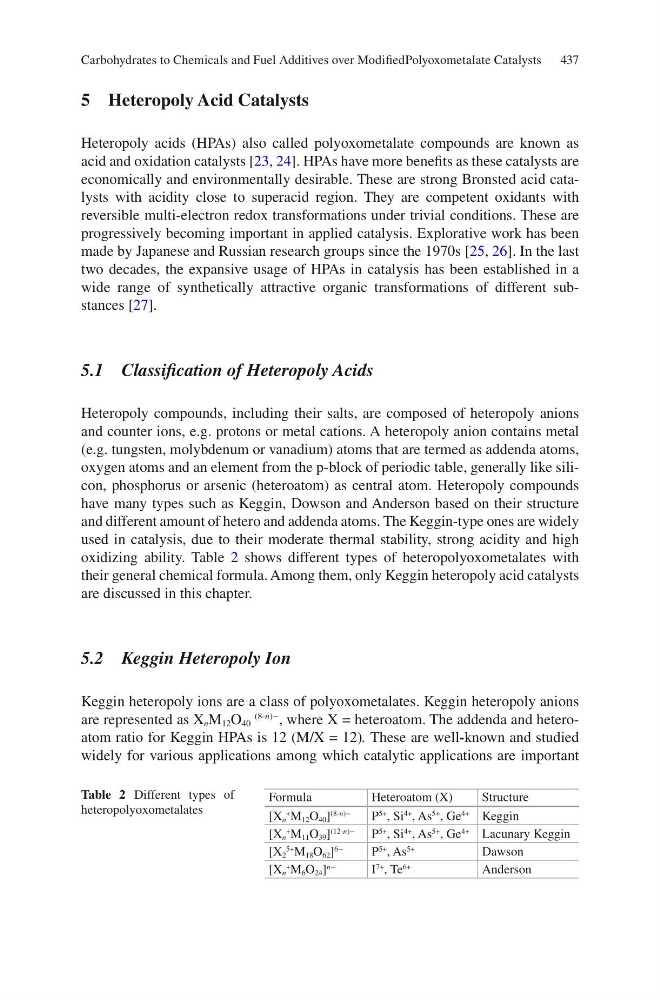
oxidizing ability. Table 2 shows different types of heteropolyoxometalates with
their general chemical formula. Among them, only Keggin heteropoly acid catalysts
are discussed in this chapter.
5.2 Keggin Heteropoly Ion
Keggin heteropoly ions are a class of polyoxometalates. Keggin heteropoly anions
are represented as X n M 12 O 40
(8-n)−
, where X = heteroatom. The addenda and heteroatom ratio for Keggin HPAs is 12 (M/X = 12). These are well-known and studied
widely for various applications among which catalytic applications are important
Table 2 Different types of
heteropolyoxometalates
Formula
Heteroatom (X)
Structure
[X n
+
M 12 O 40 ]
(8-n)−
P
5+ , Si
4+
, As
5+ , Ge
4+
Keggin
[X n
+
M 11 O 39 ]
(12-n)−
P
5+
, Si
4+
, As
5+
, Ge
4+
Lacunary Keggin
[X 2
5+
M 18 O 62 ]
6−
P
5+
, As
5+
Dawson
[X n
+ M 6 O 24 ]
n−
I
7+ , Te
6+
Anderson
Carbohydrates to Chemicals and Fuel Additives over ModifiedPolyoxometalate Catalysts
5 Heteropoly Acid Catalysts
Heteropoly acids (HPAs) also called polyoxometalate compounds are known as
acid and oxidation catalysts [23, 24]. HPAs have more benefits as these catalysts are
economically and environmentally desirable. These are strong Bronsted acid catalysts with acidity close to superacid region. They are competent oxidants with
reversible multi-electron redox transformations under trivial conditions. These are
progressively becoming important in applied catalysis. Explorative work has been
made by Japanese and Russian research groups since the 1970s [25, 26]. In the last
two decades, the expansive usage of HPAs in catalysis has been established in a
wide range of synthetically attractive organic transformations of different substances [27].
5.1 Classification of Heteropoly Acids
Heteropoly compounds, including their salts, are composed of heteropoly anions
and counter ions, e.g. protons or metal cations. A heteropoly anion contains metal
(e.g. tungsten, molybdenum or vanadium) atoms that are termed as addenda atoms,
oxygen atoms and an element from the p-block of periodic table, generally like silicon, phosphorus or arsenic (heteroatom) as central atom. Heteropoly compounds
have many types such as Keggin, Dowson and Anderson based on their structure
and different amount of hetero and addenda atoms. The Keggin-type ones are widely
used in catalysis, due to their moderate thermal stability, strong acidity and high
oxidizing ability. Table 2 shows different types of heteropolyoxometalates with
their general chemical formula. Among them, only Keggin heteropoly acid catalysts
are discussed in this chapter.
5.2 Keggin Heteropoly Ion
Keggin heteropoly ions are a class of polyoxometalates. Keggin heteropoly anions
are represented as X n M 12 O 40
(8-n)−
, where X = heteroatom. The addenda and heteroatom ratio for Keggin HPAs is 12 (M/X = 12). These are well-known and studied
widely for various applications among which catalytic applications are important
Table 2 Different types of
heteropolyoxometalates
Formula
Heteroatom (X)
Structure
[X n
+
M 12 O 40 ]
(8-n)−
P
5+ , Si
4+
, As
5+ , Ge
4+
Keggin
[X n
+
M 11 O 39 ]
(12-n)−
P
5+
, Si
4+
, As
5+
, Ge
4+
Lacunary Keggin
[X 2
5+
M 18 O 62 ]
6−
P
5+
, As
5+
Dawson
[X n
+ M 6 O 24 ]
n−
I
7+ , Te
6+
Anderson
Carbohydrates to Chemicals and Fuel Additives over ModifiedPolyoxometalate Catalysts