

438
due to their moderately high thermal stability and redox and acidic properties. The
heteroatom X is mostly either P
5+
or Si
4+
, and many other metals have been reported
to act as heteroatom, and M is usually W
6+
or Mo
6+
.
5.3 Structure of Keggin Heteropoly Acids
The first heteropoly anion [PMo 12 O 40 ]
3−
was reported in 1826 by Berzelius. Several
conjectures were created on the structure of HPAs, particularly by Alfred Werner
followed by Linus Pauling. A century later in 1933, J.F. Keggin from the University
of Manchester did powder X-ray diffraction studies on 12-tungstophosphoric acid
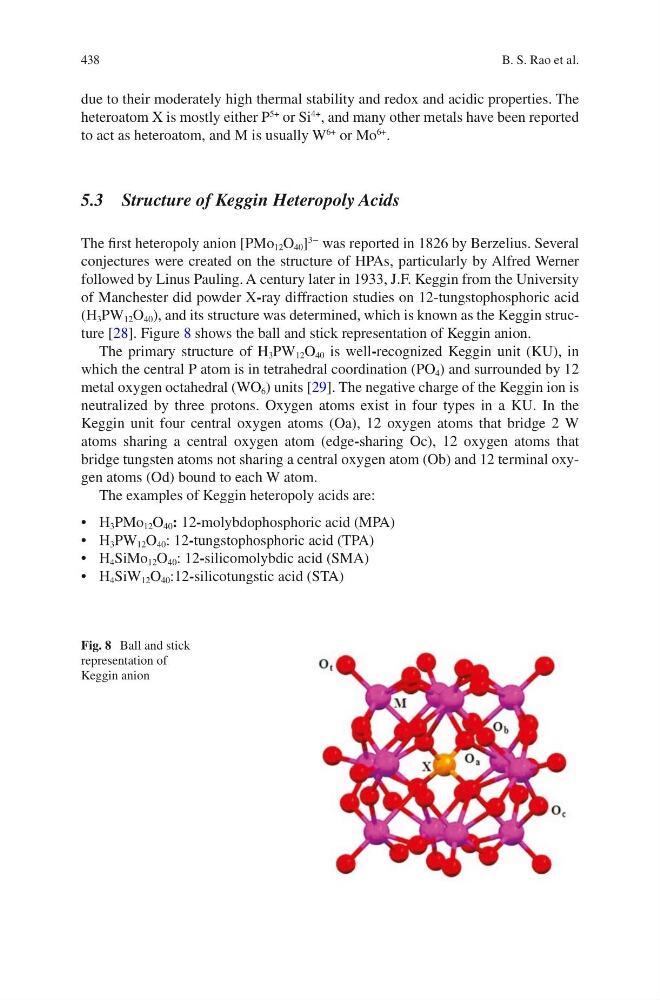
(H 3 PW 12 O 40 ), and its structure was determined, which is known as the Keggin structure [28]. Figure 8 shows the ball and stick representation of Keggin anion.
The primary structure of H 3 PW 12 O 40 is well-recognized Keggin unit (KU), in
which the central P atom is in tetrahedral coordination (PO 4 ) and surrounded by 12
metal oxygen octahedral (WO 6 ) units [29]. The negative charge of the Keggin ion is
neutralized by three protons. Oxygen atoms exist in four types in a KU. In the
Keggin unit four central oxygen atoms (Oa), 12 oxygen atoms that bridge 2 W
atoms sharing a central oxygen atom (edge-sharing Oc), 12 oxygen atoms that
bridge tungsten atoms not sharing a central oxygen atom (Ob) and 12 terminal oxygen atoms (Od) bound to each W atom.
The examples of Keggin heteropoly acids are:
• H 3 PMo 12 O 40 : 12-molybdophosphoric acid (MPA)
• H 3 PW 12 O 40 : 12-tungstophosphoric acid (TPA)
• H 4 SiMo 12 O 40 : 12-silicomolybdic acid (SMA)
• H 4 SiW 12 O 40 :12-silicotungstic acid (STA)
Fig. 8 Ball and stick
representation of
Keggin anion
B. S. Rao et al.
due to their moderately high thermal stability and redox and acidic properties. The
heteroatom X is mostly either P
5+
or Si
4+
, and many other metals have been reported
to act as heteroatom, and M is usually W
6+
or Mo
6+
.
5.3 Structure of Keggin Heteropoly Acids
The first heteropoly anion [PMo 12 O 40 ]
3−
was reported in 1826 by Berzelius. Several
conjectures were created on the structure of HPAs, particularly by Alfred Werner
followed by Linus Pauling. A century later in 1933, J.F. Keggin from the University
of Manchester did powder X-ray diffraction studies on 12-tungstophosphoric acid
(H 3 PW 12 O 40 ), and its structure was determined, which is known as the Keggin structure [28]. Figure 8 shows the ball and stick representation of Keggin anion.
The primary structure of H 3 PW 12 O 40 is well-recognized Keggin unit (KU), in
which the central P atom is in tetrahedral coordination (PO 4 ) and surrounded by 12
metal oxygen octahedral (WO 6 ) units [29]. The negative charge of the Keggin ion is
neutralized by three protons. Oxygen atoms exist in four types in a KU. In the
Keggin unit four central oxygen atoms (Oa), 12 oxygen atoms that bridge 2 W
atoms sharing a central oxygen atom (edge-sharing Oc), 12 oxygen atoms that
bridge tungsten atoms not sharing a central oxygen atom (Ob) and 12 terminal oxygen atoms (Od) bound to each W atom.
The examples of Keggin heteropoly acids are:
• H 3 PMo 12 O 40 : 12-molybdophosphoric acid (MPA)
• H 3 PW 12 O 40 : 12-tungstophosphoric acid (TPA)
• H 4 SiMo 12 O 40 : 12-silicomolybdic acid (SMA)
• H 4 SiW 12 O 40 :12-silicotungstic acid (STA)
Fig. 8 Ball and stick
representation of
Keggin anion
B. S. Rao et al.