

434
Hemicellulose is a heteropolymer of pentoses (xylose and arabinose) and hexoses
(glucose, galactose and mannose) and sugar acids (acetic). The structural forms of
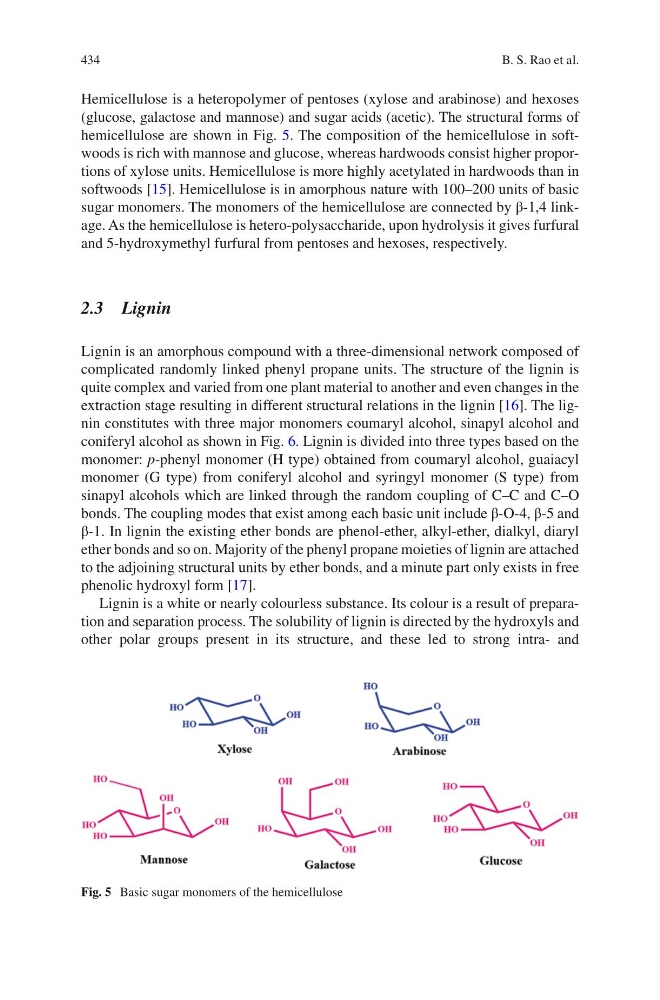
hemicellulose are shown in Fig. 5. The composition of the hemicellulose in softwoods is rich with mannose and glucose, whereas hardwoods consist higher proportions of xylose units. Hemicellulose is more highly acetylated in hardwoods than in
softwoods [15]. Hemicellulose is in amorphous nature with 100–200 units of basic
sugar monomers. The monomers of the hemicellulose are connected by β-1,4 linkage. As the hemicellulose is hetero-polysaccharide, upon hydrolysis it gives furfural
and 5-hydroxymethyl furfural from pentoses and hexoses, respectively.
2.3 Lignin
Lignin is an amorphous compound with a three-dimensional network composed of
complicated randomly linked phenyl propane units. The structure of the lignin is
quite complex and varied from one plant material to another and even changes in the
extraction stage resulting in different structural relations in the lignin [16]. The lignin constitutes with three major monomers coumaryl alcohol, sinapyl alcohol and
coniferyl alcohol as shown in Fig. 6. Lignin is divided into three types based on the
monomer: p-phenyl monomer (H type) obtained from coumaryl alcohol, guaiacyl
monomer (G type) from coniferyl alcohol and syringyl monomer (S type) from
sinapyl alcohols which are linked through the random coupling of C–C and C–O
bonds. The coupling modes that exist among each basic unit include β-O-4, β-5 and
β-1. In lignin the existing ether bonds are phenol-ether, alkyl-ether, dialkyl, diaryl
ether bonds and so on. Majority of the phenyl propane moieties of lignin are attached
to the adjoining structural units by ether bonds, and a minute part only exists in free
phenolic hydroxyl form [17].
Lignin is a white or nearly colourless substance. Its colour is a result of preparation and separation process. The solubility of lignin is directed by the hydroxyls and
other polar groups present in its structure, and these led to strong intra- and
Fig. 5 Basic sugar monomers of the hemicellulose
B. S. Rao et al.
Hemicellulose is a heteropolymer of pentoses (xylose and arabinose) and hexoses
(glucose, galactose and mannose) and sugar acids (acetic). The structural forms of
hemicellulose are shown in Fig. 5. The composition of the hemicellulose in softwoods is rich with mannose and glucose, whereas hardwoods consist higher proportions of xylose units. Hemicellulose is more highly acetylated in hardwoods than in
softwoods [15]. Hemicellulose is in amorphous nature with 100–200 units of basic
sugar monomers. The monomers of the hemicellulose are connected by β-1,4 linkage. As the hemicellulose is hetero-polysaccharide, upon hydrolysis it gives furfural
and 5-hydroxymethyl furfural from pentoses and hexoses, respectively.
2.3 Lignin
Lignin is an amorphous compound with a three-dimensional network composed of
complicated randomly linked phenyl propane units. The structure of the lignin is
quite complex and varied from one plant material to another and even changes in the
extraction stage resulting in different structural relations in the lignin [16]. The lignin constitutes with three major monomers coumaryl alcohol, sinapyl alcohol and
coniferyl alcohol as shown in Fig. 6. Lignin is divided into three types based on the
monomer: p-phenyl monomer (H type) obtained from coumaryl alcohol, guaiacyl
monomer (G type) from coniferyl alcohol and syringyl monomer (S type) from
sinapyl alcohols which are linked through the random coupling of C–C and C–O
bonds. The coupling modes that exist among each basic unit include β-O-4, β-5 and
β-1. In lignin the existing ether bonds are phenol-ether, alkyl-ether, dialkyl, diaryl
ether bonds and so on. Majority of the phenyl propane moieties of lignin are attached
to the adjoining structural units by ether bonds, and a minute part only exists in free
phenolic hydroxyl form [17].
Lignin is a white or nearly colourless substance. Its colour is a result of preparation and separation process. The solubility of lignin is directed by the hydroxyls and
other polar groups present in its structure, and these led to strong intra- and
Fig. 5 Basic sugar monomers of the hemicellulose
B. S. Rao et al.