

418
3.2 Hetero-functionalization of Carboxylic Acids
via Benzazoles
Similar to enols, a radical intermediate can also be stabilized at the α-position of a
carboxylate equivalent. These radical intermediates can be scavenged with a
heteroatom- based radical species under transition metal catalysis to form a new C–
heteroatom bond at the α-position with respect to the carboxy-equivalent functional group.
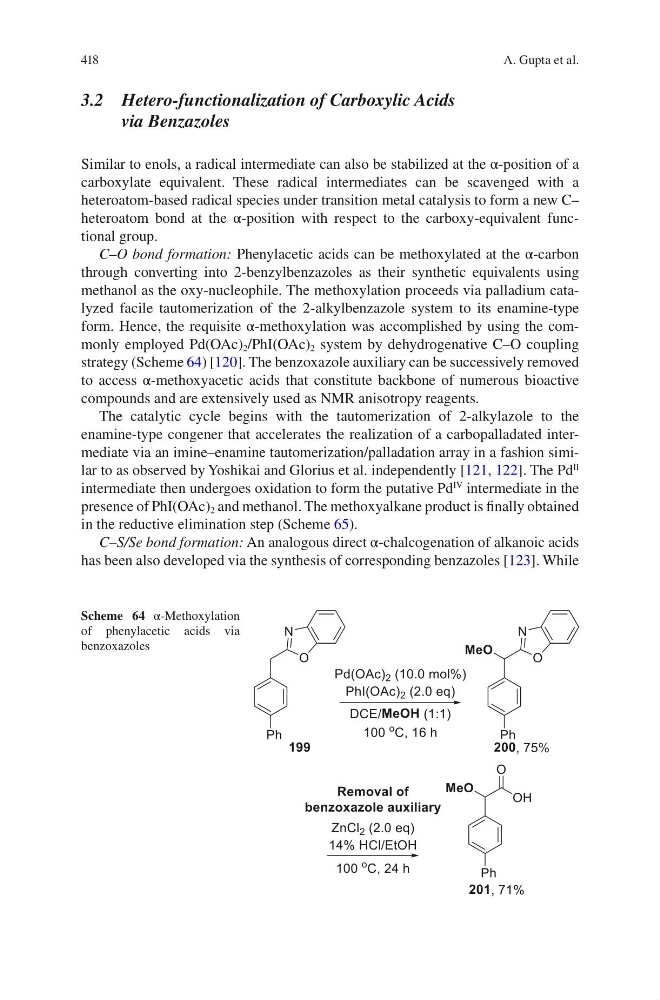
C–O bond formation: Phenylacetic acids can be methoxylated at the α-carbon
through converting into 2-benzylbenzazoles as their synthetic equivalents using
methanol as the oxy-nucleophile. The methoxylation proceeds via palladium catalyzed facile tautomerization of the 2-alkylbenzazole system to its enamine-type
form. Hence, the requisite α-methoxylation was accomplished by using the commonly employed Pd(OAc) 2 /PhI(OAc) 2 system by dehydrogenative C–O coupling
strategy (Scheme 64) [120]. The benzoxazole auxiliary can be successively removed
to access α-methoxyacetic acids that constitute backbone of numerous bioactive
compounds and are extensively used as NMR anisotropy reagents.
The catalytic cycle begins with the tautomerization of 2-alkylazole to the
enamine-type congener that accelerates the realization of a carbopalladated intermediate via an imine–enamine tautomerization/palladation array in a fashion similar to as observed by Yoshikai and Glorius et al. independently [121, 122]. The Pd
II
intermediate then undergoes oxidation to form the putative Pd
IV
intermediate in the
presence of PhI(OAc) 2 and methanol. The methoxyalkane product is finally obtained
in the reductive elimination step (Scheme 65).
C–S/Se bond formation: An analogous direct α-chalcogenation of alkanoic acids
has been also developed via the synthesis of corresponding benzazoles [123]. While
Scheme 64 α-Methoxylation
of phenylacetic acids via
benzoxazoles
A. Gupta et al.
3.2 Hetero-functionalization of Carboxylic Acids
via Benzazoles
Similar to enols, a radical intermediate can also be stabilized at the α-position of a
carboxylate equivalent. These radical intermediates can be scavenged with a
heteroatom- based radical species under transition metal catalysis to form a new C–
heteroatom bond at the α-position with respect to the carboxy-equivalent functional group.
C–O bond formation: Phenylacetic acids can be methoxylated at the α-carbon
through converting into 2-benzylbenzazoles as their synthetic equivalents using
methanol as the oxy-nucleophile. The methoxylation proceeds via palladium catalyzed facile tautomerization of the 2-alkylbenzazole system to its enamine-type
form. Hence, the requisite α-methoxylation was accomplished by using the commonly employed Pd(OAc) 2 /PhI(OAc) 2 system by dehydrogenative C–O coupling
strategy (Scheme 64) [120]. The benzoxazole auxiliary can be successively removed
to access α-methoxyacetic acids that constitute backbone of numerous bioactive
compounds and are extensively used as NMR anisotropy reagents.
The catalytic cycle begins with the tautomerization of 2-alkylazole to the
enamine-type congener that accelerates the realization of a carbopalladated intermediate via an imine–enamine tautomerization/palladation array in a fashion similar to as observed by Yoshikai and Glorius et al. independently [121, 122]. The Pd
II
intermediate then undergoes oxidation to form the putative Pd
IV
intermediate in the
presence of PhI(OAc) 2 and methanol. The methoxyalkane product is finally obtained
in the reductive elimination step (Scheme 65).
C–S/Se bond formation: An analogous direct α-chalcogenation of alkanoic acids
has been also developed via the synthesis of corresponding benzazoles [123]. While
Scheme 64 α-Methoxylation
of phenylacetic acids via
benzoxazoles
A. Gupta et al.