

417
through chelation assistance and consequently undergoes phosphorylation with
phosphonates to afford α-phosphorylated products.
C–S bond formation: In general, C-centered radicals at the α-position with regard
to an amide or ester are further stabilized due to the delocalization with the carboxy
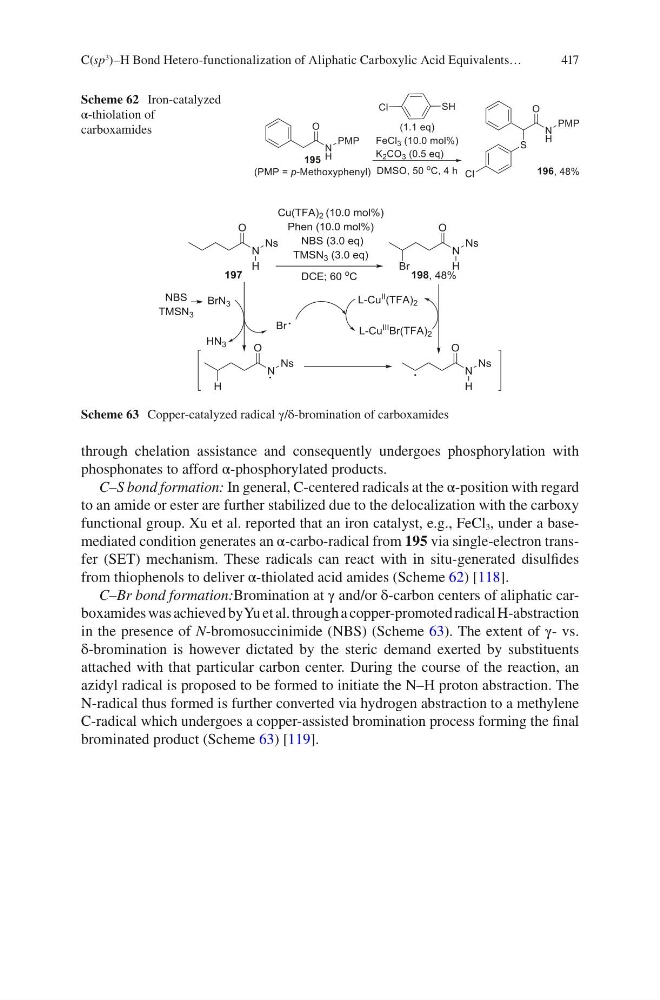
functional group. Xu et al. reported that an iron catalyst, e.g., FeCl 3 , under a basemediated condition generates an α-carbo-radical from 195 via single-electron transfer (SET) mechanism. These radicals can react with in situ-generated disulfides
from thiophenols to deliver α-thiolated acid amides (Scheme 62) [118].
C–Br bond formation:Bromination at γ and/or δ-carbon centers of aliphatic carboxamides was achieved by Yu et al. through a copper-promoted radical H-abstraction
in the presence of N-bromosuccinimide (NBS) (Scheme 63). The extent of γ- vs.
δ-bromination is however dictated by the steric demand exerted by substituents
attached with that particular carbon center. During the course of the reaction, an
azidyl radical is proposed to be formed to initiate the N–H proton abstraction. The
N-radical thus formed is further converted via hydrogen abstraction to a methylene
C-radical which undergoes a copper-assisted bromination process forming the final
brominated product (Scheme 63) [119].
Scheme 62 Iron-catalyzed
α-thiolation of
carboxamides
Scheme 63 Copper-catalyzed radical γ/δ-bromination of carboxamides
C(sp
3
)–H Bond Hetero-functionalization of Aliphatic Carboxylic Acid Equivalents…
through chelation assistance and consequently undergoes phosphorylation with
phosphonates to afford α-phosphorylated products.
C–S bond formation: In general, C-centered radicals at the α-position with regard
to an amide or ester are further stabilized due to the delocalization with the carboxy
functional group. Xu et al. reported that an iron catalyst, e.g., FeCl 3 , under a basemediated condition generates an α-carbo-radical from 195 via single-electron transfer (SET) mechanism. These radicals can react with in situ-generated disulfides
from thiophenols to deliver α-thiolated acid amides (Scheme 62) [118].
C–Br bond formation:Bromination at γ and/or δ-carbon centers of aliphatic carboxamides was achieved by Yu et al. through a copper-promoted radical H-abstraction
in the presence of N-bromosuccinimide (NBS) (Scheme 63). The extent of γ- vs.
δ-bromination is however dictated by the steric demand exerted by substituents
attached with that particular carbon center. During the course of the reaction, an
azidyl radical is proposed to be formed to initiate the N–H proton abstraction. The
N-radical thus formed is further converted via hydrogen abstraction to a methylene
C-radical which undergoes a copper-assisted bromination process forming the final
brominated product (Scheme 63) [119].
Scheme 62 Iron-catalyzed
α-thiolation of
carboxamides
Scheme 63 Copper-catalyzed radical γ/δ-bromination of carboxamides
C(sp
3
)–H Bond Hetero-functionalization of Aliphatic Carboxylic Acid Equivalents…