

404
oxidant, was found crucial for the highly selective lactamization process via β-C–H
activation of methyl groups of 8-aminoquinoline-functionalized carboxamides.
However, the scope of the reaction is limited to substrates having quaternary
α-carbon centers (Scheme 38) [92].
In another independent Ni-catalyzed approach, an analogous C–H β-lactamization
was attained under the assistance of 5-chloroquinoline-derived carboxamide in the
presence of molecular iodine as the stoichiometric additive [93]. In this case, two
reaction pathways were suggested for the formation of the β-lactam ring (Scheme
39). The first possibility involves a common C−N bond reductive elimination step
from higher-valent cyclometallated Ni
III
(128) or Ni
IV
intermediate (129). The other
route can be a stepwise mechanism in which a direct β-iodination of the aliphatic
amide takes place followed by a ready intramolecular cyclization leading to the
β-lactam ring. Interestingly, when the preformed β-iodinated amide 131 was subjected to amidation even in the absence of the Ni catalyst, molecular iodine, and
other additives, the cyclized β-lactam product was predominated, indicating an indirect evidence for the stepwise pathway to be operational for the lactamization
process.
A cobalt-based catalytic system was also introduced for the C–H β-lactam synthesis from 8-aminoquinolinyl amides. The catalyst system, comprising Co(OAc) 2 ,
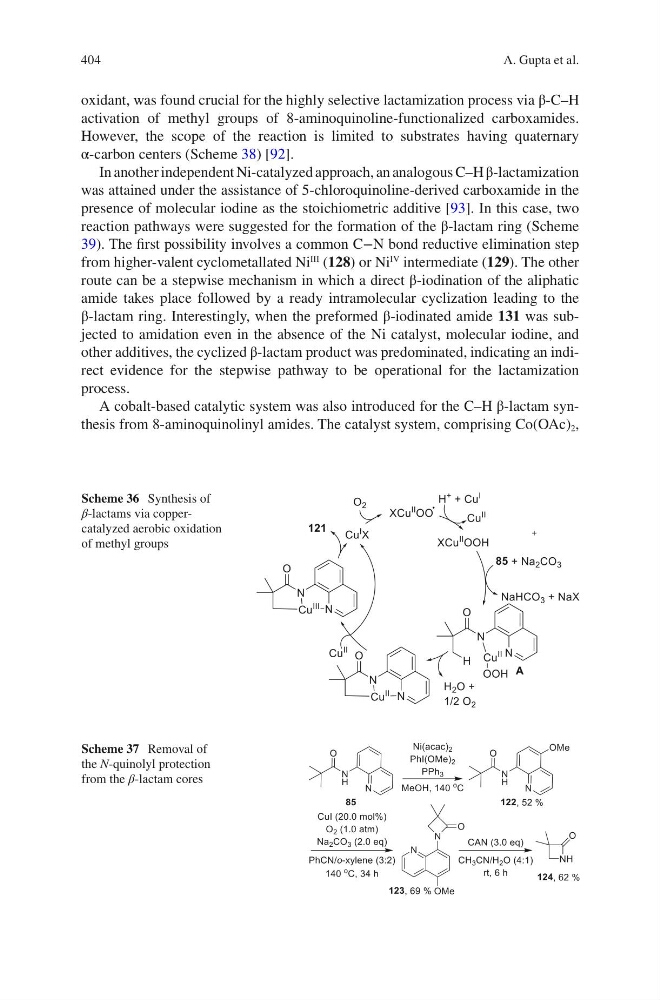
Scheme 36 Synthesis of
β-lactams via coppercatalyzed aerobic oxidation
of methyl groups
Scheme 37 Removal of
the N-quinolyl protection
from the β-lactam cores
A. Gupta et al.
oxidant, was found crucial for the highly selective lactamization process via β-C–H
activation of methyl groups of 8-aminoquinoline-functionalized carboxamides.
However, the scope of the reaction is limited to substrates having quaternary
α-carbon centers (Scheme 38) [92].
In another independent Ni-catalyzed approach, an analogous C–H β-lactamization
was attained under the assistance of 5-chloroquinoline-derived carboxamide in the
presence of molecular iodine as the stoichiometric additive [93]. In this case, two
reaction pathways were suggested for the formation of the β-lactam ring (Scheme
39). The first possibility involves a common C−N bond reductive elimination step
from higher-valent cyclometallated Ni
III
(128) or Ni
IV
intermediate (129). The other
route can be a stepwise mechanism in which a direct β-iodination of the aliphatic
amide takes place followed by a ready intramolecular cyclization leading to the
β-lactam ring. Interestingly, when the preformed β-iodinated amide 131 was subjected to amidation even in the absence of the Ni catalyst, molecular iodine, and
other additives, the cyclized β-lactam product was predominated, indicating an indirect evidence for the stepwise pathway to be operational for the lactamization
process.
A cobalt-based catalytic system was also introduced for the C–H β-lactam synthesis from 8-aminoquinolinyl amides. The catalyst system, comprising Co(OAc) 2 ,
Scheme 36 Synthesis of
β-lactams via coppercatalyzed aerobic oxidation
of methyl groups
Scheme 37 Removal of
the N-quinolyl protection
from the β-lactam cores
A. Gupta et al.