

403
aerobic lactamization is particularly beneficial in terms of product economy and
waste minimization (water is the only by-product) (Scheme 36) [85]. Contrary to
the copper-catalyzed protocols that operate through employing silver carbonate or
duroquinone as the oxidant, the aerobic system is highly site-selective for the oxidation of β-methyl groups even in the presence of a β-benzylic C–H bond. The
N-quinolyl auxiliary can be elegantly disintegrated by further converting it into
5-methoxyquinolyl motif via coupling with a Ni-catalyzed methoxylation strategy
(Scheme 37) [86–88].
A nickel-based catalyst system was also developed relying on the assumption
that in the presence of an external single-electron oxidant, the Ni
II
catalyst can
undergo a Ni
II
/Ni
III
catalytic cycle in which the higher-valent Ni
III
intermediate
reductively eliminates the C–N cross-coupled product [89–91]. Thus, a catalyst system, consisting of Ni(dme) 2 I 2 as the Ni
II
source and TEMPO as the single-electron
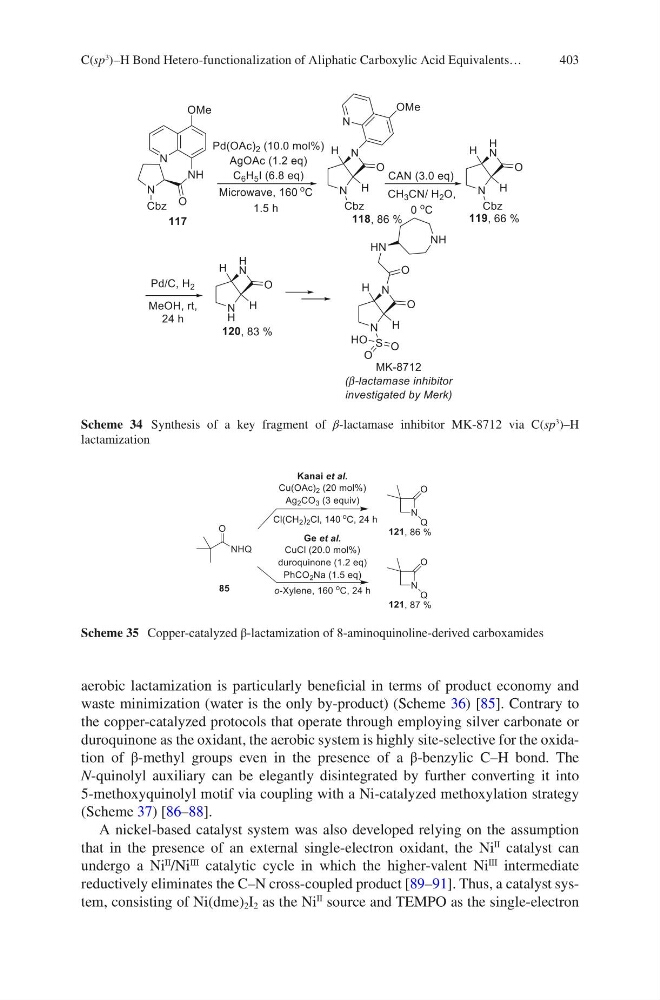
Scheme 34 Synthesis of a key fragment of β-lactamase inhibitor MK-8712 via C(sp
3
)–H
lactamization
Scheme 35 Copper- catalyzed β-lactamization of 8-aminoquinoline- derived carboxamides
C(sp
3
)–H Bond Hetero-functionalization of Aliphatic Carboxylic Acid Equivalents…
aerobic lactamization is particularly beneficial in terms of product economy and
waste minimization (water is the only by-product) (Scheme 36) [85]. Contrary to
the copper-catalyzed protocols that operate through employing silver carbonate or
duroquinone as the oxidant, the aerobic system is highly site-selective for the oxidation of β-methyl groups even in the presence of a β-benzylic C–H bond. The
N-quinolyl auxiliary can be elegantly disintegrated by further converting it into
5-methoxyquinolyl motif via coupling with a Ni-catalyzed methoxylation strategy
(Scheme 37) [86–88].
A nickel-based catalyst system was also developed relying on the assumption
that in the presence of an external single-electron oxidant, the Ni
II
catalyst can
undergo a Ni
II
/Ni
III
catalytic cycle in which the higher-valent Ni
III
intermediate
reductively eliminates the C–N cross-coupled product [89–91]. Thus, a catalyst system, consisting of Ni(dme) 2 I 2 as the Ni
II
source and TEMPO as the single-electron
Scheme 34 Synthesis of a key fragment of β-lactamase inhibitor MK-8712 via C(sp
3
)–H
lactamization
Scheme 35 Copper- catalyzed β-lactamization of 8-aminoquinoline- derived carboxamides
C(sp
3
)–H Bond Hetero-functionalization of Aliphatic Carboxylic Acid Equivalents…