

401
β-lactam can be further converted into orthogonally protected anti-α,β-diamino
acids (Scheme 32).
In another report, it has been documented that pentafluoroiodobenzene, being an
electron-withdrawing agent, can act as a crucial component of the Pd
II
/Pd
IV
-based
catalytic cycle for the 8-aminoquinoline-directed intramolecular lactamization by
not only regulating the steric and electronic nature of intermediates in favor of the
C−N bond formation but also as an oxidant to the Pd
II
-metallacycle species (Scheme
33) [81, 82].
This fine-tuning of the catalytic system by the addition of C 6 F 5 I has enabled the
straightforward synthesis of β-lactams with 5/4, 6/4, 7/4, or 8/4 cis-fused ring systems including the key fragment of the β-lactamase inhibitor MK-8712 (Scheme
34) [82].
Earth abundant, first row transition metals, e.g., copper, nickel, and cobalt, can
also effectively catalyze the oxidation of methyl and methylene protons of
8- aminoquinoline-derived carboxylic amides. The β-lactam ring is constructed via
the activation of a β-C(sp
3
)–H bond through the formation of five-fused fivemembered metallacycle, similar to a palladacycle intermediate. The copper-catalyzed intramolecular amidation of 8-aminoquinoline-derived carboxamides to
β-lactams was accomplished by employing either silver carbonate or duroquinone
as the stoichiometric oxidant (Scheme 35) [83, 84]. The C(sp
3
)–H lactamization
took place favorably at the terminal β-methyl group or at internal β-benzylic
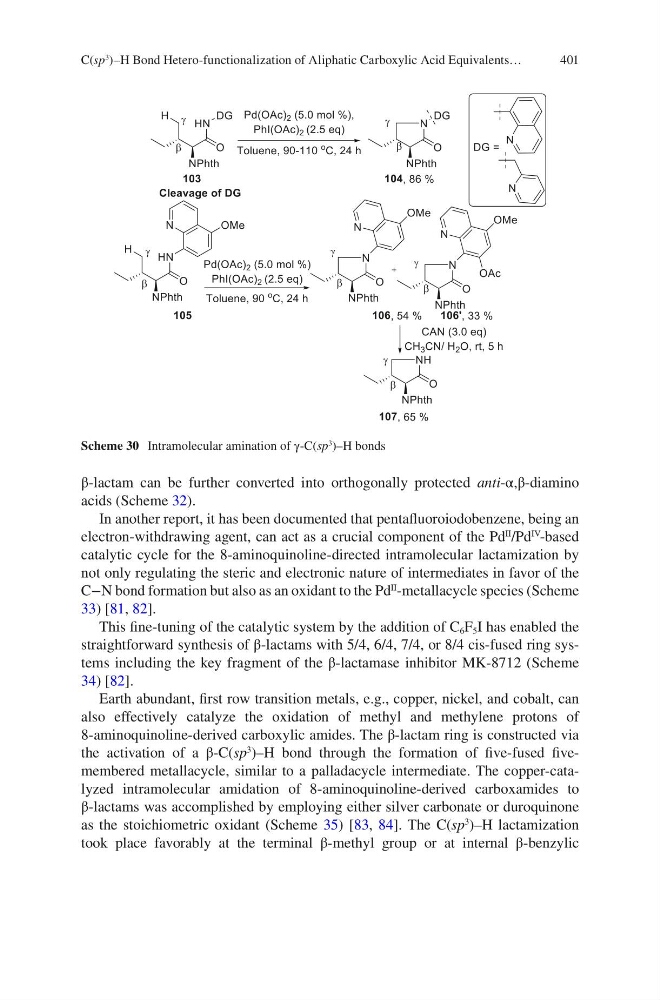
Scheme 30 Intramolecular amination of γ-C(sp
3 )–H bonds
C(sp
3
)–H Bond Hetero-functionalization of Aliphatic Carboxylic Acid Equivalents…
β-lactam can be further converted into orthogonally protected anti-α,β-diamino
acids (Scheme 32).
In another report, it has been documented that pentafluoroiodobenzene, being an
electron-withdrawing agent, can act as a crucial component of the Pd
II
/Pd
IV
-based
catalytic cycle for the 8-aminoquinoline-directed intramolecular lactamization by
not only regulating the steric and electronic nature of intermediates in favor of the
C−N bond formation but also as an oxidant to the Pd
II
-metallacycle species (Scheme
33) [81, 82].
This fine-tuning of the catalytic system by the addition of C 6 F 5 I has enabled the
straightforward synthesis of β-lactams with 5/4, 6/4, 7/4, or 8/4 cis-fused ring systems including the key fragment of the β-lactamase inhibitor MK-8712 (Scheme
34) [82].
Earth abundant, first row transition metals, e.g., copper, nickel, and cobalt, can
also effectively catalyze the oxidation of methyl and methylene protons of
8- aminoquinoline-derived carboxylic amides. The β-lactam ring is constructed via
the activation of a β-C(sp
3
)–H bond through the formation of five-fused fivemembered metallacycle, similar to a palladacycle intermediate. The copper-catalyzed intramolecular amidation of 8-aminoquinoline-derived carboxamides to
β-lactams was accomplished by employing either silver carbonate or duroquinone
as the stoichiometric oxidant (Scheme 35) [83, 84]. The C(sp
3
)–H lactamization
took place favorably at the terminal β-methyl group or at internal β-benzylic
Scheme 30 Intramolecular amination of γ-C(sp
3 )–H bonds
C(sp
3
)–H Bond Hetero-functionalization of Aliphatic Carboxylic Acid Equivalents…