

396
N-donor directing groups, holding gem-dimethyl substituents at the benzylic site
next to the pyridine ring, promotes the palladium-catalyzed methoxylation process
at considerably faster rate (Scheme 22) [66]. This is possibly attributed to the fact
that the formation of the metallacycle intermediate is accelerated through entropic
restraint and bond angle compression by the gem-dimethyl substituents.
Notably, the typically used Pd(OAc) 2 /PhI(OAc) 2 catalyst system enables the
β-C(sp
3
)–H alkoxylation of PIP-decorated amides in the presence of a 1:1 combination of m-xylene and an alcohol. The PIP group can be detached from the
β-alkoxylated products under mild condition to form the corresponding carboxylic
acids (Scheme 23).
However, relatively little prospect has been made in building C(sp
3
)−O bonds
via directed approach by means of a chiral auxiliary. Along this track, an intramolecular etherification was realized in stereoselective manner with the aid of a privileged chiral bidentate group in the absence of an optically active ligand. The reaction
yields numerous sterically demanding cyclic ethers and oxaspirocyclic compounds
in highly diastereoselective manner (up to dr = 39:1) (Scheme 24) [67, 68].
Mechanistic investigation and DFT calculations indicate that only low levels of diastereoselectivity were persuaded at the C–H metalation–deprotonation step and
were markedly enhanced at the reductive elimination step.
C–S and C–Se bond formation: Synthesis of chalcogenated acids, particularly
thioether-substituted carboxylic acids/equivalents, via chelation-assisted direct
functionalization of a C–H bond is a rather new-fangled approach. The major
hitches associated with thiolating a C–H bond is originated due to the catalyst poisoning effect by the sulfur agent [69]. Nevertheless, the catalyst retarding effect can
be minimized with the use of dichalcogenides. For example, 8-aminoquinolinederived amides were thiolated at the β-carbon centers by using disulfides
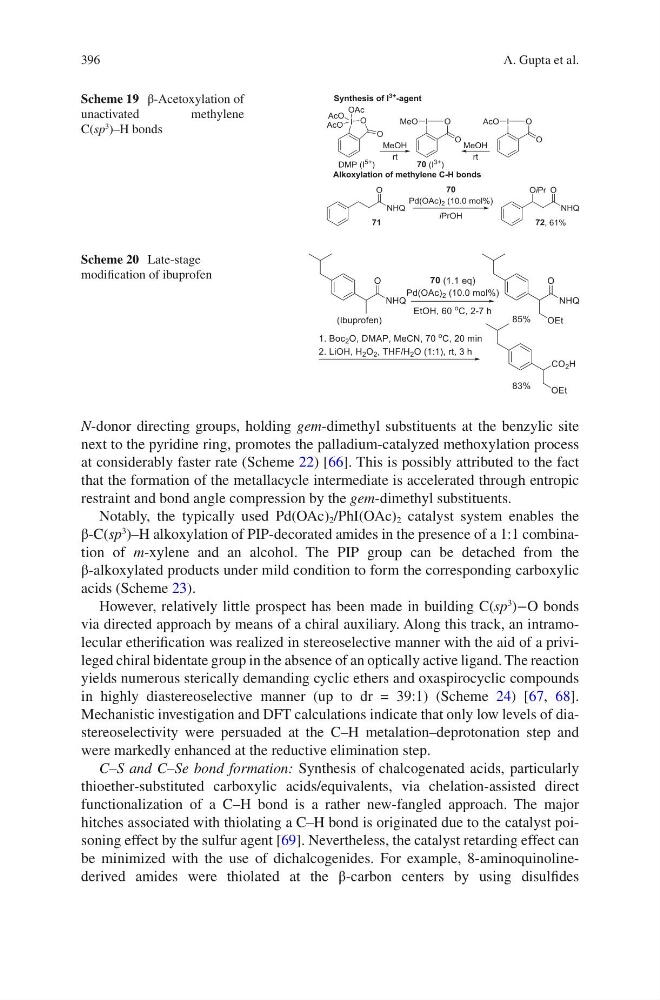
Scheme 20 Late-stage
modification of ibuprofen
Scheme 19 β-Acetoxylation of
unactivated
methylene
C(sp
3 )–H bonds
A. Gupta et al.
N-donor directing groups, holding gem-dimethyl substituents at the benzylic site
next to the pyridine ring, promotes the palladium-catalyzed methoxylation process
at considerably faster rate (Scheme 22) [66]. This is possibly attributed to the fact
that the formation of the metallacycle intermediate is accelerated through entropic
restraint and bond angle compression by the gem-dimethyl substituents.
Notably, the typically used Pd(OAc) 2 /PhI(OAc) 2 catalyst system enables the
β-C(sp
3
)–H alkoxylation of PIP-decorated amides in the presence of a 1:1 combination of m-xylene and an alcohol. The PIP group can be detached from the
β-alkoxylated products under mild condition to form the corresponding carboxylic
acids (Scheme 23).
However, relatively little prospect has been made in building C(sp
3
)−O bonds
via directed approach by means of a chiral auxiliary. Along this track, an intramolecular etherification was realized in stereoselective manner with the aid of a privileged chiral bidentate group in the absence of an optically active ligand. The reaction
yields numerous sterically demanding cyclic ethers and oxaspirocyclic compounds
in highly diastereoselective manner (up to dr = 39:1) (Scheme 24) [67, 68].
Mechanistic investigation and DFT calculations indicate that only low levels of diastereoselectivity were persuaded at the C–H metalation–deprotonation step and
were markedly enhanced at the reductive elimination step.
C–S and C–Se bond formation: Synthesis of chalcogenated acids, particularly
thioether-substituted carboxylic acids/equivalents, via chelation-assisted direct
functionalization of a C–H bond is a rather new-fangled approach. The major
hitches associated with thiolating a C–H bond is originated due to the catalyst poisoning effect by the sulfur agent [69]. Nevertheless, the catalyst retarding effect can
be minimized with the use of dichalcogenides. For example, 8-aminoquinolinederived amides were thiolated at the β-carbon centers by using disulfides
Scheme 20 Late-stage
modification of ibuprofen
Scheme 19 β-Acetoxylation of
unactivated
methylene
C(sp
3 )–H bonds
A. Gupta et al.