

397
(Scheme 25). Nickel-based catalyst systems permitted the required transformation
by oxidizing β-C–H bonds of methyl groups with high monoselectivity [70, 71].
These thiolations proceed via the formation of a five-fused five-membered nickelacycle intermediate, and commonly the C–S bond formations occur at the reductive
elimination step. Subsequently, the 8-aminoquinoline auxiliary was simply removed
by hydrolysis to furnish the corresponding thioether-substituted acid that can be
further derivatized.
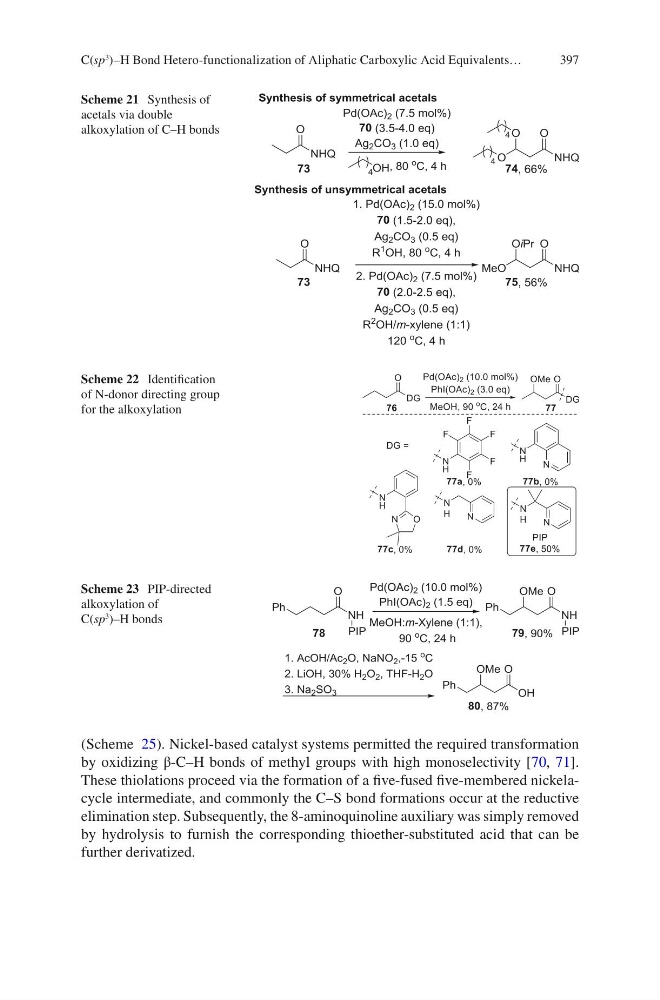
Scheme 21 Synthesis of
acetals via double
alkoxylation of C–H bonds
Scheme 22 Identification
of N-donor directing group
for the alkoxylation
Scheme 23 PIP-directed
alkoxylation of
C(sp
3 )–H bonds
C(sp
3
)–H Bond Hetero-functionalization of Aliphatic Carboxylic Acid Equivalents…
(Scheme 25). Nickel-based catalyst systems permitted the required transformation
by oxidizing β-C–H bonds of methyl groups with high monoselectivity [70, 71].
These thiolations proceed via the formation of a five-fused five-membered nickelacycle intermediate, and commonly the C–S bond formations occur at the reductive
elimination step. Subsequently, the 8-aminoquinoline auxiliary was simply removed
by hydrolysis to furnish the corresponding thioether-substituted acid that can be
further derivatized.
Scheme 21 Synthesis of
acetals via double
alkoxylation of C–H bonds
Scheme 22 Identification
of N-donor directing group
for the alkoxylation
Scheme 23 PIP-directed
alkoxylation of
C(sp
3 )–H bonds
C(sp
3
)–H Bond Hetero-functionalization of Aliphatic Carboxylic Acid Equivalents…