

389
resulted in a mixture of monoborylated and geminal bis-borylated products. The
monoborylated compound 47 can be converted into a tertiary amine through a subsequent reaction step (Scheme 13).
C–halogen bond formations:Halogenated carboxylic acids and amides act as
vital building blocks as they can be further transformed into useful synthetic compounds relying on dehalogenation and C–halogen bond activation strategies. The
iodination of β-C–H groups with respect to a σ-chelating oxazoline auxiliary was
achieved by molecular I 2 in the presence of Pd(OAc) 2 /PhI(OAc) 2 system [48]. Thus,
the cyclopropane substrate prepared from (R)-tert-leucinol was iodinated as a single
stereoisomer that can be transformed into the corresponding carboxylic acid ester in
outstanding enantioselectivity (99% ee) upon a hydrolysis/esterification sequence
(Scheme 14). One of the unique advantages of this catalytic system is the recyclability of the Pd catalyst that precipitates as PdI 2 at the end of the reaction and can be
further reused.
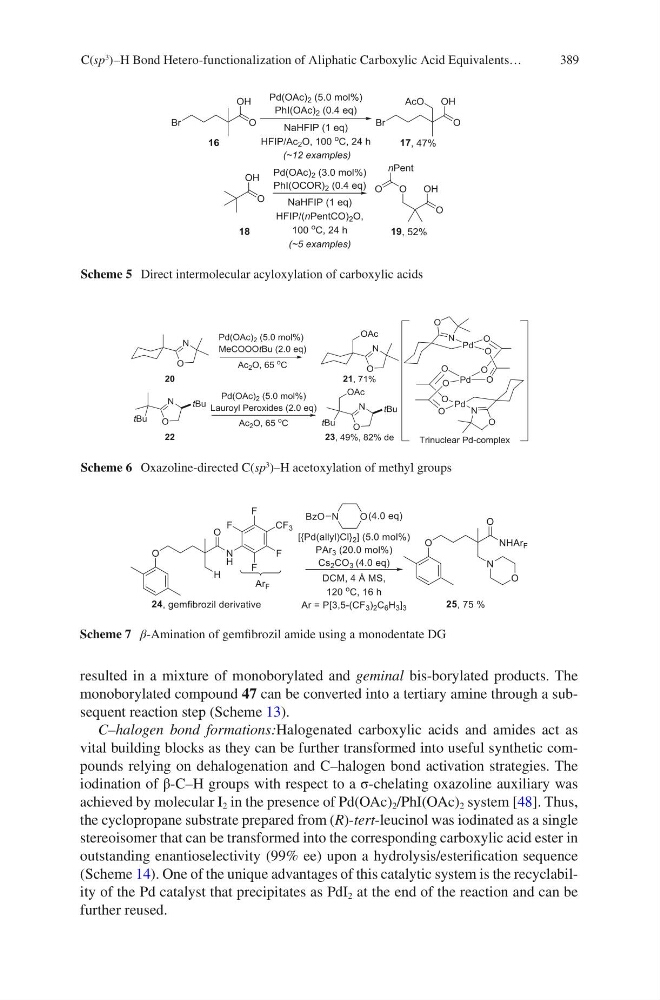
Scheme 6 Oxazoline-directed C(sp
3
)–H acetoxylation of methyl groups
Scheme 7 β-Amination of gemfibrozil amide using a monodentate DG
Scheme 5 Direct intermolecular acyloxylation of carboxylic acids
C(sp
3
)–H Bond Hetero-functionalization of Aliphatic Carboxylic Acid Equivalents…
resulted in a mixture of monoborylated and geminal bis-borylated products. The
monoborylated compound 47 can be converted into a tertiary amine through a subsequent reaction step (Scheme 13).
C–halogen bond formations:Halogenated carboxylic acids and amides act as
vital building blocks as they can be further transformed into useful synthetic compounds relying on dehalogenation and C–halogen bond activation strategies. The
iodination of β-C–H groups with respect to a σ-chelating oxazoline auxiliary was
achieved by molecular I 2 in the presence of Pd(OAc) 2 /PhI(OAc) 2 system [48]. Thus,
the cyclopropane substrate prepared from (R)-tert-leucinol was iodinated as a single
stereoisomer that can be transformed into the corresponding carboxylic acid ester in
outstanding enantioselectivity (99% ee) upon a hydrolysis/esterification sequence
(Scheme 14). One of the unique advantages of this catalytic system is the recyclability of the Pd catalyst that precipitates as PdI 2 at the end of the reaction and can be
further reused.
Scheme 6 Oxazoline-directed C(sp
3
)–H acetoxylation of methyl groups
Scheme 7 β-Amination of gemfibrozil amide using a monodentate DG
Scheme 5 Direct intermolecular acyloxylation of carboxylic acids
C(sp
3
)–H Bond Hetero-functionalization of Aliphatic Carboxylic Acid Equivalents…