

388
[38–41] and (2) the resulting C–B bonds are often reactive and may undergo further
transmetallation leading to deborylated and/or β-hydride eliminated products [42,
43]. Yu et al. developed a palladium-catalyzed, ligand-enabled procedure for the
C(sp
3
)-H β-borylation of alkyl carboxylic acids using a monodentate fluorinated
directing group [44]. The palladium-based system, comprising an electron-rich and
sterically less hindered quinoline ligand, when combined with tetrabutylammonium
tetrafluoroborate (TEABF 4 ) exhibited superior results in terms of both yield and
selectivity (Scheme 9). The β-borylated products can be further transformed into the
corresponding β-hydroxylated compounds through a subsequent reaction step
(Scheme 10).
The enantioselective variant of the Pd-catalyzed β-C(sp
3
)−H borylation of
cycloalkane carboxylic acid amides was achieved by using a mono-N-protected
amino acid (MPAA) ligand, namely, acetyl-protected aminomethyl oxazoline
(APAO). Modification in the oxazoline ligand core enables the enantioselective
borylation of various weakly coordinating cycloalkane carboxamides, e.g., cyclopropanes, cyclobutanes, and cyclohexanes in excellent enantioselectivity [45].
Thus, while the borylation of cyclobutanes was operational by employing an (S,R)oxazoline ligand 30, that of cyclopropane and cyclohexane derivatives were realized
by using 31 and 32, respectively, as optimal ligands (Scheme 11). The borylated
cyclohexanes were successively oxidized into the corresponding diastereo- and
enantio-enriched alcohols. The absolute configuration of the products is in accord
with the involvement of the transition state as shown in Fig. 1. The functional groups
in the ligand framework exhibit a synergistic interplay to preferably form the fivemembered palladacycle 40 over 41.
Although the palladium-catalyzed borylation of cyclopropane carboxylic acid
amides led to the formation of highly enantio-enriched monoborylated cyclopropane 36, the scope of the transformation is inadequate as the bis-borylated cyclopropane ring-opened product 37 was always identified as the by-product. Nevertheless,
by altering the palladium system with an iridium catalyst in conjunction with a
chiral bidentate boryl ligand, the desired ring borylation of cyclopropyl amides was
successfully achieved in high yield and enantioselectivity (Scheme 12) [46]. The
stereochemical outcome of the reaction was justified by comparing the two proposed complexes (1R,2S)-45 and (1S,2R)-45 in the stereoselective oxidative addition step (Fig. 2).
In an independent report, the borylation of 2-alkyl-1,3-azoles at the β-C-H bond
with regard to the azole ring in the 2-alkyl side chain was achieved by means of
silica-supported monophosphine-iridium catalyst [47]. The borylation strategy was
equally effective for both primary and secondary C(sp
3
)-Η bonds of alicyclic and
acyclic substituents attached with the azole ring (oxazoles, thiazoles, and imidazoles). However, benzazoles bearing sterically less congested alkyl chains often
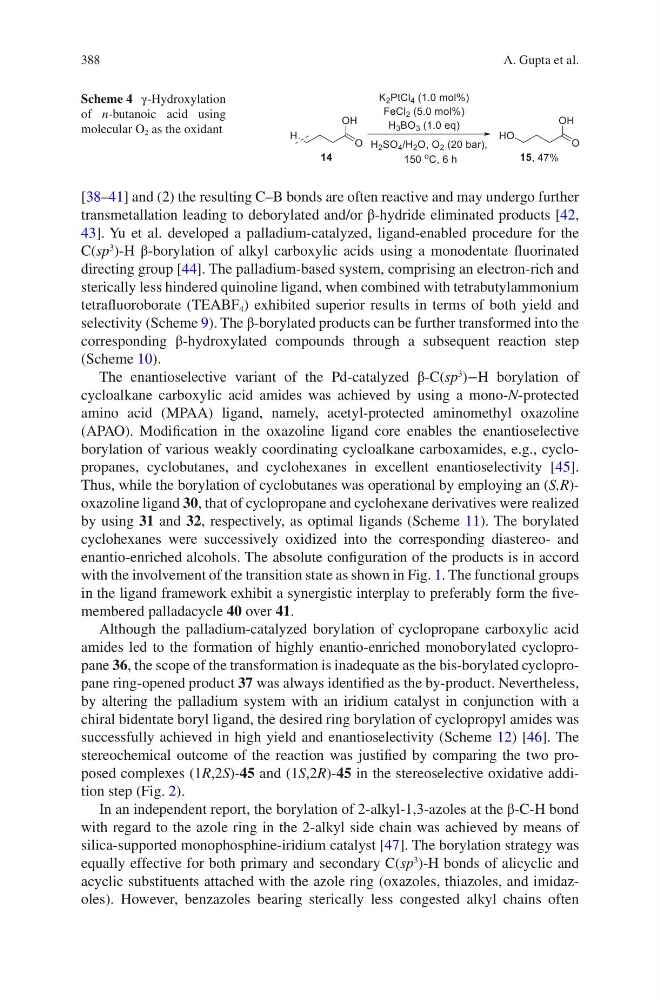
Scheme 4 γ-Hydroxylation
of n-butanoic acid using
molecular O 2 as the oxidant
A. Gupta et al.
[38–41] and (2) the resulting C–B bonds are often reactive and may undergo further
transmetallation leading to deborylated and/or β-hydride eliminated products [42,
43]. Yu et al. developed a palladium-catalyzed, ligand-enabled procedure for the
C(sp
3
)-H β-borylation of alkyl carboxylic acids using a monodentate fluorinated
directing group [44]. The palladium-based system, comprising an electron-rich and
sterically less hindered quinoline ligand, when combined with tetrabutylammonium
tetrafluoroborate (TEABF 4 ) exhibited superior results in terms of both yield and
selectivity (Scheme 9). The β-borylated products can be further transformed into the
corresponding β-hydroxylated compounds through a subsequent reaction step
(Scheme 10).
The enantioselective variant of the Pd-catalyzed β-C(sp
3
)−H borylation of
cycloalkane carboxylic acid amides was achieved by using a mono-N-protected
amino acid (MPAA) ligand, namely, acetyl-protected aminomethyl oxazoline
(APAO). Modification in the oxazoline ligand core enables the enantioselective
borylation of various weakly coordinating cycloalkane carboxamides, e.g., cyclopropanes, cyclobutanes, and cyclohexanes in excellent enantioselectivity [45].
Thus, while the borylation of cyclobutanes was operational by employing an (S,R)oxazoline ligand 30, that of cyclopropane and cyclohexane derivatives were realized
by using 31 and 32, respectively, as optimal ligands (Scheme 11). The borylated
cyclohexanes were successively oxidized into the corresponding diastereo- and
enantio-enriched alcohols. The absolute configuration of the products is in accord
with the involvement of the transition state as shown in Fig. 1. The functional groups
in the ligand framework exhibit a synergistic interplay to preferably form the fivemembered palladacycle 40 over 41.
Although the palladium-catalyzed borylation of cyclopropane carboxylic acid
amides led to the formation of highly enantio-enriched monoborylated cyclopropane 36, the scope of the transformation is inadequate as the bis-borylated cyclopropane ring-opened product 37 was always identified as the by-product. Nevertheless,
by altering the palladium system with an iridium catalyst in conjunction with a
chiral bidentate boryl ligand, the desired ring borylation of cyclopropyl amides was
successfully achieved in high yield and enantioselectivity (Scheme 12) [46]. The
stereochemical outcome of the reaction was justified by comparing the two proposed complexes (1R,2S)-45 and (1S,2R)-45 in the stereoselective oxidative addition step (Fig. 2).
In an independent report, the borylation of 2-alkyl-1,3-azoles at the β-C-H bond
with regard to the azole ring in the 2-alkyl side chain was achieved by means of
silica-supported monophosphine-iridium catalyst [47]. The borylation strategy was
equally effective for both primary and secondary C(sp
3
)-Η bonds of alicyclic and
acyclic substituents attached with the azole ring (oxazoles, thiazoles, and imidazoles). However, benzazoles bearing sterically less congested alkyl chains often
Scheme 4 γ-Hydroxylation
of n-butanoic acid using
molecular O 2 as the oxidant
A. Gupta et al.