

386
amino acids are known to pre-associate with a metal ion in a bidentate manner, the
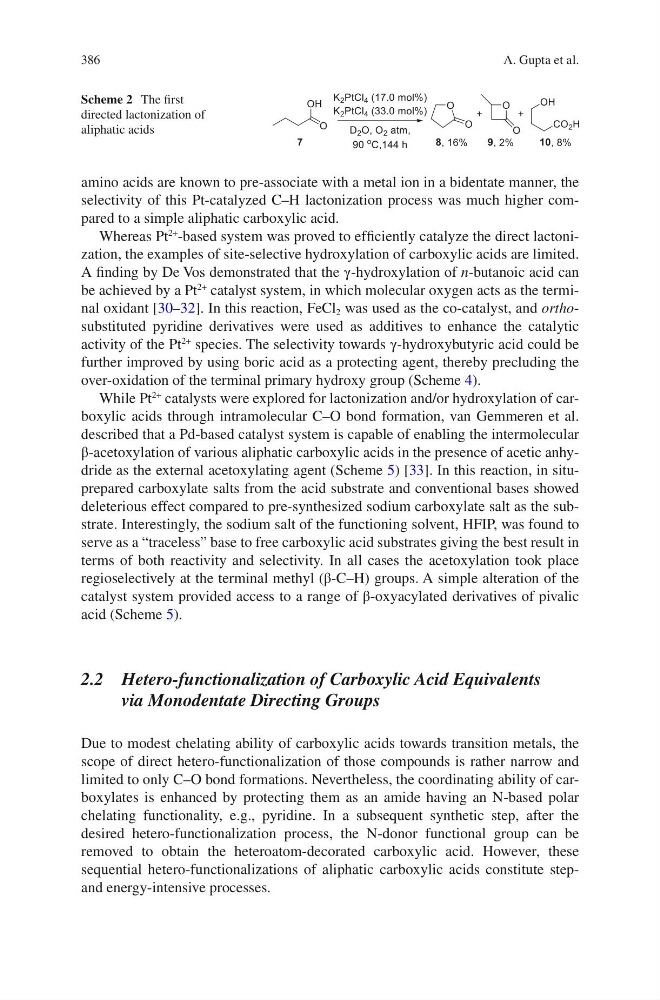
selectivity of this Pt-catalyzed C–H lactonization process was much higher compared to a simple aliphatic carboxylic acid.
Whereas Pt
2+
-based system was proved to efficiently catalyze the direct lactonization, the examples of site-selective hydroxylation of carboxylic acids are limited.
A finding by De Vos demonstrated that the γ-hydroxylation of n-butanoic acid can
be achieved by a Pt
2+
catalyst system, in which molecular oxygen acts as the terminal oxidant [30–32]. In this reaction, FeCl 2 was used as the co-catalyst, and orthosubstituted pyridine derivatives were used as additives to enhance the catalytic
activity of the Pt
2+
species. The selectivity towards γ-hydroxybutyric acid could be
further improved by using boric acid as a protecting agent, thereby precluding the
over-oxidation of the terminal primary hydroxy group (Scheme 4).
While Pt
2+
catalysts were explored for lactonization and/or hydroxylation of carboxylic acids through intramolecular C–O bond formation, van Gemmeren et al.
described that a Pd-based catalyst system is capable of enabling the intermolecular
β-acetoxylation of various aliphatic carboxylic acids in the presence of acetic anhydride as the external acetoxylating agent (Scheme 5) [33]. In this reaction, in situprepared carboxylate salts from the acid substrate and conventional bases showed
deleterious effect compared to pre-synthesized sodium carboxylate salt as the substrate. Interestingly, the sodium salt of the functioning solvent, HFIP, was found to
serve as a “traceless” base to free carboxylic acid substrates giving the best result in
terms of both reactivity and selectivity. In all cases the acetoxylation took place
regioselectively at the terminal methyl (β-C–H) groups. A simple alteration of the
catalyst system provided access to a range of β-oxyacylated derivatives of pivalic
acid (Scheme 5).
2.2 Hetero-functionalization of Carboxylic Acid Equivalents
via Monodentate Directing Groups
Due to modest chelating ability of carboxylic acids towards transition metals, the
scope of direct hetero-functionalization of those compounds is rather narrow and
limited to only C–O bond formations. Nevertheless, the coordinating ability of carboxylates is enhanced by protecting them as an amide having an N-based polar
chelating functionality, e.g., pyridine. In a subsequent synthetic step, after the
desired hetero-functionalization process, the N-donor functional group can be
removed to obtain the heteroatom-decorated carboxylic acid. However, these
sequential hetero-functionalizations of aliphatic carboxylic acids constitute stepand energy-intensive processes.
Scheme 2 The first
directed lactonization of
aliphatic acids
A. Gupta et al.
amino acids are known to pre-associate with a metal ion in a bidentate manner, the
selectivity of this Pt-catalyzed C–H lactonization process was much higher compared to a simple aliphatic carboxylic acid.
Whereas Pt
2+
-based system was proved to efficiently catalyze the direct lactonization, the examples of site-selective hydroxylation of carboxylic acids are limited.
A finding by De Vos demonstrated that the γ-hydroxylation of n-butanoic acid can
be achieved by a Pt
2+
catalyst system, in which molecular oxygen acts as the terminal oxidant [30–32]. In this reaction, FeCl 2 was used as the co-catalyst, and orthosubstituted pyridine derivatives were used as additives to enhance the catalytic
activity of the Pt
2+
species. The selectivity towards γ-hydroxybutyric acid could be
further improved by using boric acid as a protecting agent, thereby precluding the
over-oxidation of the terminal primary hydroxy group (Scheme 4).
While Pt
2+
catalysts were explored for lactonization and/or hydroxylation of carboxylic acids through intramolecular C–O bond formation, van Gemmeren et al.
described that a Pd-based catalyst system is capable of enabling the intermolecular
β-acetoxylation of various aliphatic carboxylic acids in the presence of acetic anhydride as the external acetoxylating agent (Scheme 5) [33]. In this reaction, in situprepared carboxylate salts from the acid substrate and conventional bases showed
deleterious effect compared to pre-synthesized sodium carboxylate salt as the substrate. Interestingly, the sodium salt of the functioning solvent, HFIP, was found to
serve as a “traceless” base to free carboxylic acid substrates giving the best result in
terms of both reactivity and selectivity. In all cases the acetoxylation took place
regioselectively at the terminal methyl (β-C–H) groups. A simple alteration of the
catalyst system provided access to a range of β-oxyacylated derivatives of pivalic
acid (Scheme 5).
2.2 Hetero-functionalization of Carboxylic Acid Equivalents
via Monodentate Directing Groups
Due to modest chelating ability of carboxylic acids towards transition metals, the
scope of direct hetero-functionalization of those compounds is rather narrow and
limited to only C–O bond formations. Nevertheless, the coordinating ability of carboxylates is enhanced by protecting them as an amide having an N-based polar
chelating functionality, e.g., pyridine. In a subsequent synthetic step, after the
desired hetero-functionalization process, the N-donor functional group can be
removed to obtain the heteroatom-decorated carboxylic acid. However, these
sequential hetero-functionalizations of aliphatic carboxylic acids constitute stepand energy-intensive processes.
Scheme 2 The first
directed lactonization of
aliphatic acids
A. Gupta et al.