

385
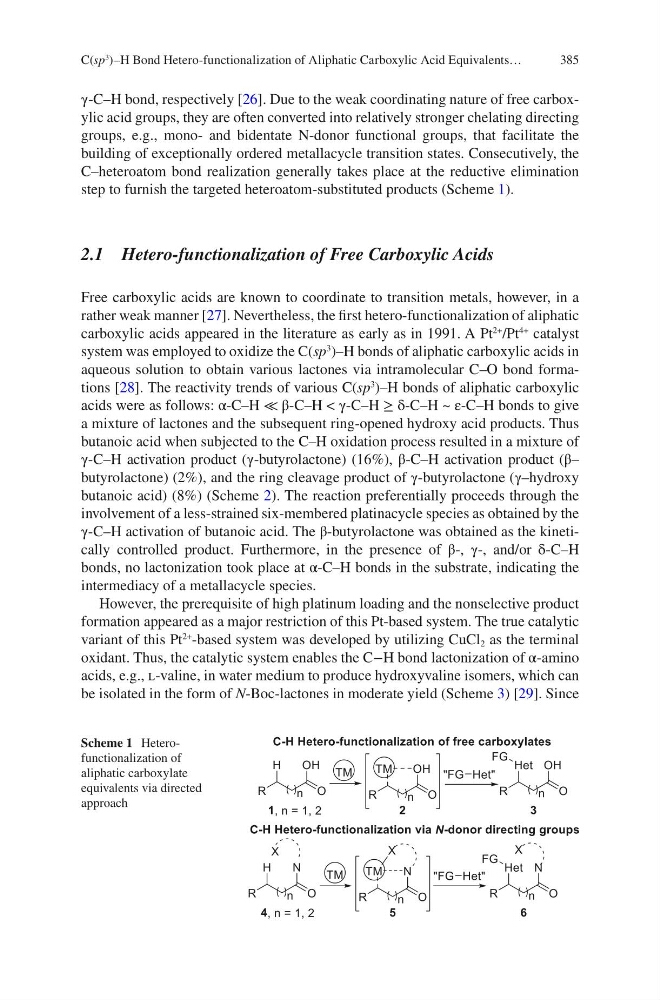
γ-C–H bond, respectively [26]. Due to the weak coordinating nature of free carboxylic acid groups, they are often converted into relatively stronger chelating directing
groups, e.g., mono- and bidentate N-donor functional groups, that facilitate the
building of exceptionally ordered metallacycle transition states. Consecutively, the
C–heteroatom bond realization generally takes place at the reductive elimination
step to furnish the targeted heteroatom-substituted products (Scheme 1).
2.1 Hetero-functionalization of Free Carboxylic Acids
Free carboxylic acids are known to coordinate to transition metals, however, in a
rather weak manner [27]. Nevertheless, the first hetero-functionalization of aliphatic
carboxylic acids appeared in the literature as early as in 1991. A Pt
2+
/Pt
4+
catalyst
system was employed to oxidize the C(sp
3
)–H bonds of aliphatic carboxylic acids in
aqueous solution to obtain various lactones via intramolecular C–O bond formations [28]. The reactivity trends of various C(sp
3
)–H bonds of aliphatic carboxylic
acids were as follows: α-C–H ≪ β-C–H < γ-C–H ≥ δ-C–H ~ ε-C–H bonds to give
a mixture of lactones and the subsequent ring-opened hydroxy acid products. Thus
butanoic acid when subjected to the C–H oxidation process resulted in a mixture of
γ-C–H activation product (γ-butyrolactone) (16%), β-C–H activation product (β–
butyrolactone) (2%), and the ring cleavage product of γ-butyrolactone (γ–hydroxy
butanoic acid) (8%) (Scheme 2). The reaction preferentially proceeds through the
involvement of a less-strained six-membered platinacycle species as obtained by the
γ-C–H activation of butanoic acid. The β-butyrolactone was obtained as the kinetically controlled product. Furthermore, in the presence of β-, γ-, and/or δ-C–H
bonds, no lactonization took place at α-C–H bonds in the substrate, indicating the
intermediacy of a metallacycle species.
However, the prerequisite of high platinum loading and the nonselective product
formation appeared as a major restriction of this Pt-based system. The true catalytic
variant of this Pt
2+
-based system was developed by utilizing CuCl 2 as the terminal
oxidant. Thus, the catalytic system enables the C−H bond lactonization of α-amino
acids, e.g., l-valine, in water medium to produce hydroxyvaline isomers, which can
be isolated in the form of N-Boc-lactones in moderate yield (Scheme 3) [29]. Since
Scheme 1 Heterofunctionalization of
aliphatic carboxylate
equivalents via directed
approach
C(sp
3
)–H Bond Hetero-functionalization of Aliphatic Carboxylic Acid Equivalents…
γ-C–H bond, respectively [26]. Due to the weak coordinating nature of free carboxylic acid groups, they are often converted into relatively stronger chelating directing
groups, e.g., mono- and bidentate N-donor functional groups, that facilitate the
building of exceptionally ordered metallacycle transition states. Consecutively, the
C–heteroatom bond realization generally takes place at the reductive elimination
step to furnish the targeted heteroatom-substituted products (Scheme 1).
2.1 Hetero-functionalization of Free Carboxylic Acids
Free carboxylic acids are known to coordinate to transition metals, however, in a
rather weak manner [27]. Nevertheless, the first hetero-functionalization of aliphatic
carboxylic acids appeared in the literature as early as in 1991. A Pt
2+
/Pt
4+
catalyst
system was employed to oxidize the C(sp
3
)–H bonds of aliphatic carboxylic acids in
aqueous solution to obtain various lactones via intramolecular C–O bond formations [28]. The reactivity trends of various C(sp
3
)–H bonds of aliphatic carboxylic
acids were as follows: α-C–H ≪ β-C–H < γ-C–H ≥ δ-C–H ~ ε-C–H bonds to give
a mixture of lactones and the subsequent ring-opened hydroxy acid products. Thus
butanoic acid when subjected to the C–H oxidation process resulted in a mixture of
γ-C–H activation product (γ-butyrolactone) (16%), β-C–H activation product (β–
butyrolactone) (2%), and the ring cleavage product of γ-butyrolactone (γ–hydroxy
butanoic acid) (8%) (Scheme 2). The reaction preferentially proceeds through the
involvement of a less-strained six-membered platinacycle species as obtained by the
γ-C–H activation of butanoic acid. The β-butyrolactone was obtained as the kinetically controlled product. Furthermore, in the presence of β-, γ-, and/or δ-C–H
bonds, no lactonization took place at α-C–H bonds in the substrate, indicating the
intermediacy of a metallacycle species.
However, the prerequisite of high platinum loading and the nonselective product
formation appeared as a major restriction of this Pt-based system. The true catalytic
variant of this Pt
2+
-based system was developed by utilizing CuCl 2 as the terminal
oxidant. Thus, the catalytic system enables the C−H bond lactonization of α-amino
acids, e.g., l-valine, in water medium to produce hydroxyvaline isomers, which can
be isolated in the form of N-Boc-lactones in moderate yield (Scheme 3) [29]. Since
Scheme 1 Heterofunctionalization of
aliphatic carboxylate
equivalents via directed
approach
C(sp
3
)–H Bond Hetero-functionalization of Aliphatic Carboxylic Acid Equivalents…