

327
(Table 9, entry 3) [141]. The catalytic activity of Sn-montmorillonite (mont) was
explored towards this conversion in DMSO-THF binary mixture of solvents, and the
HMF yield was 78% in 1 h at 160 °C from fructose (Table 9, entry 4) [142]. The
aluminium-exchanged montmorillonite-K-10 clay was found to be an efficient catalyst for the dehydration of fructose to HMF in DMSO solvent with 93.2% yield at
120 °C in 3 h (Table 9, entry 5) [143]. Yang et al. provided a green and economic
pathway for the conversion of fructose to HMF using natural clay attapulgite (ATP)
in a 2-butanol-water system. The highest activity was observed with phosphoric
acid-treated attapulgite (ATP-P) catalyst. This excellent activity was attributed to
the appropriate amount of Bronsted acidic sites which brought the HMF yield of
96.3% (Table 9, entry 6) [144].
3.2 Applications of 5-Hydroxymethylfurfural
HMF is a multifunctional molecule which can undergo many organic transformations, for example, oxidation, hydrogenation, etherification, hydrodeoxygenation,
hydration, decarboxylation, hydrogenation-hydrogenolysis and esterification, with
several high value-added products as mentioned in Scheme 16. Thus, HMF is known
as the “sleeping giant” in the field of biomass and is a common building platform
reported in the survey by DOE and EU.
Among the applications FDCA conversion of HMF, the selective oxidation product FDCA is attractive in the present scenario as it is a precursor for polyethylene
furanoate (PEF), a suitable alternative for the replacement of fossil-based terephthalic acid (TPA)-derived polyethylene terephthalate (PET) for making plastics
(Scheme 17) [145]. Unfortunately, HMF is not stable for long periods under ambient
conditions, though pure HMF remains stable up to 8 months under freezing conditions. Presence of small impurity promotes the formation of dimer and oligomers.
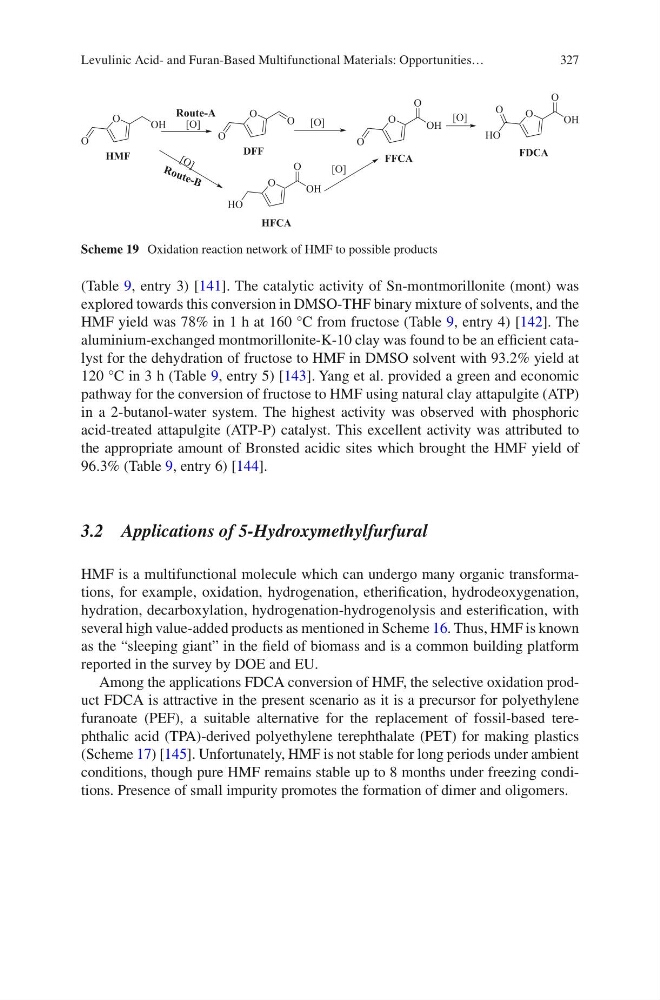
Scheme 19 Oxidation reaction network of HMF to possible products
Levulinic Acid- and Furan-Based Multifunctional Materials: Opportunities…
(Table 9, entry 3) [141]. The catalytic activity of Sn-montmorillonite (mont) was
explored towards this conversion in DMSO-THF binary mixture of solvents, and the
HMF yield was 78% in 1 h at 160 °C from fructose (Table 9, entry 4) [142]. The
aluminium-exchanged montmorillonite-K-10 clay was found to be an efficient catalyst for the dehydration of fructose to HMF in DMSO solvent with 93.2% yield at
120 °C in 3 h (Table 9, entry 5) [143]. Yang et al. provided a green and economic
pathway for the conversion of fructose to HMF using natural clay attapulgite (ATP)
in a 2-butanol-water system. The highest activity was observed with phosphoric
acid-treated attapulgite (ATP-P) catalyst. This excellent activity was attributed to
the appropriate amount of Bronsted acidic sites which brought the HMF yield of
96.3% (Table 9, entry 6) [144].
3.2 Applications of 5-Hydroxymethylfurfural
HMF is a multifunctional molecule which can undergo many organic transformations, for example, oxidation, hydrogenation, etherification, hydrodeoxygenation,
hydration, decarboxylation, hydrogenation-hydrogenolysis and esterification, with
several high value-added products as mentioned in Scheme 16. Thus, HMF is known
as the “sleeping giant” in the field of biomass and is a common building platform
reported in the survey by DOE and EU.
Among the applications FDCA conversion of HMF, the selective oxidation product FDCA is attractive in the present scenario as it is a precursor for polyethylene
furanoate (PEF), a suitable alternative for the replacement of fossil-based terephthalic acid (TPA)-derived polyethylene terephthalate (PET) for making plastics
(Scheme 17) [145]. Unfortunately, HMF is not stable for long periods under ambient
conditions, though pure HMF remains stable up to 8 months under freezing conditions. Presence of small impurity promotes the formation of dimer and oligomers.
Scheme 19 Oxidation reaction network of HMF to possible products
Levulinic Acid- and Furan-Based Multifunctional Materials: Opportunities…