

321
To overcome the difficulty in separation and large usage of ionic liquids (ILs), HPAILs composites were developed for this acid-catalysed dehydration reaction. Such a
system was reusable at least five times (Table 6, entry 5) [125]. Ganji recently
reported tin-loaded silicotungstic acid (Sn-STA-2) by hydrothermal microwave
treatment which showed good conversion and yield of HMF in DMSO medium. The
surface acidity of the catalyst (Sn-STA-2) plays a crucial role for optimum catalytic
activity (Table 6, entry 6) [126].
Ion-Exchange Resins
Ion-exchange resins are insoluble solid matrix/support normally in the form of
0.5–1 nm size beads or balls. The appearance varies from yellow, brown and faded
black colour, made from organic polymeric substrate. Predominantly, two main
classes of ion-exchange resins are available, styrene-based sulfonic acid resins and
Dow-type resins [127, 128]. The resin catalysts show high catalytic activity towards
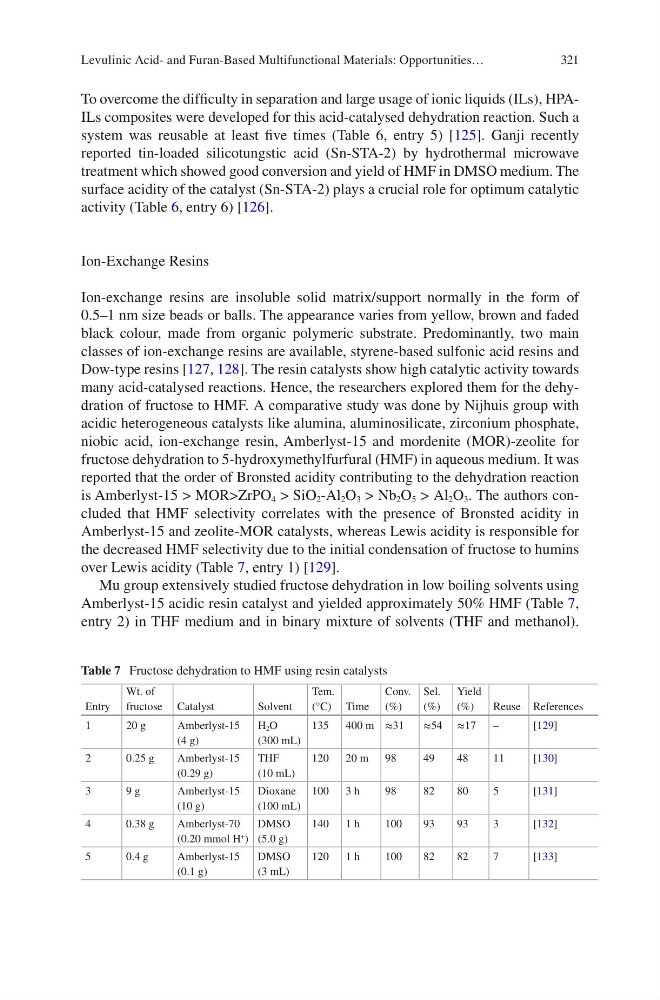
many acid-catalysed reactions. Hence, the researchers explored them for the dehydration of fructose to HMF. A comparative study was done by Nijhuis group with
acidic heterogeneous catalysts like alumina, aluminosilicate, zirconium phosphate,
niobic acid, ion-exchange resin, Amberlyst-15 and mordenite (MOR)-zeolite for
fructose dehydration to 5-hydroxymethylfurfural (HMF) in aqueous medium. It was
reported that the order of Bronsted acidity contributing to the dehydration reaction
is Amberlyst-15 > MOR>ZrPO 4 > SiO 2 -Al 2 O 3 > Nb 2 O 5 > Al 2 O 3 . The authors concluded that HMF selectivity correlates with the presence of Bronsted acidity in
Amberlyst-15 and zeolite-MOR catalysts, whereas Lewis acidity is responsible for
the decreased HMF selectivity due to the initial condensation of fructose to humins
over Lewis acidity (Table 7, entry 1) [129].
Mu group extensively studied fructose dehydration in low boiling solvents using
Amberlyst-15 acidic resin catalyst and yielded approximately 50% HMF (Table 7,
entry 2) in THF medium and in binary mixture of solvents (THF and methanol).
Table 7 Fructose dehydration to HMF using resin catalysts
Entry
Wt. of
fructose Catalyst
Solvent
Tem.
(°C) Time
Conv.
(%)
Sel.
(%)
Yield
(%)
Reuse References
1
20 g
Amberlyst-15
(4 g)
H 2 O
(300 mL)
135 400 m ≈31
≈54 ≈17
–
[129]
2
0.25 g
Amberlyst-15
(0.29 g)
THF
(10 mL)
120 20 m 98
49
48
11
[130]
3
9 g
Amberlyst-15
(10 g)
Dioxane
(100 mL)
100 3 h
98
82
80
5
[131]
4
0.38 g
Amberlyst-70
(0.20 mmol H
+ )
DMSO
(5.0 g)
140 1 h
100
93
93
3
[132]
5
0.4 g
Amberlyst-15
(0.1 g)
DMSO
(3 mL)
120 1 h
100
82
82
7
[133]
Levulinic Acid- and Furan-Based Multifunctional Materials: Opportunities…
To overcome the difficulty in separation and large usage of ionic liquids (ILs), HPAILs composites were developed for this acid-catalysed dehydration reaction. Such a
system was reusable at least five times (Table 6, entry 5) [125]. Ganji recently
reported tin-loaded silicotungstic acid (Sn-STA-2) by hydrothermal microwave
treatment which showed good conversion and yield of HMF in DMSO medium. The
surface acidity of the catalyst (Sn-STA-2) plays a crucial role for optimum catalytic
activity (Table 6, entry 6) [126].
Ion-Exchange Resins
Ion-exchange resins are insoluble solid matrix/support normally in the form of
0.5–1 nm size beads or balls. The appearance varies from yellow, brown and faded
black colour, made from organic polymeric substrate. Predominantly, two main
classes of ion-exchange resins are available, styrene-based sulfonic acid resins and
Dow-type resins [127, 128]. The resin catalysts show high catalytic activity towards
many acid-catalysed reactions. Hence, the researchers explored them for the dehydration of fructose to HMF. A comparative study was done by Nijhuis group with
acidic heterogeneous catalysts like alumina, aluminosilicate, zirconium phosphate,
niobic acid, ion-exchange resin, Amberlyst-15 and mordenite (MOR)-zeolite for
fructose dehydration to 5-hydroxymethylfurfural (HMF) in aqueous medium. It was
reported that the order of Bronsted acidity contributing to the dehydration reaction
is Amberlyst-15 > MOR>ZrPO 4 > SiO 2 -Al 2 O 3 > Nb 2 O 5 > Al 2 O 3 . The authors concluded that HMF selectivity correlates with the presence of Bronsted acidity in
Amberlyst-15 and zeolite-MOR catalysts, whereas Lewis acidity is responsible for
the decreased HMF selectivity due to the initial condensation of fructose to humins
over Lewis acidity (Table 7, entry 1) [129].
Mu group extensively studied fructose dehydration in low boiling solvents using
Amberlyst-15 acidic resin catalyst and yielded approximately 50% HMF (Table 7,
entry 2) in THF medium and in binary mixture of solvents (THF and methanol).
Table 7 Fructose dehydration to HMF using resin catalysts
Entry
Wt. of
fructose Catalyst
Solvent
Tem.
(°C) Time
Conv.
(%)
Sel.
(%)
Yield
(%)
Reuse References
1
20 g
Amberlyst-15
(4 g)
H 2 O
(300 mL)
135 400 m ≈31
≈54 ≈17
–
[129]
2
0.25 g
Amberlyst-15
(0.29 g)
THF
(10 mL)
120 20 m 98
49
48
11
[130]
3
9 g
Amberlyst-15
(10 g)
Dioxane
(100 mL)
100 3 h
98
82
80
5
[131]
4
0.38 g
Amberlyst-70
(0.20 mmol H
+ )
DMSO
(5.0 g)
140 1 h
100
93
93
3
[132]
5
0.4 g
Amberlyst-15
(0.1 g)
DMSO
(3 mL)
120 1 h
100
82
82
7
[133]
Levulinic Acid- and Furan-Based Multifunctional Materials: Opportunities…